Turkey Makes Aviation History 2026: First Successful Shootdown of a Supersonic Drone Target
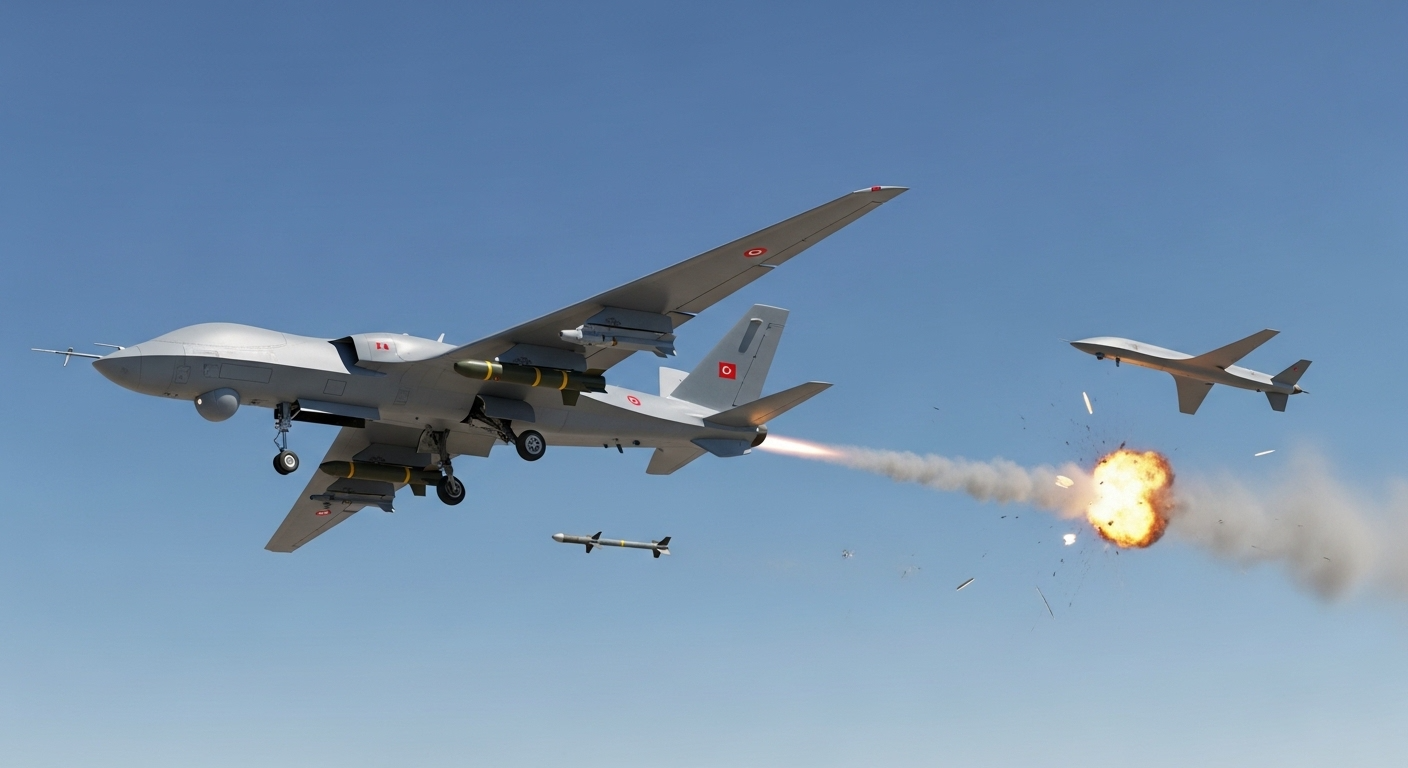
In a moment that defense analysts are already calling a turning point in modern air warfare, Turkey has achieved something no nation had done before — successfully intercepting and destroying a supersonic drone target traveling at Mach 2. The engagement took place at an altitude of 18,000 meters and marked a defining milestone not just for Turkey’s military, but for the future of air defense systems worldwide.
The world is paying close attention, and with good reason.
What Actually Happened
Turkey’s air defense forces tracked, engaged, and neutralized a high-speed unmanned aerial target moving at approximately 2,500 kilometers per hour — twice the speed of sound. The drone was designed to replicate the most demanding real-world threat scenarios, featuring:
- Mach 2 speed (roughly 1,550 mph)
- An operational altitude of 18,000 meters (59,000 feet)
- Highly agile maneuverability including tight turns and evasive patterns
- A reduced radar cross-section specifically designed to complicate detection
- A range of approximately 1,500 kilometers
This was not a straightforward target. It was engineered to be as difficult to intercept as possible — and Turkey’s air defense systems handled it.
Why This Is So Technically Difficult
To understand why this achievement matters, it helps to understand what intercepting a hypersonic target actually demands. At Mach 2, the drone covers roughly 700 meters every single second. There is almost no margin for error in detection, tracking, or engagement timing.
The core technical challenges include:
- Radar detection of a target with a deliberately reduced signature at extreme altitude
- Real-time trajectory prediction that accounts for high-speed evasive maneuvers
- Data fusion across multiple sensor systems working simultaneously
- Launching an interceptor missile with enough precision to meet a target that will have moved significantly by the time the missile arrives
- Split-second command decisions that leave no room for hesitation
Experts believe Turkey’s success came from integrating advanced radar networks, sophisticated data processing algorithms, and precision interceptor missiles into a system that could operate faster than any human operator could manage alone.
The Intelligence and Preparation Behind the Intercept
Turkey’s success was not purely a matter of having the right hardware. Months — and likely years — of intelligence gathering, simulation, and training preceded this engagement.
Turkey’s military planners had been closely monitoring the global development of hypersonic drone technology, both to understand the threat and to develop countermeasures tailored specifically to it. Pre-engagement preparation included:
- Extensive computer simulations modeling various intercept scenarios
- Training exercises designed around supersonic target profiles
- Integration of intelligence inputs to anticipate drone performance characteristics
- Coordination drills between radar operators, missile batteries, and command centres
When the live engagement came, Turkey’s forces were not encountering this challenge for the first time. They had rehearsed it.
Turkey’s Air Defense Architecture
This achievement did not emerge from nowhere. Turkey has been systematically modernising its air defense capabilities for over a decade, building a layered architecture that combines:
- Long-range radar networks with enhanced high-altitude detection capability
- Surface-to-air missile systems capable of engaging fast-moving targets
- Robust command-and-control infrastructure that integrates data from multiple sources
- Integration with NATO’s broader air defense framework
The result is a system with both the sensors to find a supersonic target and the weapons to reach it — a combination that has proven elusive for many advanced militaries.
What This Means for Regional Security
Turkey’s demonstration of this capability sends a clear message across the region. The ability to intercept targets moving at Mach 2 at high altitude fundamentally changes the strategic calculus for any potential adversary considering the use of fast aerial platforms against Turkish territory or assets.
Defense analysts highlight several immediate strategic implications:
- It establishes Turkey as possessing tier-one air defense capability in its region
- It strengthens Turkey’s deterrence posture against both drone and missile threats
- It signals to neighboring states that high-speed aerial approaches are no longer a reliable tactic
- It enhances Turkey’s value within NATO as an alliance member with proven advanced interception capability
Regional powers are taking note, and the diplomatic ripple effects are already being discussed in security circles.
NATO’s Interest in Turkey’s Achievement
Within the NATO alliance, Turkey’s success has generated significant attention. As member states collectively grapple with the growing threat posed by hypersonic weapons and advanced unmanned systems, a proven interception capability demonstrated by an alliance member carries real strategic weight.
Alliance analysts suggest this event could accelerate several developments:
- Greater knowledge-sharing between NATO members on hypersonic intercept techniques
- Increased investment by other member states in similar detection and engagement systems
- Stronger emphasis on interoperability between national air defense networks
- Turkey’s achievement potentially influencing NATO’s collective capability development roadmap
As Brigadier General (Ret.) Serdar Öner, former Deputy Commander of the Turkish Air Force, noted — this is not just a national achievement, but a meaningful contribution to the alliance’s collective defense posture.
What Comes Next for Drone Warfare
Turkey’s successful intercept will accelerate development on both sides of the drone warfare equation. Nations investing in supersonic drone technology will now work harder to push speeds higher, reduce radar signatures further, and build in more sophisticated evasion capabilities.
Simultaneously, the air defense community worldwide will study Turkey’s approach closely, looking to replicate and improve upon what was achieved. The operational data generated by this engagement — radar performance, missile guidance behaviour, intercept geometry — is enormously valuable for the next generation of system design.
The broader implications extend beyond military applications. Advances in sensor fusion, high-speed tracking algorithms, and precision engagement systems developed for military purposes consistently find their way into civilian aerospace, air traffic management, and satellite tracking technology over time.
Expert Voices on the Achievement
Dr. Ahmet Kasım Han, Professor of International Relations at Altınbaş University, described the intercept as a game-changer, pointing to the combination of technological capability and operational excellence it represents.
Defense analyst Lale Kemal highlighted the strategic dimension — arguing the event will reshape how potential adversaries calculate risk when considering aerial operations near Turkish airspace.
The consensus among analysts is consistent: this matters well beyond Turkey’s borders.
FAQs
Q: What speed was the drone traveling when it was intercepted? A: The drone was traveling at Mach 2 — approximately 2,500 km/h or 1,550 mph.
Q: At what altitude did the interception take place? A: The engagement occurred at 18,000 meters, roughly 59,000 feet above sea level.
Q: Why is intercepting a supersonic drone so difficult? A: At Mach 2, the target covers 700 meters per second, leaving almost no margin for error in detection, tracking, and engagement timing.
Q: What systems did Turkey use to achieve the intercept? A: Turkey used an integrated combination of advanced radar networks, precision surface-to-air missile systems, and sophisticated data fusion and command infrastructure.
Q: How does this affect Turkey’s position within NATO? A: It significantly strengthens Turkey’s strategic value within the alliance and is expected to influence NATO’s collective air defense development priorities.
Q: Will this change how other countries develop drone technology? A: Yes — nations investing in supersonic drones will now push to develop faster and harder-to-detect systems, while air defense developers worldwide will study Turkey’s intercept approach.
Q: What are the regional security implications? A: Turkey’s proven interception capability serves as a strong deterrent and alters the strategic calculations of regional powers regarding aerial threat options.