French Fighter Jet Engines 2026: How France Masters Precision Manufacturing for Military Aviation
When a Rafale fighter jet tears through the sky at supersonic speed, most people see raw power and national pride. What they do not see is the extraordinary engineering underneath — years of precision manufacturing, advanced materials research, and relentless quality control that make that performance possible.
France has built one of the world’s most respected military aeroengine industries, and in 2026, that reputation is stronger than ever.
A Heritage Built on Innovation
France’s relationship with aeroengine manufacturing goes back over a century. During World War I, French-built engines powered some of the most capable fighter aircraft of the era. That early tradition of pushing technical boundaries never stopped.
Today, Safran Group stands at the centre of French military propulsion, manufacturing the engines that power the Rafale — France’s premier multirole fighter jet. Safran’s engineers have built upon generations of accumulated knowledge, developing high-bypass turbofan engines, advanced thermal management systems, and materials that simply did not exist a decade ago.
The result is an engine lineage that other nations study and, in many cases, seek to purchase.
Precision That Is Measured in Microns
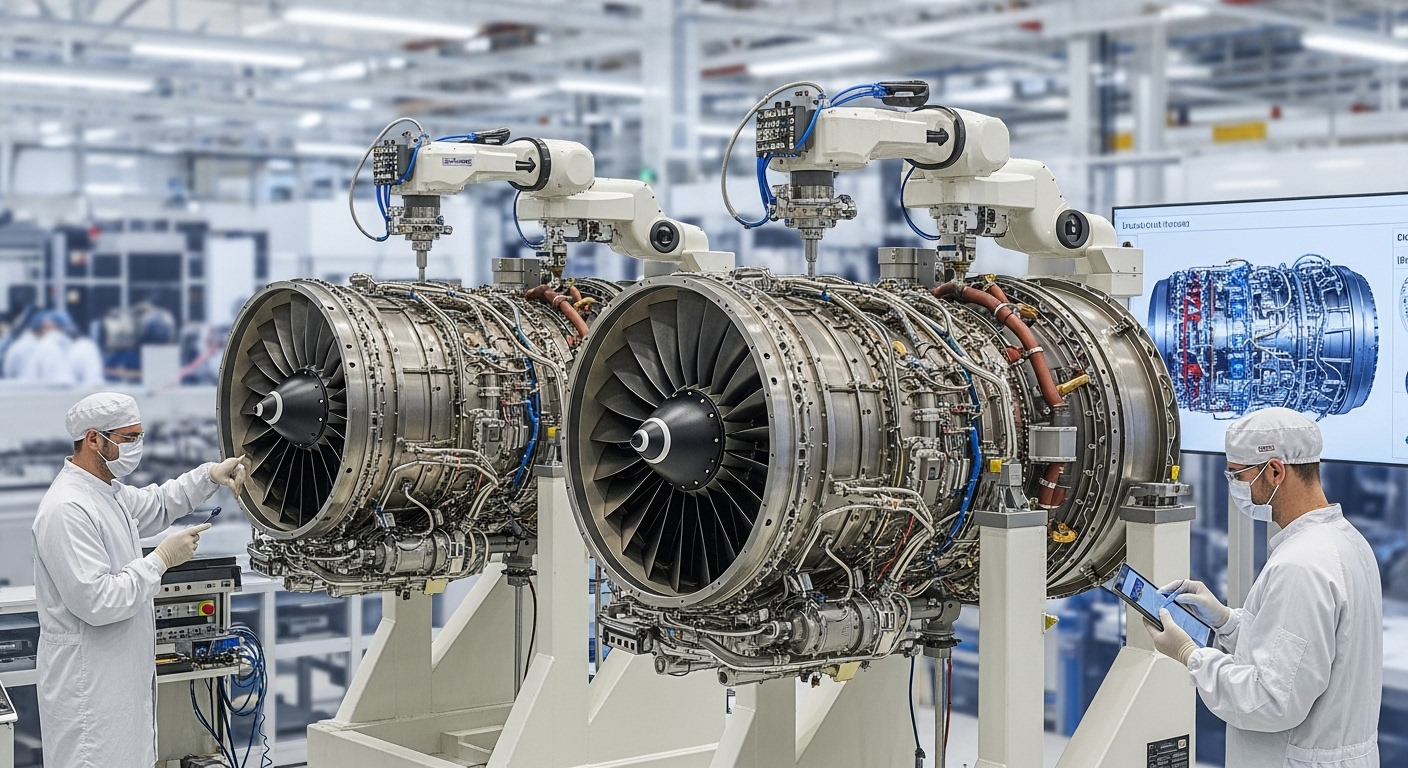
What separates a military-grade aeroengine from everything else is the level of precision required at every stage of production. These engines operate under extreme temperature, pressure, and mechanical stress — conditions that would destroy less carefully manufactured components within minutes.
French aeroengine manufacturing routinely works to tolerances measured in microns — a fraction of the width of a human hair. Every turbine blade, compressor disk, and combustion chamber component must meet exact specifications before it is cleared for assembly.
This level of precision is not achieved by accident. It requires:
- Highly skilled technicians with years of specialist training
- State-of-the-art CNC machining capable of holding micron-level tolerances
- Advanced metrology equipment that verifies every critical dimension
- Multi-stage quality inspection at each point in the manufacturing process
A single component that falls outside tolerance does not get adjusted — it gets rejected.
Advanced Materials at the Core
Pushing engine performance higher means operating at temperatures and pressures that would destroy conventional metals. The French aeroengine industry has addressed this by leading the development of materials that simply did not exist in earlier generations of aircraft.
Key advances driving current engine performance include:
- High-temperature superalloys that retain structural integrity under extreme heat
- Ceramic matrix composites (CMC) that are lighter than metal but withstand higher temperatures
- Advanced coatings that protect turbine blades from thermal degradation
- Sophisticated cooling systems that manage heat inside the engine core
These materials do more than survive extreme conditions — they allow engineers to push thrust-to-weight ratios and fuel efficiency to levels that give French fighter jets a genuine performance edge.
The DGA: France’s Engine Quality Guardian
Behind every certified French military engine is the Directorate General of Armaments (DGA) — the government body responsible for defence procurement and quality assurance. The DGA does not simply approve finished engines. It is embedded throughout the manufacturing process from the earliest stages.
The DGA’s framework covers:
- Raw material selection and certification
- In-process manufacturing inspection
- Final assembly verification
- Ground and flight testing validation
- Ongoing performance monitoring across the engine’s service life
This cradle-to-grave oversight is one of the reasons French military engines carry such strong credibility internationally. When customers around the world purchase French-built aircraft, the DGA’s involvement is part of what they are buying.
CNC Technology and the Tools Behind Precision
Modern aeroengine components are among the most geometrically complex manufactured objects in existence. Producing them consistently and accurately at scale requires computer numerical control (CNC) machining at the highest level of capability.
French aerospace manufacturers have invested heavily in the latest generation of CNC equipment, combined with specialised cutting tools designed specifically for aerospace-grade materials. The combination allows for:
- Complex three-dimensional geometries machined in a single setup
- Consistent repeatability across production batches
- Minimal human error at the machining stage
- Faster production cycles without sacrificing accuracy
Alongside the machines, the human expertise required to program, operate, and verify CNC processes remains irreplaceable. France has invested in developing that workforce over decades.
European Collaboration Amplifies French Capability
France does not operate its aerospace industry in isolation. A network of European partnerships and joint programmes has strengthened the entire sector, allowing French manufacturers to draw on expertise and resources from across the continent.
The most visible example is the collaborative work done on engines for both the Eurofighter Typhoon and the Dassault Rafale, involving French, German, and British aerospace companies working in close coordination. These partnerships have produced propulsion systems that are more capable, more cost-effective to produce, and easier to maintain than any single nation could have developed alone.
This industrial ecosystem — suppliers, research institutions, testing facilities, and manufacturers spread across Europe — gives the French aeroengine industry a depth of resource that no purely domestic programme could match.
Testing Never Stops
Building a precision engine to specification is only the beginning. Before any engine is cleared for operational use, it passes through multiple layers of testing and validation designed to expose any weakness before it matters in the air.
The validation process includes:
- Advanced computer simulation to model performance under extreme conditions
- Component-level stress testing before full assembly
- Ground test cell runs at full power
- Flight testing programmes that progressively push the engine to its limits
- Ongoing data collection throughout the engine’s service life
Every test result feeds back into the engineering process. Issues identified during testing become improvements in the next production batch or the next engine generation.
Strategic Importance in 2026
France’s aeroengine manufacturing capability is not just an industrial achievement — it is a strategic asset in a world where air power continues to define defence capability.
In an increasingly complex global security environment, the ability to design, manufacture, and maintain world-class fighter jet engines domestically gives France a degree of strategic independence that few nations possess. It reduces reliance on foreign suppliers for critical defence technology and supports France’s ability to export advanced military aircraft to allied nations.
Looking ahead, the French aerospace industry is already working on the technologies that will power the next generation of combat aircraft — exploring additive manufacturing for complex engine components, investigating alternative propulsion concepts, and developing materials that push current performance boundaries further still.
FAQs
Q: Who manufactures the engines for France’s Rafale fighter jet? A: Safran Group is the primary manufacturer of Rafale engines, building on decades of French aeroengine expertise.
Q: What makes French military jet engines so precise? A: A combination of micron-level CNC machining, advanced metrology, strict DGA quality oversight, and highly trained specialist technicians.
Q: What role does the DGA play in engine manufacturing? A: The DGA oversees quality assurance across the entire manufacturing process — from raw material selection through to final testing and service life monitoring.
Q: How does France use advanced materials in its engines? A: French engines use high-temperature superalloys and ceramic matrix composites to withstand extreme heat while reducing weight and improving fuel efficiency.
Q: Does France collaborate with other European countries on engine development? A: Yes — France works closely with German and British aerospace companies on joint programmes, strengthening the overall capability of European military aviation.
Q: What is the future direction of French aeroengine technology? A: The industry is exploring additive manufacturing, next-generation materials, and alternative propulsion systems to power future combat aircraft programmes.