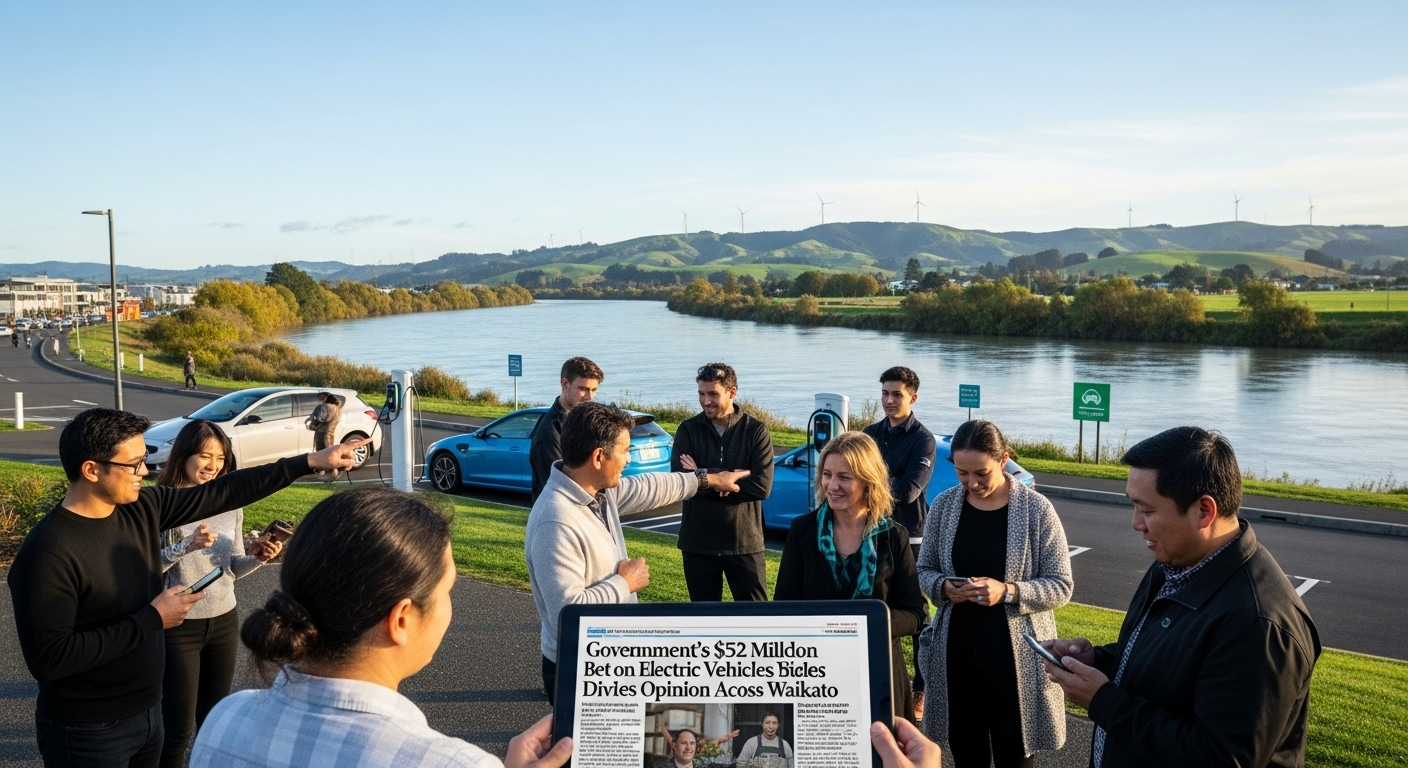
Government’s $52 Million Bet on Electric Vehicles Divides Opinion Across Waikato
On paper, it sounds like an easy win. The government has announced a $52.7 million loan programme aimed at more than doubling the number of public electric vehicle charging points across New Zealand — from roughly 1,200 today to nearly 3,800 — and the target is ambitious enough to have drawn headlines nationwide.
But in Waikato, where long rural stretches separate towns and farms sit well beyond the reach of any charger network, the reaction has been more complicated than the press release might suggest.
“Until there’s a charger at the end of every rural road, this is still a city policy dressed up as a national one.”
That assessment, from a Cambridge-based agricultural consultant, captures the mood that has been bubbling through farming communities since the announcement. The 2,574 new charge points are to be funded through low-interest government loans to private operators, with the intention of filling gaps in the existing network rather than duplicating what is already there. Lobby group Drive Electric, while broadly supportive, has also flagged that loan terms need to be attractive enough for operators to take the risk in low-traffic areas.
For urban Hamilton residents, the picture looks more positive. The city already has one of the stronger charging networks outside of Auckland and Wellington, and the new investment is expected to add meaningful capacity along key corridors into the Waikato. The government says the scheme is expected to unlock private co-investment and help New Zealand meet its clean transport commitments under the Paris Agreement. Whether that framing persuades farmers still running diesel utes is another matter entirely.