Banana Peel in Vinegar: Why This Mix Is Recommended and What It’s For
Sustainable gardening has a way of turning ordinary kitchen waste into something genuinely useful, and one of the more interesting examples currently gaining attention among home growers is the combination of banana peels soaked in vinegar. What sounds like an unlikely pairing turns out to have a reasonable scientific basis, and the results reported by gardeners who use it regularly suggest it is worth understanding properly rather than dismissing as another internet trend.
What Makes Banana Peels Useful for Plants
Banana peels have been used as a garden fertiliser in various forms for a long time, and the reasoning behind it is straightforward. The peels contain a meaningful concentration of nutrients that plants actively need. Potassium sits at around 42 milligrams per 100 grams of peel, making it the dominant mineral present. Phosphorus comes in at approximately 25 milligrams per 100 grams, magnesium at around 29 milligrams, and calcium at roughly 8 milligrams.
Potassium is particularly important for flowering plants because it supports the development of buds, strengthens cell walls, and improves the plant’s ability to manage water uptake and stress. Phosphorus plays a central role in root development and energy transfer within the plant. Magnesium is the central atom in chlorophyll molecules, which means it directly supports a plant’s ability to photosynthesise and maintain healthy green foliage.
The challenge with using banana peels directly in the garden is that the nutrients are locked inside the cellular structure of the peel and need to break down before they become available to plant roots. This is where vinegar enters the picture.
What the Vinegar Actually Does
White vinegar contains acetic acid, typically at a concentration of around five percent. When banana peels are submerged in vinegar, the acetic acid begins breaking down the cellulose and starches that form the peel’s structure. This process, sometimes called solubilisation, releases the potassium, phosphorus, and magnesium from within the peel cells and makes them available in the liquid rather than locked inside solid organic material.
The result is a liquid that carries these nutrients in a form that soil microbes and plant roots can access relatively quickly, rather than waiting for the slow decomposition process that would occur if you simply buried the peels or added them to compost in their original form.
The acetic acid itself also has a mild acidifying effect on soil when diluted and applied. Many plants, including a broad range of flowering annuals, tomatoes, berries, and leafy herbs, prefer a slightly acidic soil pH. In alkaline soils, a diluted acidic amendment can help shift the pH toward the range where nutrient uptake is more efficient. This is a secondary benefit rather than the primary one, and it is worth noting that the diluted fertiliser as used in practice has a modest effect on soil pH rather than a dramatic one.
How to Make It
The preparation process is simple and takes very little active time, though it does require patience during the steeping period.
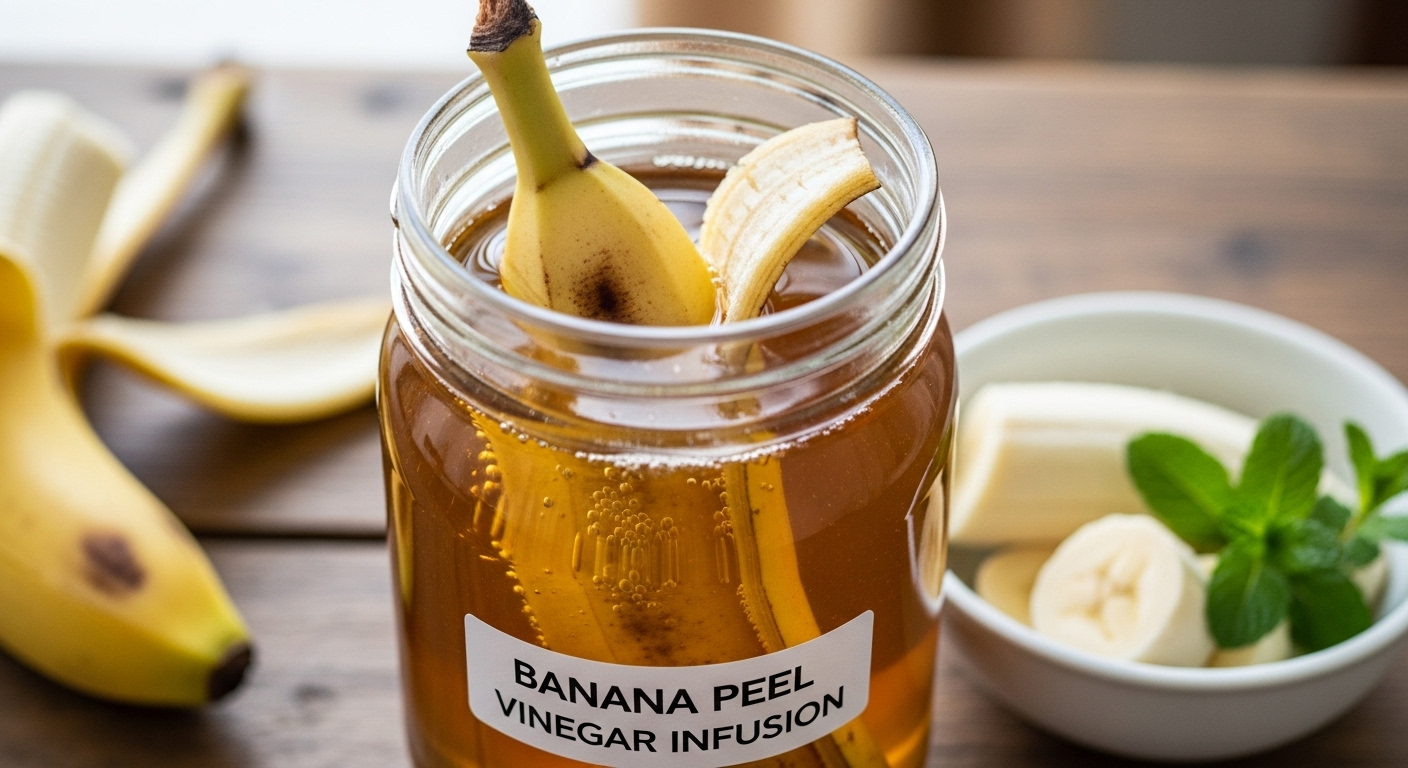
Collect banana peels over time and store them in a sealed container or bag in the refrigerator until you have enough to work with. Three or four peels is sufficient for a standard jar-sized batch. Place the peels in a clean glass jar or container and cover them completely with white vinegar. Seal the container and leave it to steep for a minimum of one week, stirring or shaking the mixture every day or two. Two weeks of steeping produces a more concentrated extract.
Once steeping is complete, strain out the peel material through a fine sieve or piece of muslin cloth. The remaining liquid is your fertiliser concentrate. This can be stored in a sealed container in a cool, dark location for up to several weeks, though using it within a month of preparation gives you the best nutrient availability.
Before applying to plants, dilute the concentrate with water at a ratio of approximately one part fertiliser to ten parts water. This is an important step rather than an optional one. Applying the concentrate undiluted risks creating a nutrient imbalance and the residual acidity of the vinegar could stress or damage plant roots at full strength.
How and When to Apply It
Water the diluted fertiliser directly into the soil around the base of your plants rather than onto the leaves. Root uptake is the primary mechanism for absorbing these nutrients, and foliar application of an acidic solution is not advisable. Apply it in the morning if possible, giving the soil time to absorb moisture before the heat of the day.
For most plants during the growing season, applying every four to six weeks is a reasonable frequency. Monitor how your plants respond and adjust from there. If you see very rapid new growth with unusually dark green foliage, you may be applying it more frequently than needed. If plants look pale or slow-growing and soil tests indicate deficiencies in potassium or phosphorus, more frequent application may help.
The plants that tend to respond most visibly to this fertiliser are flowering annuals such as marigolds, petunias, and zinnias, fruiting vegetables including tomatoes, capsicum, and zucchini, and herbs like basil and parsley. These plants have relatively high potassium and phosphorus requirements, particularly during flowering and fruiting periods, which aligns well with what this fertiliser provides.
Fitting It Into a Broader Garden Routine
Banana peel vinegar fertiliser works best as a supplement within a broader approach to soil health rather than as a standalone solution to all nutrient needs. It is not a complete fertiliser. It provides a reasonable potassium and phosphorus boost along with some secondary minerals, but it does not supply significant nitrogen, which is critical for leafy growth, nor does it replace the benefits of regular organic matter addition through compost or mulch.
Think of it as one useful tool among several rather than a replacement for good soil-building practices. Used alongside compost, mulching, and crop rotation or plant rotation in containers, it contributes meaningfully to overall plant health without adding any synthetic chemistry to the mix.
The used banana peels left over after straining can go directly into the compost bin. They retain some organic matter and trace minerals that will continue to break down and contribute to compost quality, so nothing is wasted in the process.
A Practical Note on Odour
The vinegar during the steeping phase has a noticeable sharp smell, which is unavoidable. Once diluted and applied to soil, the scent dissipates quickly. Keeping the steeping container tightly sealed and stored away from living areas makes the preparation stage more manageable. The finished fertiliser, once diluted to the ten-to-one ratio for application, has a very mild and quickly fading smell at ground level.
The broader appeal of this approach is that it converts something that would otherwise go into the bin into a garden input that actually costs nothing and works with well-understood plant biology. Potassium and phosphorus matter for plant health. Vinegar breaks down the peels and makes those minerals accessible. The diluted result delivers them to the root zone where plants can use them. The logic holds together, the cost is zero beyond a little time, and the environmental footprint of replacing even some synthetic fertiliser use with this approach is straightforwardly positive.
Read More: For more gardening tips, sustainable living ideas, and practical home advice written for Australian readers, visit wizemind.com.au