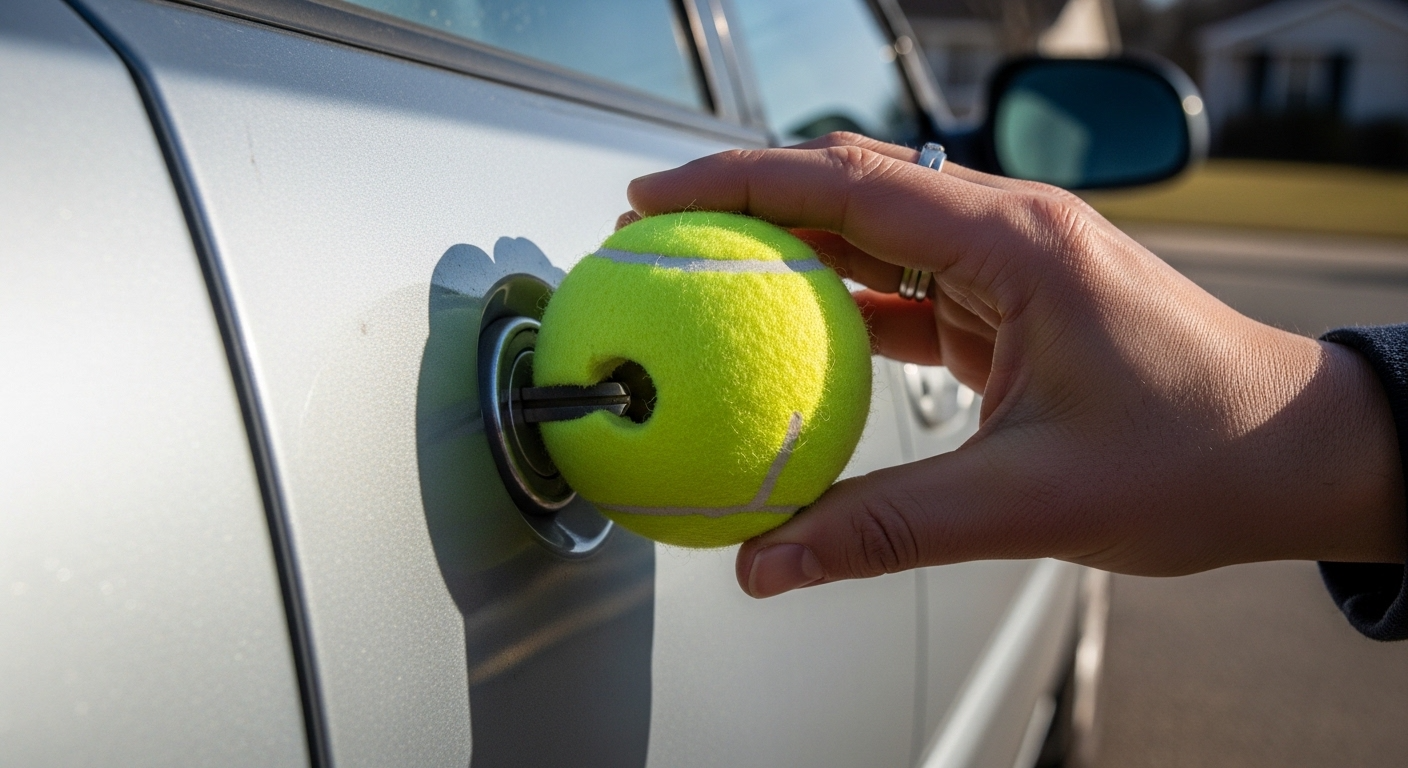
The “Genius” Tennis Ball Trick to Unlock Your Car When You Left the Keys Inside
Picture this scenario. You are running late for something important, you reach the car park, and you realise with a sinking feeling that your keys are sitting on the seat inside a locked vehicle. In a moment of desperation you remember seeing a viral hack online. The tennis ball trick. Take a tennis ball, puncture a hole in it, press it against the lock mechanism, and the burst of air pressure supposedly forces the lock to pop open. Simple, clever, and completely free. The only problem is that it almost certainly will not work, and attempting it could make your situation considerably worse.
The Rise and Fall of a Viral Hack
The tennis ball trick has been circulating the internet for well over a decade, consistently resurfacing every time someone shares the video with genuine enthusiasm. The premise has an appealing internal logic. Car door locks involve mechanical components. Air pressure can move mechanical components. A compressed tennis ball releases air pressure when squeezed. Therefore, in theory, pressing a punctured tennis ball against a car door lock could create enough pressure to disengage the mechanism.
The problem is that this logic does not hold up against how modern vehicle locks are actually engineered. Contemporary cars use electronic locking systems rather than simple mechanical linkages. The lock buttons you press inside the cabin connect to actuators driven by electrical signals, not air pressure channels that can be activated from the exterior. There is no pathway through which a burst of air from a tennis ball could reach the relevant components, let alone trigger them in the right way.
Automotive security specialists are unambiguous on this point. The tennis ball hack is largely a myth, with any documented successes limited to certain older vehicle models with much simpler locking mechanisms. On the modern vehicles found in the overwhelming majority of Australian driveways, it simply does not work.
Beyond being ineffective, repeated attempts to force the trick can cause real damage. Pressing a compressed object against door seals or lock mechanisms with significant force can crack seals, scratch paintwork around the door frame, or stress components in ways that create repair costs considerably higher than the locksmith call-out fee you were trying to avoid.
What Actually Works
When you are locked out of your vehicle, the options that reliably resolve the situation without causing damage fall into a few clear categories.
A professional locksmith is the most straightforward solution in most situations. A qualified locksmith carries the tools to open a wide range of vehicle makes and models quickly and without causing damage. Call-out costs in Australia typically range between $50 and $150 depending on your location and the time of day, and most locksmiths can reach you and have the car open within an hour. For a problem that feels urgent and stressful in the moment, having a professional handle it cleanly is worth the cost.
Roadside assistance is the other primary option, and one that many Australians already have access to without realising it. NRMA, RACQ, RAA, RACT, and RAC all include lockout assistance as part of their membership benefits. Many comprehensive car insurance policies also include roadside assistance either as a standard feature or as an inexpensive add-on. If you are already a member of any of these services, a locked-out situation is exactly what that membership is designed to cover, and the call costs you nothing beyond the membership fee you already pay.
A spare key, if you have one stored safely and accessibly, is obviously the simplest solution of all. Many people have a spare key but keep it in a location that makes it inaccessible precisely when they need it, such as inside another bag that is also inside the locked car, or at home when they are elsewhere.
Comparing Your Options Honestly
Looking at the realistic comparison between approaches makes the case for professional assistance clear.
A professional locksmith or roadside assistance provider will typically reach you within thirty minutes to an hour, open the car without damage, and leave you free to get on with your day. The cost for a locksmith ranges from $50 to $150. Roadside assistance is covered by existing membership or insurance in many cases.
The tennis ball trick costs nothing if somehow successful, which automotive experts say is effectively never the case on modern vehicles. It takes an indeterminate amount of time, is very unlikely to produce results, and carries a real risk of damaging door seals, paintwork, or lock components in the process. The potential repair bill for unintended damage quickly exceeds whatever you were hoping to save.
Preventing the Problem in the First Place
The most effective response to a locked-out situation is ensuring it does not happen in the first place, which sounds obvious but is genuinely achievable with a couple of simple habits.
Keeping a spare key somewhere accessible is the most valuable single step. This might mean leaving one with a trusted family member or neighbour, or using a magnetic key holder attached to an inconspicuous part of the vehicle’s exterior. The latter option carries some security risk, so placement matters, but for many people it provides exactly the emergency access they need without relying on anyone else being available at short notice.
Modern vehicles increasingly offer keyless entry systems and smartphone-connected features that can prevent accidental lockouts or allow remote unlocking through a manufacturer’s app. If your vehicle supports these features and you have not yet set them up, doing so costs nothing beyond a small amount of time and provides a genuine safety net.
Building the simple habit of checking for your keys before closing the door takes approximately one second and eliminates the problem entirely.
The tennis ball trick is one of those internet hacks that survives on the appeal of its premise rather than its actual performance. The idea of outsmarting your car’s security with a piece of sporting equipment has a satisfying cleverness to it that makes people want it to be true. But when automotive security specialists and experienced locksmiths agree that it simply does not work on modern vehicles, the most useful thing is to know that clearly before you find yourself in a car park pressing a punctured tennis ball against your door and wondering why nothing is happening. Call the locksmith, contact roadside assistance, or retrieve your spare key. Those options work.
Read More: For more practical lifestyle tips, home hacks, and consumer advice written for Australian readers, visit wizemind.com.au