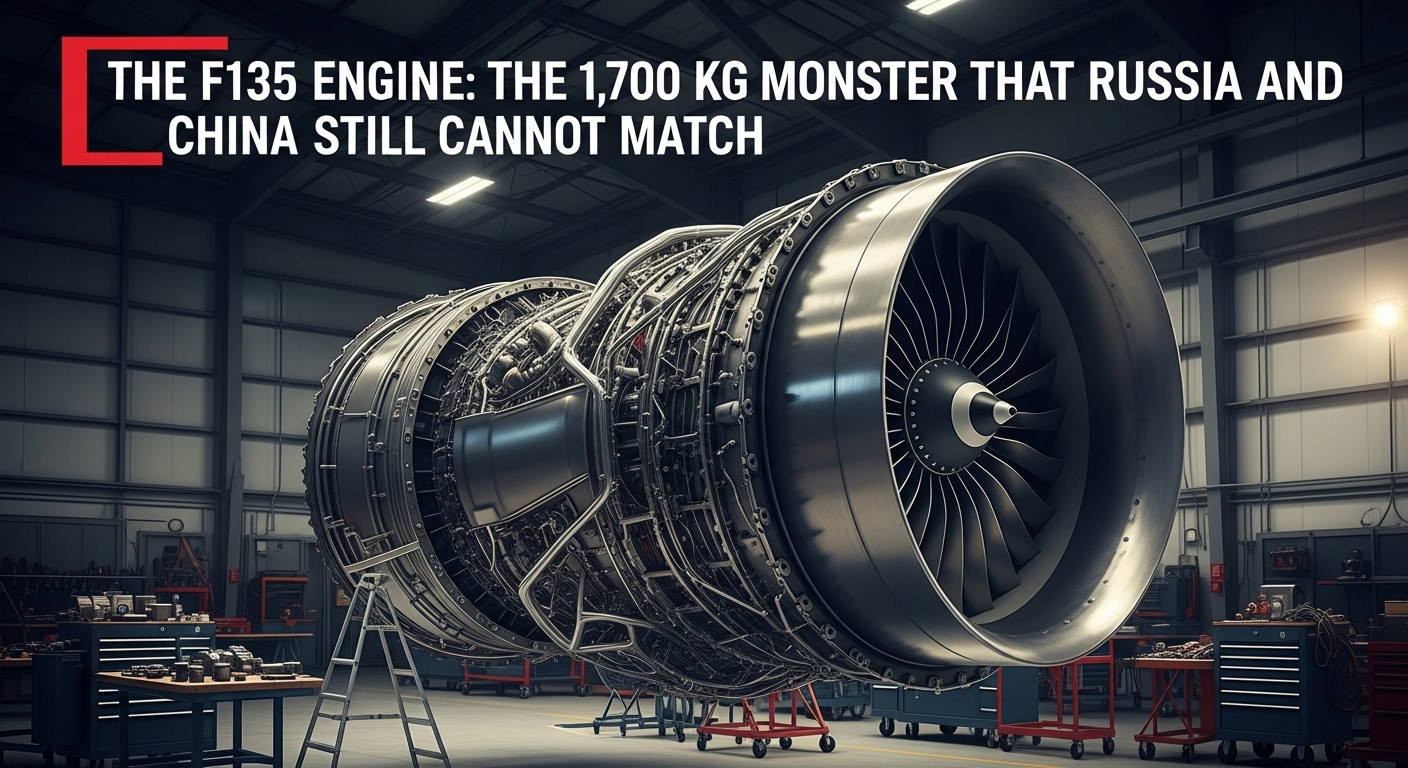
The F135 Engine: The 1,700 kg Monster That Russia and China Still Cannot Match
At the core of the world’s most advanced combat aircraft sits a 1,700 kilogram engineering marvel that has quietly become one of the most consequential pieces of military technology on the planet. The F135 engine, built by Pratt and Whitney for the F-35 Lightning II, generates more thrust than any fighter engine ever produced.
Russia and China have been trying to match it for years. Neither has come close.
What the F135 Actually Delivers
The F135 produces 43,000 pounds of thrust, a figure that dwarfs the output of competing engines from both Russia and China. That raw power gives the F-35 its combination of speed, manoeuvrability, and extended operational range across both air-to-air and air-to-ground mission profiles.
The engine’s design incorporates a three-stage fan and a two-stage turbine, optimised to maintain the F-35’s stealth profile while delivering maximum thrust on demand. Performance and low observability coexist in a single powerplant in ways that competing programmes have not been able to replicate.
How the F135 Compares to Its Rivals
| Feature | F135 Engine | Russian AL-41F1 | Chinese WS-15 |
|---|---|---|---|
| Thrust in pounds | 43,000 | 32,500 | 35,000 estimated |
| Specific fuel consumption | 0.68 lb per lbf-hr | 0.79 lb per lbf-hr | 0.75 estimated |
| Thrust to weight ratio | 9.4 | 8.3 | 8.5 estimated |
| Mean time between repair | Over 3,000 hours | Around 1,000 hours | Unknown |
The numbers tell a clear story. The F135 does not just outperform competing engines on raw thrust. It delivers that power more efficiently and far more reliably than anything Russia or China currently fields.
Reliability Is Where the Gap Is Most Dramatic
A mean time between repair of over 3,000 hours is what separates the F135 most decisively from its nearest competitor. The Russian AL-41F1 achieves around 1,000 hours between repairs, meaning the F135 operates for three times as long before requiring maintenance intervention.
For frontline military aviation, reliability is operational power. An aircraft that is being maintained is an aircraft that is not flying. The F135’s reliability advantage translates directly into higher sortie rates, lower maintenance costs, and greater operational flexibility for every nation that flies the F-35.
The Materials That Make the Difference
High-temperature superalloys and ceramic matrix composites are central to the F135’s performance advantage. These advanced materials allow the engine to operate at temperatures that would destroy conventional components, enabling greater efficiency and durability simultaneously.
State-of-the-art control and monitoring systems provide real-time performance management across all operating conditions. The combination of advanced materials and intelligent controls is what gives the F135 its edge in sustained high-performance operation that competitors have struggled to replicate.
Why Russia and China Cannot Simply Copy It
Developing an engine of this calibre requires decades of accumulated industrial knowledge, specialised manufacturing capability, and sustained investment in materials science that cannot be shortcut. Russia and China have poured significant resources into closing the gap and have made genuine progress.
Neither has matched the F135 on the metrics that matter most. Thrust, fuel efficiency, and especially reliability remain areas where both programmes fall measurably short of what Pratt and Whitney has achieved over decades of continuous development.
Read More: https://wizemind.com.au/
The Geopolitical Weight of Engine Dominance
The F135’s export reach extends America’s strategic influence in ways that go beyond the aircraft itself. Every nation that purchases the F-35 enters a long-term maintenance, upgrade, and support relationship with the United States defence industrial base. The engine is part of that relationship.
Russia and China watch allied nations queue for F-35 access knowing that the engine powering each aircraft represents technology their own programmes cannot match. That gap has geopolitical weight that compounds with every new F-35 operator nation added to the programme.
Fuel Efficiency as a Strategic Asset
The F135’s specific fuel consumption of 0.68 pounds per pound-force per hour outperforms both the Russian and Chinese alternatives. Lower fuel consumption translates directly into extended range and endurance on every mission flown.
In modern air warfare, range is strategic depth. An aircraft that can fly further, loiter longer, and return with fuel reserves gives operators options that shorter-range competitors simply do not have. The F135’s efficiency advantage compounds mission after mission across the operational life of every F-35 airframe.
Continuous Improvement Keeps the Gap Wide
Pratt and Whitney and the US government are committed to ongoing upgrades to the F135 beyond its already exceptional baseline performance. The Enhancement Package programmes planned for the coming years will increase thrust, reduce heat signature, and further improve fuel efficiency.
Competitors chasing the current F135 will find the target moving as each upgrade cycle widens rather than narrows the performance gap. That dynamic of continuous improvement is itself a strategic asset that sustains American aviation dominance over the long term.
The F-35 Export Success the Engine Enables
Over a dozen allied nations have committed to the F-35 programme, drawn in significant part by the capabilities that the F135 engine makes possible. The export success of the aircraft is inseparable from the performance of its engine.
Each new operator nation strengthens the industrial and strategic network around the F135 and the F-35 programme. Maintenance facilities, pilot training programmes, parts supply chains, and intelligence sharing arrangements all grow with every additional nation that enters the programme.
Frequently Asked Questions
What makes the F135 engine the most powerful fighter engine ever built? Its thrust output of 43,000 pounds exceeds every other fighter engine currently in production or operational service. Combined with its fuel efficiency and reliability metrics, it represents the highest overall performance package ever achieved in a single combat aircraft powerplant.
How does the F135 compare to the Russian AL-41F1 engine? The F135 generates significantly more thrust, burns fuel more efficiently, and operates for over three times as long before requiring repair. The Russian engine produces 32,500 pounds of thrust against the F135’s 43,000, and achieves around 1,000 hours mean time between repair against the F135’s 3,000 plus.
Why have Russia and China been unable to match the F135? Decades of accumulated materials science, manufacturing expertise, and sustained investment in engine development cannot be replicated quickly. Both nations have invested heavily in closing the gap but have not achieved comparable thrust, efficiency, or reliability in their competing programmes.
What advanced materials give the F135 its performance advantage? High-temperature superalloys and ceramic matrix composites allow the engine to operate at extreme temperatures that would destroy conventional components. These materials are central to the F135’s ability to deliver high thrust with superior durability and fuel efficiency simultaneously.
How does the F135’s reliability advantage affect military operations? A mean time between repair exceeding 3,000 hours means the F-35 spends far more time flying and far less time in maintenance than aircraft powered by competing engines. Higher availability translates directly into more sorties, lower operating costs, and greater operational flexibility.
Why does engine dominance matter geopolitically? Every F-35 operator nation enters a long-term relationship with the US defence industrial base through maintenance, upgrades, and support. The engine is a geopolitical anchor that deepens alliance relationships and extends American strategic influence with each additional programme participant.
What planned upgrades will the F135 receive? Enhancement Package programmes are planned to increase thrust output, reduce infrared signature, and further improve fuel efficiency beyond the already exceptional baseline. These upgrades ensure the performance gap widens rather than narrows as competing programmes attempt to catch up.
How does the F135’s fuel efficiency affect operational range? Lower specific fuel consumption of 0.68 pounds per pound-force per hour means the F-35 can fly further and loiter longer on every mission compared to aircraft powered by less efficient engines. In modern air warfare, that range advantage translates directly into strategic depth and mission flexibility.
Does the F135 engine work across all three F-35 variants? The F135 powers all three variants of the F-35 including the conventional takeoff F-35A, the short takeoff and vertical landing F-35B, and the carrier variant F-35C. The engine is adapted for each variant while maintaining the core performance characteristics that define the powerplant.
How has the F135 shaped international defence partnerships? Nations purchasing the F-35 join a network of maintenance, training, and intelligence-sharing arrangements built around the aircraft and its engine. The F135’s performance is central to that network’s appeal and to the strategic relationships it creates between the United States and its allies.
Key Points
- The F135 generates 43,000 pounds of thrust, making it the most powerful fighter engine ever produced, exceeding Russian and Chinese alternatives by thousands of pounds of thrust.
- Mean time between repair exceeds 3,000 hours, more than three times the Russian AL-41F1’s approximately 1,000 hours, giving F-35 operators a decisive operational availability advantage.
- Advanced materials including ceramic matrix composites enable performance at temperatures that destroy conventional components, a capability gap that neither Russia nor China has closed.
- Continuous upgrade programmes ensure the performance gap widens over time rather than narrows as competing engines attempt to match a target that keeps moving forward.
Conclusion
The F135 engine is not simply a powerful component inside an advanced aircraft. It is a strategic asset that extends American influence through every allied nation that flies the F-35, maintains a technology gap that neither Russia nor China has been able to close, and delivers operational reliability that changes the calculus of air power planning.
At 1,700 kilograms, it punches far above its weight in geopolitical significance. The thrust numbers and reliability metrics are impressive on their own terms. Their implications for the global balance of military aviation power are what make the F135 truly extraordinary.
As Pratt and Whitney continues its enhancement programmes and the F-35 operator network grows, the engine that stunned Russia and China will continue doing exactly that for the foreseeable future.