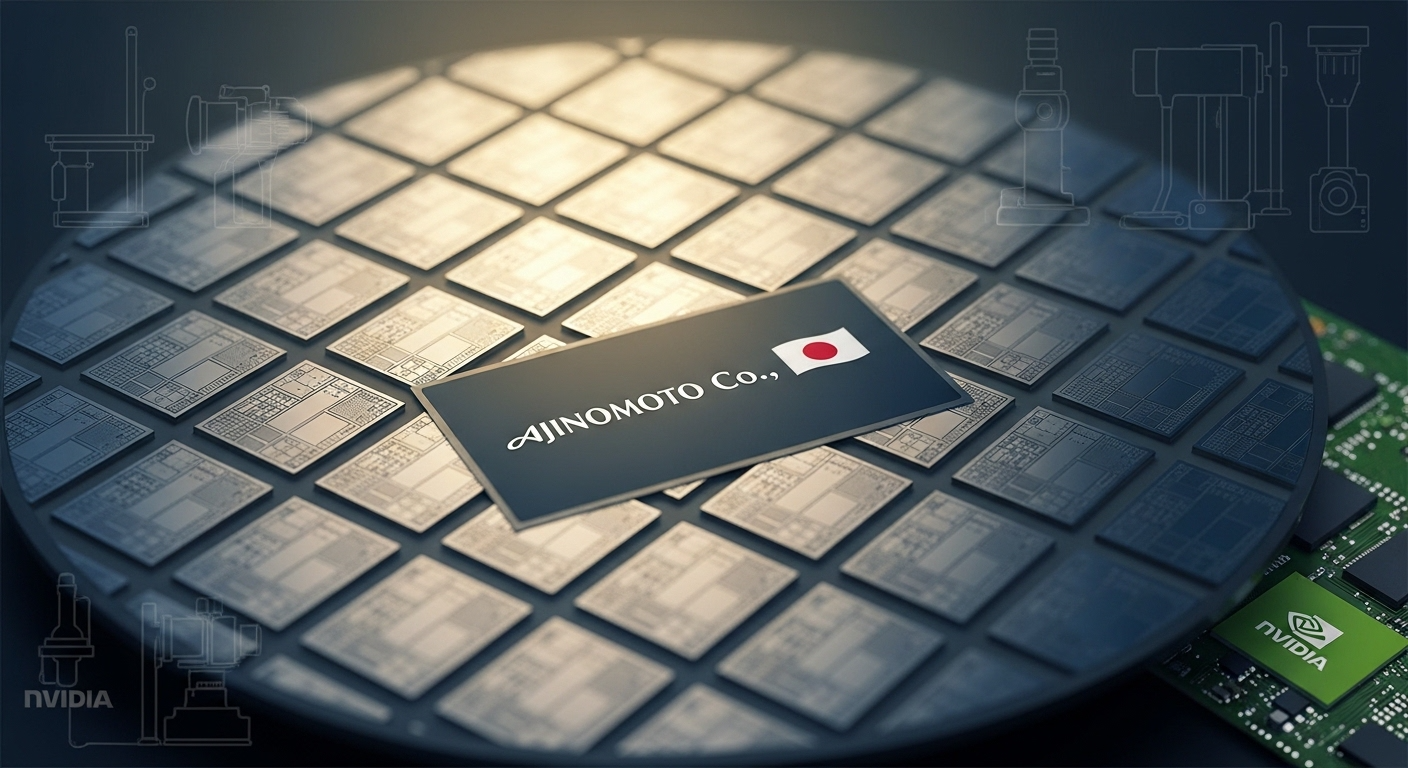
Few People Know Japan Controls 95% of This Material Vital to Nvidia’s AI Chips, Thanks to Ajinomoto
Most people know Ajinomoto as the company behind instant soups and MSG — the white powder that turns a bland dish into something deeply savoury. What almost nobody knows is that this same Japanese food giant quietly controls 95 percent of a material that Nvidia, Intel, and TSMC cannot build their most powerful chips without.
It’s one of the stranger stories in modern technology: a seasoning company sitting at the centre of the artificial intelligence revolution.
From the Kitchen to the Chip Factory
Ajinomoto’s journey into semiconductors began with the same expertise that made it famous in food: organic chemistry. The company spent decades mastering the science of molecular structures and chemical synthesis — skills that translate surprisingly well from flavour enhancement to advanced materials engineering.
As the semiconductor industry grew more complex through the 1990s and 2000s, chipmakers needed new materials to keep pace with miniaturisation. Transistors were shrinking to microscopic scales, and the wiring connecting them was becoming impossibly intricate. Standard materials weren’t cutting it anymore.
Ajinomoto’s answer was something called Ajinomoto Build-up Film, known in the industry as ABF. It’s a specialised substrate — essentially a thin layer of material that serves as the foundation for the complex wiring inside high-performance chips. Without it, the intricate interconnections that allow a modern AI processor to handle billions of calculations per second simply can’t be manufactured reliably.
The company developed the material, refined its production process over years, and gradually became the supplier that everyone in the industry depended on. Today, Ajinomoto controls roughly 95 percent of the global ABF market.
Why Nvidia Depends on a Food Company
Nvidia’s AI accelerators — the chips powering everything from ChatGPT to autonomous vehicles to drug discovery — rely on ABF in their construction. So do Intel’s processors and TSMC’s most advanced fabrication processes.
These aren’t peripheral relationships. ABF is a core component of the manufacturing process for the chips driving the current AI boom. When AI companies race to buy more of Nvidia’s H100 or B200 chips, they are, without realising it, creating demand that flows directly back to a Japanese food company’s specialised film production lines.
The connection between a bowl of instant soup and a data centre humming with AI workloads is not poetic licence. It is a literal supply chain dependency.
Why Nobody Else Can Make ABF at Scale
The obvious question is why competitors haven’t moved in. The answer is that reproducing Ajinomoto’s ABF is considerably harder than it sounds.
The manufacturing process involves precise control over molecular structures, chemical compositions, and tolerances measured at the nanoscale. The equipment required is highly specialised and enormously expensive. The institutional knowledge — the accumulated understanding of how to produce consistent, high-quality ABF across millions of units — took Ajinomoto decades to develop.
For a potential competitor, the prospect of spending years and billions of dollars to challenge a deeply entrenched incumbent with superior expertise and established customer relationships is deeply unattractive. Most companies have simply decided it isn’t worth attempting.
This has left Ajinomoto in an unusual position: a near-monopoly on a material that the world’s most important technology companies cannot function without, held by a firm that still sells soy sauce.
When the Supply Chain Cracked
The strategic fragility this creates became visible during the semiconductor shortages of the early 2020s. When supply chains across the industry buckled under pandemic pressure, disruptions to ABF supply created ripple effects that reached all the way to finished chip production. Manufacturers who couldn’t get enough ABF couldn’t complete chips. Chips that couldn’t be completed couldn’t be shipped. Technologies waiting on those chips faced delays.
The crisis drew attention to something that had been hiding in plain sight: the entire semiconductor supply chain, and by extension a significant portion of the global technology industry, had a single point of failure in a Japanese food company’s production facilities.
The Geopolitical Dimension
This matters beyond the boardrooms of tech companies. Advanced semiconductors have become a central front in great-power competition. The United States and China are engaged in an intense contest over who will lead in artificial intelligence, and control of chip supply chains has emerged as a key lever of that rivalry.
Against that backdrop, the fact that 95 percent of a critical chip ingredient is controlled by a single company in a single country takes on a different weight. Japan is a close US ally, which reduces some of the immediate concern. But the concentration itself is a vulnerability — one that any disruption, whether from natural disaster, industrial accident, or geopolitical pressure, could suddenly make very visible.
Governments are beginning to notice. Conversations about supply chain resilience, which intensified around silicon shortages and rare earth dependencies, increasingly include materials like ABF. The question of whether the world should be this dependent on one company for one critical material has moved from academic curiosity to policy concern.
What Comes Next
There is growing investment in developing alternatives and diversifying supply. Some companies are quietly working on substitute materials or exploring whether they can reduce their dependence on ABF-based processes. These efforts will take years, possibly decades, to mature.
In the meantime, Ajinomoto occupies a peculiar position in the global order: a company most people think of as a condiment brand, quietly providing the material foundation for the technologies that are reshaping the world. Its factories are not in the headlines. Its executives are not invited onto panels at AI conferences. Its brand does not appear on the boxes that Nvidia ships.
And yet without it, many of those boxes would be empty.
Frequently Asked Questions
What exactly is Ajinomoto Build-up Film? ABF is a specialised substrate material used in the production of advanced semiconductors. It provides the structural foundation for the complex wiring inside high-performance chips, enabling the rapid processing and data transmission that modern AI applications require.
How did Ajinomoto come to dominate this market? Through decades of research in organic chemistry and materials science, Ajinomoto developed deep expertise in the precise manufacturing processes ABF requires. That accumulated knowledge and the high cost of replicating their production capabilities created a dominant market position that competitors have found very difficult to challenge.
Why can’t other companies simply make their own ABF? The manufacturing process requires extremely precise control over molecular structures and chemical compositions, specialised equipment, and years of institutional knowledge. The barriers to entry are high enough that most potential competitors have chosen not to attempt it.
Does this create a security risk for countries that depend on these chips? It creates a supply chain vulnerability that governments are increasingly aware of. Since ABF is essential to producing advanced AI chips, any disruption to Ajinomoto’s supply — from natural disaster, industrial accident, or geopolitical events — could affect global chip production. Japan is a close ally of the United States and other major democracies, which reduces immediate geopolitical risk, but concentration in any single supplier is widely considered a vulnerability worth addressing.
Are there any alternatives being developed? Research into alternative materials and processes is ongoing, but reproducing the performance characteristics of ABF at scale is technically challenging. Progress is being made but any serious diversification of supply is likely years away.
How did the pandemic highlight this dependency? The global semiconductor shortage exposed how tightly coupled the chip supply chain is. Disruptions to ABF supply during that period contributed to production delays, making the industry’s dependence on a single supplier for a critical material suddenly visible to executives and policymakers who had previously paid little attention to it.
I drop some in the bottom of the vase, it’s magic”: put this in to make your tulip bouquet last longer By yourfix / March 19, 2026 I drop some in the bottom of the vase, it’s magic”: put this in to make your tulip bouquet last longer In the ever-evolving world of flower arranging, tulips have