Australia Mortgage Outlook 2026 — Homeowners Prepare for Tougher Repayment Pressures
Australia’s housing market is entering one of its more demanding periods for existing homeowners, with mortgage repayment pressures expected to intensify through 2026 as interest rate movements, tighter lending conditions, and rising living costs combine to test household financial resilience across the country.
For the millions of Australians carrying home loans, the question is no longer whether the environment will be challenging but how to navigate it with the least possible financial damage. Understanding the forces at work and the practical options available is the starting point for every homeowner making decisions about their mortgage in the current climate.
The Forces Shaping the 2026 Mortgage Environment
Several distinct pressures are converging simultaneously to create the conditions homeowners are now managing, and understanding each one separately helps clarify why the overall picture feels heavier than any single factor would suggest.
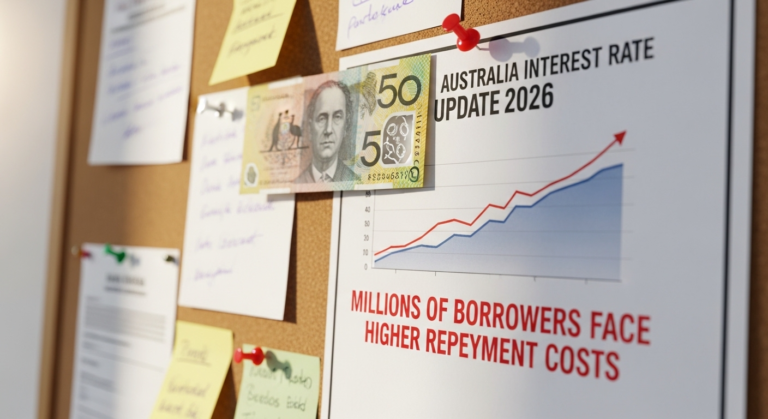
Interest rate movements remain the most direct driver of repayment costs. The Reserve Bank’s policy decisions flow through to variable mortgage rates quickly, and even modest adjustments at the official level produce meaningful changes in monthly repayments for borrowers with large balances. The speed of that transmission means variable-rate borrowers have limited time to prepare once a decision is announced.
Inflation continues to affect household budgets independent of mortgage costs. When groceries, energy, insurance, and everyday services all cost more, the proportion of income available to service mortgage debt shrinks even before any rate movement occurs. Households managing both pressures simultaneously are in a genuinely more constrained position than one or the other in isolation would produce.
Lending conditions have tightened, which affects new borrowers more than existing ones but signals the broader direction of the market. Lenders are applying more stringent assessment criteria to new loan applications, stress-testing serviceability at higher rates and requiring stronger evidence of repayment capacity. This reflects lenders’ own reading of the risk environment and has the effect of reducing borrowing capacity across the market.
| Impact Factor | Effect on Homeowners |
|---|---|
| Changes in interest rates | Monthly mortgage repayments increase directly |
| Inflation and living costs | Household budget capacity for debt servicing shrinks |
| Tighter lending rules | Stricter approval processes for new and refinancing borrowers |
| Refinancing options | Potential to secure better loan terms with active management |
| Economic conditions | Affects employment stability and overall repayment capacity |
Who Is Carrying the Greatest Risk
Not every mortgage holder enters 2026 in the same position, and the distribution of risk across the borrowing population is uneven in ways that are worth understanding clearly.
Borrowers with large variable-rate balances carry the most direct exposure to rate movements, with each upward adjustment producing a larger absolute increase in monthly repayments. A household that stretched their borrowing capacity during a period of historically low rates may find that the buffer between their repayment obligation and their income has narrowed to a point that leaves little room for further movement.
Fixed-rate borrowers whose terms expire in 2026 face a specific and abrupt transition. Moving from a rate that was locked in during a low-rate period to a current variable or newly negotiated fixed rate can represent a significant single-step change in monthly costs. For some households, this transition is the largest financial adjustment they have made in years, and planning for it before it arrives is considerably more effective than reacting to it after.
Recent first home buyers who entered the market at elevated property prices with high loan-to-value ratios typically carry larger balances relative to their income and have smaller equity buffers than established owners. Their exposure to rate movements is amplified by the size of their outstanding debt and the proportion of their income already committed to repayments.
Investors with multiple properties face a different version of the pressure, where higher repayment costs across several loans combine with any softening in rental income to squeeze investment returns and in some cases require decisions about portfolio composition.
How Homeowners Are Responding
The most financially resilient households in 2026 are those who are responding to the environment actively rather than waiting for conditions to force their hand. Several approaches are proving effective across different borrower circumstances.
Refinancing remains the most widely explored option for homeowners looking to reduce their rate or secure better loan conditions. The difference between what a borrower pays on their current product and what is available through active market comparison can be substantial, particularly for those who have not reviewed their loan in several years. Lenders compete for business, and borrowers who present with good repayment histories and stable income are often in a stronger negotiating position than they assume.
Transitioning to fixed rates for a defined period provides certainty about repayment costs in an environment where future rate movements remain uncertain. The tradeoff is losing the potential benefit of any downward rate movement during the fixed period, but for households whose primary need is predictability rather than optionality, fixing can reduce planning uncertainty significantly.
Building or restoring an emergency savings buffer addresses the vulnerability that arises when a rate movement or unexpected expense arrives without financial reserves to absorb it. Financial advisers consistently recommend maintaining three to six months of essential expenses in accessible savings, and for mortgage holders the cost of not having this buffer when it is needed often exceeds the cost of building it.
Detailed household budgeting that reflects current repayment obligations rather than historical ones is foundational to managing this environment. Many households are operating on mental budgets that predate the rate movements of recent years, and the gap between assumed and actual costs is a source of ongoing financial stress that accurate budgeting resolves.
What to Expect as the Year Progresses
The mortgage outlook for the remainder of 2026 depends on factors that remain genuinely uncertain, and any specific prediction about rate direction should be held loosely against the possibility that economic conditions develop differently than forecast.
Inflation data will continue to drive Reserve Bank decision-making, and evidence of sustained price moderation would create the conditions for a shift toward rate stability or reduction. Equally, persistent inflation above target would extend the pressure on borrowers. Employment conditions, global economic developments, and commodity price movements all feed into the picture in ways that make confident forecasting difficult.
What is more predictable is the structural advice that applies regardless of how rates move. Households that are actively managing their loans, maintaining financial buffers, and making decisions based on current information are better positioned for any outcome than those who are passively waiting for conditions to improve.
The housing market itself, underpinned by population growth and sustained demand in major cities, continues to demonstrate resilience that provides context for the repayment pressure story. Property values in most markets have not collapsed despite the rate environment, which means the equity position of many homeowners is better than their monthly cash flow situation might suggest. That equity can be a resource for refinancing or structural loan changes, but it requires active engagement with lenders to access.
Frequently Asked Questions
What does the 2026 mortgage outlook mean for Australian homeowners? It refers to the combined effect of interest rate movements, inflation, and tighter lending conditions on mortgage repayment costs and household financial management. Most borrowers will face higher repayment costs than they experienced in previous years, requiring active budget management and loan review.
Why are mortgage repayments expected to increase in 2026? Rate movements by the Reserve Bank flow directly to variable mortgage rates, and the general direction in 2026 has been upward in response to inflation control objectives. Fixed-rate borrowers whose terms expire during the year also face the transition to current market rates, which are higher than the locked rates many secured previously.
How can homeowners prepare for higher repayment costs? Reviewing and comparing refinancing options, considering fixed-rate arrangements for repayment certainty, building an emergency savings buffer, and constructing an accurate current budget that reflects real repayment obligations are all practical and effective responses.
Will mortgage rates eventually stabilise or fall? Rate stabilisation or reduction depends primarily on whether inflation returns to the Reserve Bank’s target range and whether economic conditions support a loosening of monetary policy. The timing of any such shift remains uncertain and subject to data that continues to evolve through the year.