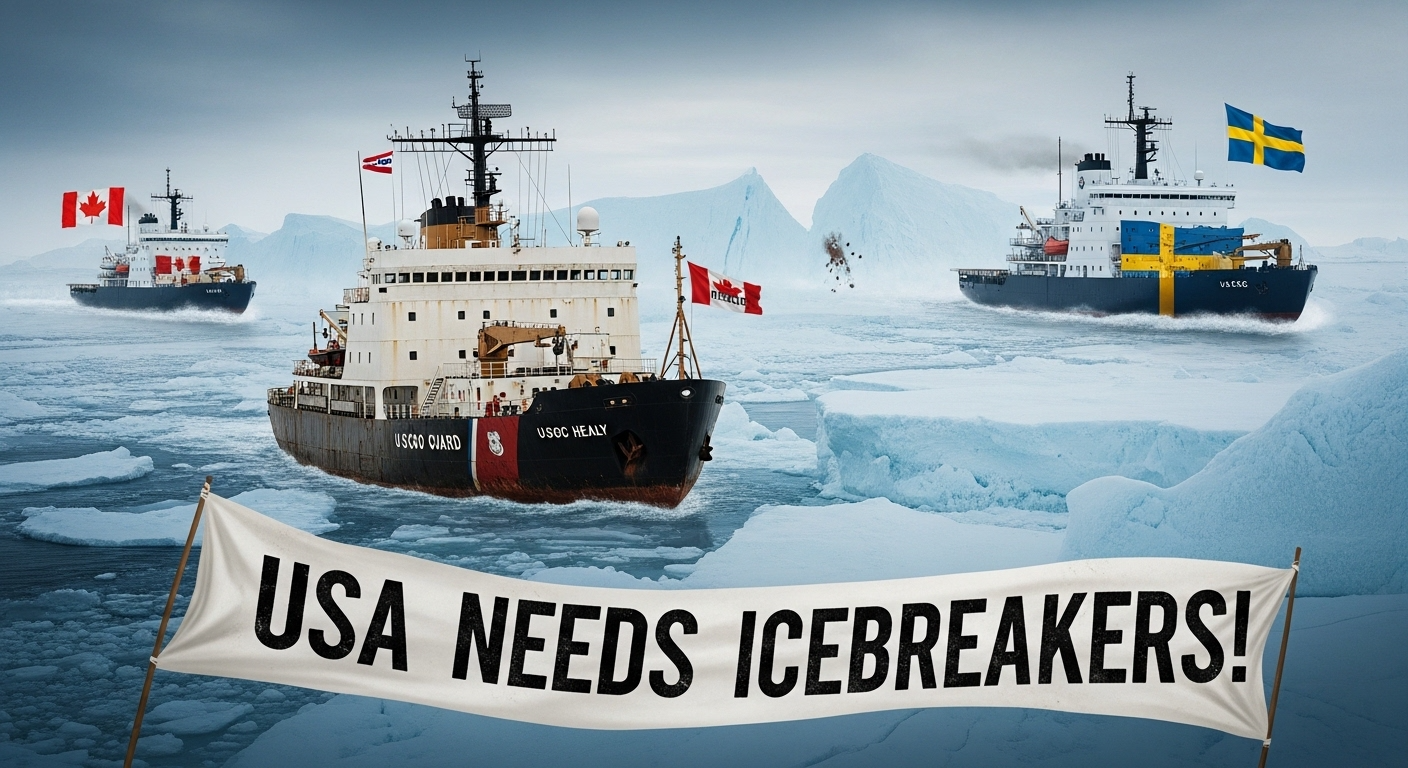
The United States Has Fallen So Far Behind in Strengthening Its Icebreaker Fleet That It Is Calling for Help From the Two Western Superpowers in the Field
The first time you see an icebreaker in action, something about it feels almost wrong. The bow climbs up onto a thick slab of frozen ocean and hangs there for a moment, heavy and improbable, before gravity pulls it crashing down. The ice groans, fractures, and splinters outward in great radiating cracks. Then the ship lurches forward and does it again. It is not graceful. It is loud and violent and strangely magnificent.
For decades, the United States watched that kind of raw polar power slowly slip out of its hands. And now, quietly but unmistakably, it is asking for help from the two allies who never let theirs go.
A Ship Running on Stubbornness Alone
On a grey morning at the bottom of the world, the Polar Star wakes up coughing.
She is 399 feet of steel and sheer persistence, the only heavy icebreaker the United States currently has that can push through the thick Antarctic sea ice to resupply McMurdo Station. Inside her hull, pipes rattle, paint flakes in long curling strips, and engineers talk quietly to each other over the constant thrum of engines that were never supposed to still be running.
She was commissioned in 1976. Rotary phones were still standard in American homes that year. The word Arctic described the edge of a paper map, not a contested geopolitical arena.
Crew members have described her recent deployments with a mixture of dark humour and genuine unease. Flooded compartments, engine room fires, and electrical failures have all occurred on recent missions. During one Antarctic deployment the crew performed makeshift repairs mid-voyage in the Southern Ocean, welding emergency fixes together like mechanics keeping an old truck alive on a highway made of moving ice.
Her orange hull still looks fierce from a distance. Up close, she is a museum piece in motion, pushed years beyond the lifespan for which she was built. And she is alone. The United States once operated multiple heavy icebreakers. Her sister ship, the Polar Sea, is now retired. What remains is one ageing heavy icebreaker and a single medium vessel, the Healy, designed for research rather than for bulldozing through the thickest pack ice on the planet.
Meanwhile, the Arctic is opening. The Antarctic remains as brutal as ever. And the rest of the world has not been waiting.
The Two Allies Who Never Stopped Building
If the United States is an ageing champion who trained in a different era, two of its closest allies have spent the past few decades quietly building something far more capable.
Finland is a country of about five and a half million people whose coastline freezes every winter. Rather than treating that as a problem, the Finns have spent generations treating it as a design challenge. Their shipyards and engineering firms have developed some of the most technically advanced icebreakers ever built, including distinctive double-acting vessels capable of moving bow-first through open water and stern-first through heavy ice.
Finland does not merely operate icebreakers. It designs them, refines them, and exports the expertise that lets other nations build their own polar fleets. The word superpower gets used carefully in international relations, but in the specific domain of icebreaker design it is applied to Finland without exaggeration.
Canada occupies the other end of the equation. Its map looks like it has been bitten into by the Arctic Ocean. The Northwest Passage runs through its northern archipelago. Inuit communities live in places where winter is not a season but a permanent condition. For Canada, icebreakers have never been exotic. They are lifelines.
The Canadian Coast Guard has been steadily expanding and modernising its fleet, building new vessels, upgrading existing ones, and maintaining a sustained national commitment to operating in its own northern waters. The scale does not match Russia, which operates the largest icebreaking fleet on earth including nuclear-powered giants, but the direction and momentum are clear. Canada is building. The United States, until recently, was not.
How a Global Superpower Fell So Far Behind
The United States has the coastline, the budget, and the engineering talent to lead the world in icebreaking capability. The fact that it does not is the result of a long, slow accumulation of misplaced priorities and strategic miscalculation.
For decades, policymakers in Washington treated polar ice as a distant, stable backdrop rather than a strategic surface. The Arctic sat at the edges of maps and policy documents, mentioned in passing in climate reports but rarely elevated to the level of genuine national security concern. The Antarctic was viewed as a scientific outpost rather than a theatre where presence and access would one day matter.
The Coast Guard asked for new ships repeatedly. Studies were commissioned. Reports were written. Every report reached the same conclusion: the fleet was old, small, and inadequate for the demands being placed on it. Then budgets tightened, priorities shifted, and timelines stretched further into the future.
Defence spending flowed toward submarines, aircraft, drones, and cyber capabilities. Icebreakers, slow to build and expensive to justify in short political cycles, kept slipping down the list.
Then the ice itself began to change everything. The Arctic warmed at roughly four times the global average rate. Summer sea ice retreated further each year. Shipping companies began eyeing new routes. Nations started filing territorial claims over continental shelves and undersea mineral deposits. Critical minerals, rare earth elements, oil, and gas reserves buried beneath the polar seafloor suddenly became objects of serious geopolitical competition.
Icebreakers stopped being purely scientific tools. They became instruments of strategy. And by the time that realisation had fully taken hold in Washington, Russia was operating more than forty icebreakers and allies like Finland and Canada had built fleets calibrated for a new polar era.
The Numbers Tell a Stark Story
The comparison between fleets makes for uncomfortable reading from an American perspective.
| Country | Heavy Icebreakers | Total Ice-Capable Fleet | Key Strength |
|---|---|---|---|
| United States | 1 active (Polar Star) | 2 Coast Guard vessels | Global navy, strong research, aging polar fleet |
| Canada | Several medium and heavy, more planned | Dozen plus vessels | Arctic operations, sovereign northern presence |
| Finland | Powerful Baltic fleet | Fleet plus global design exports | World-class design and construction expertise |
| Russia | Dozens including nuclear-powered | Largest fleet on earth | Arctic dominance, nuclear propulsion |
The pattern is unmistakable. In the arena that is now becoming one of the most consequential geographic spaces on the planet, the United States is operating at a fraction of the capability its strategic position demands.
Swallowing Enough Pride to Ask for Help
Recognising a shortfall is one thing. Deciding to ask allies to help close it requires a different kind of decision entirely.
In recent years American delegations have visited Finnish shipyards and walked through engineering facilities where the next generation of polar vessels is designed in steel and software. They have studied hull geometries, propulsion configurations, winterisation systems, and the accumulated technical knowledge that separates a ship that merely survives ice from one that uses it efficiently.
Finland’s contribution is not necessarily to build American ships outright. It is to share decades of specialised knowledge about how to shape a vessel for polar conditions, how to angle a bow so ice breaks cleanly rather than buckling the hull, how to design propellers that remain functional in temperatures where metal behaves differently and mechanical tolerances narrow dangerously.
For a country that knows how to build aircraft carriers at industrial scale, this kind of specialist advice is genuinely valuable. Mistakes in ice are expensive and sometimes fatal, and there is little tolerance for learning those lessons the hard way when reliable expertise is available from a trusted ally.
Canada offers something complementary but distinct. Where Finland provides design knowledge, Canada provides operational wisdom accumulated over years of real deployments in real Arctic conditions.
Canadian icebreaker captains have navigated the Beaufort Sea, Hudson Bay, and the complex channels of the Northwest Passage across all seasons and all ice conditions. They understand how ice behaves after a storm, during an early freeze-up, or under the deceptive softness of a spring thaw. They know how to manage crew fatigue in endless polar twilight, how to coordinate with aircraft and satellite systems scanning the ice ahead, and how to build the institutional culture that sustains difficult polar operations year after year.
The United States and Canada already cooperate closely on Arctic search and rescue and joint exercises. As Washington works to rebuild its polar fleet, Canadian operational experience has become a practical blueprint for how to do it right.
Why This Is About Far More Than Ships
It would be easy to read this as a niche story, a drama for naval historians and polar researchers with limited relevance to broader global affairs. That reading would be wrong.
As Arctic sea ice retreats, previously inaccessible shipping routes are becoming viable for longer stretches of the year. The Northern Sea Route along Russia’s northern coast, the Northwest Passage through Canada, and potential transpolar routes across the top of the world are attracting serious commercial and strategic attention. Voyages between Asia, Europe, and North America could be shortened significantly if these routes become reliably navigable.
At the same time, the polar seafloor holds reserves of oil, gas, rare earth elements, and critical minerals that the global clean energy transition depends on. Nations have been filing territorial claims, conducting resource surveys, and establishing physical presence in the form of research stations, military installations, and regular icebreaker patrols.
In this environment an icebreaker is not just a ship. It is a key. Without one you cannot supply remote outposts, escort commercial vessels, respond to emergencies, conduct search and rescue operations, or simply maintain a visible presence in waters where your interests are at stake.
Icebreakers also carry scientists whose work shapes global understanding of climate change, sea level rise, ocean chemistry, and atmospheric dynamics. Lose those research platforms and the world loses more than capability. It loses knowledge that cannot be recovered from a satellite image or a computer model.
For the United States, a country that has defined itself as a global maritime power for generations, becoming a marginal player in polar operations is not merely an embarrassment. It is a strategic vulnerability in a part of the world that is rapidly becoming more important, not less.
What the Future Could Look Like
Imagine, a decade from now, a different scene in the high latitudes.
A new American heavy icebreaker moves through fractured floes in the early polar light. Her engines carry the steadier tone of modern power systems. Her hull geometry draws on Finnish design innovation, angles and curves tuned to the specific physics of how ice breaks under load. Her operational playbook reflects Canadian experience, how to station-keep in drifting pack ice, how to manage a crew through the psychological weight of months in polar darkness, how to coordinate the full range of assets needed to operate safely in the most demanding maritime environment on earth.
Scientists prepare instruments in the laboratories below deck. A helicopter sits ready on the aft pad. The ship’s flag is American. Her DNA is international.
That scene remains a work in progress. Shipbuilding takes years. Politics moves even more slowly. Every year that passes without new steel in the water narrows the options and deepens the gap.
But the calls for help have been made. Finland has opened its design books. Canada is sharing what it knows about living in a frozen neighbourhood. Whether the United States can translate that help into actual ships before the geopolitical and environmental stakes rise further is a question still being answered, one grinding mile at a time, in seas where nothing moves without effort.
Frequently Asked Questions
Why does the United States need icebreakers at all? Icebreakers are essential for maintaining access to polar regions for national security operations, scientific research, search and rescue, environmental protection, and logistical support of remote installations including McMurdo Station in Antarctica. Without them, large portions of the Arctic and Antarctic are effectively unreachable for much of the year.
How many heavy icebreakers does the U.S. currently operate? The United States currently has one operational heavy icebreaker, the Polar Star, which is operating well beyond its intended service life. It is supported by a single medium icebreaker, the Healy, which is designed primarily for research rather than heavy ice operations.
Why are Finland and Canada considered superpowers in this field? Finland leads the world in icebreaker design and construction, with shipyards and engineers responsible for some of the most technically advanced polar vessels ever built. Canada operates a substantial fleet and has accumulated decades of operational experience in Arctic waters, making both countries essential partners for any nation seeking to develop or expand polar capability.
Does melting Arctic ice mean icebreakers are becoming less necessary? The opposite is true. While summer sea ice is shrinking, conditions have become more unpredictable with faster-moving and less stable floes. Increased commercial shipping, resource exploration, and scientific activity in polar regions all create greater demand for ice-capable vessels, not less.
How long would it take the U.S. to rebuild its fleet? Designing, funding, and constructing modern heavy icebreakers typically requires close to a decade from initial concept to commissioning. That extended timeline is precisely what makes the current shortfall so serious and why the urgency of acting now is difficult to overstate.