If the ATM Keeps Your Card, This Fast Technique Instantly Retrieves It Before Help Arrives
The machine goes quiet, the screen freezes, and your stomach drops. Your card has just been swallowed by the ATM, and you have no idea what to do next.
It happens more often than most people realise, and the first thirty seconds matter more than anything that follows. How you respond in that initial moment determines whether you walk away with your card or spend the next week dealing with your bank.
Why ATMs Retain Cards in the First Place
Not every card retention is a malfunction. ATMs are programmed to hold cards under specific conditions, and understanding why it happened helps you decide what to do next.
The most common reason is a simple timeout. If you do not complete your transaction within the machine’s allowed window, it pulls the card back as a security measure. This is designed to protect you if you walked away and forgot it was still in the slot.
Other reasons include suspected card fraud, an expired card being flagged by the system, too many incorrect PIN entries, or a genuine mechanical fault inside the machine. In some cases the ATM is protecting you. In others it is simply broken. Knowing the difference shapes your response.
The First Thing You Must Do
The single most important action in the first few seconds is also the least instinctive one. Stop. Breathe. Do not start pulling, pressing, or hitting anything.
Panicking almost always makes the situation worse. An ATM that has retained your card on purpose will not release it under physical pressure, and an ATM that has jammed mechanically can be further damaged by force, which means your card goes deeper rather than coming back out.
Read the screen carefully before doing anything else. The message displayed will often tell you exactly what has happened and what the machine wants you to do. Many ATMs provide clear on-screen guidance for card retention situations, and following those instructions is always the right starting point.
The Fast Retrieval Technique
If the screen is not giving you useful guidance and the card has not been ejected automatically, there is a practical technique worth trying before you call anyone. It is simple, takes about thirty seconds, and works in a meaningful number of cases.
First, look at the ATM interface carefully for any button or touchscreen option labelled cancel, release card, or return card. Some machines have a dedicated card release function that is accessible from the main screen or from a submenu that appears after retention. It is easy to miss when you are stressed, so look methodically rather than at a glance.
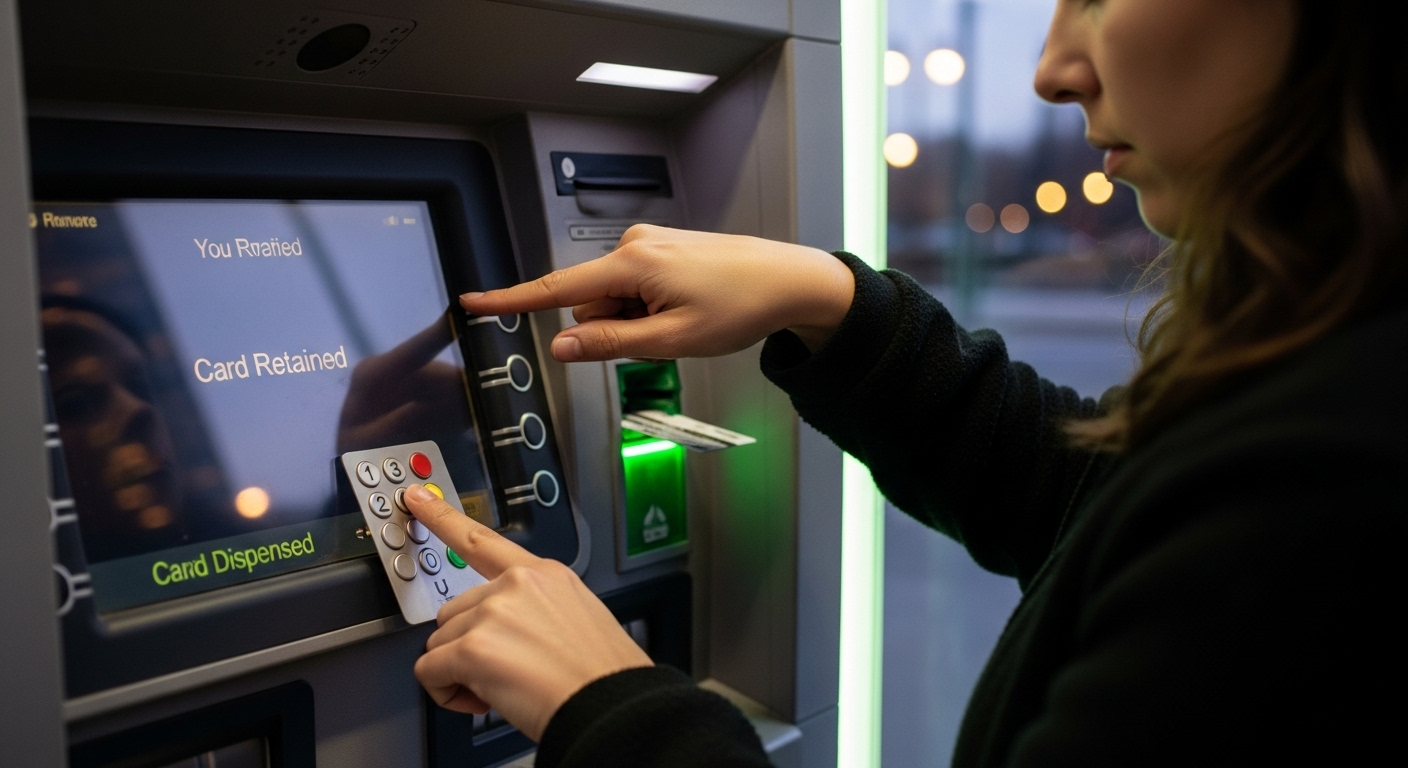
If no release option is visible, try the following. Place your fingertips very lightly on either side of the card slot and apply the gentlest possible outward pressure while simultaneously pressing the cancel button if one is available. This slight lateral movement can sometimes free a card that has been caught by a mechanical catch rather than deliberately retained by the system.
A very light tap on the side of the card slot — not the screen, not the machine body, just the slot housing — can also dislodge a card that has snagged on something internal. Use one finger, apply minimal force, and do it once. If it does not work immediately, do not repeat it harder.
What you must never do is insert anything into the slot to try to lever the card out. A pen, a coin, a fingernail, or any other object inserted into an ATM card slot can damage the mechanism, push the card further in, and potentially constitute criminal damage to bank property. It will not help, and it may create a problem significantly larger than the one you started with.
When the ATM Is Holding Your Card Deliberately
There is an important distinction between a machine that has jammed and a machine that has made a decision. If the ATM has deliberately retained your card — usually indicated by a specific on-screen message — the retrieval technique will not work, and attempting it wastes time you should spend on the right course of action instead.
Deliberate retention happens most often when the bank’s system has flagged something about your account or your card. It can be triggered by suspected unauthorised use, an account freeze, a card that has been reported lost or stolen by someone else on the account, or a system-level security hold. None of these situations can be resolved at the machine.
In this case, stay calm, note the exact wording of the message on screen, and call your bank immediately. Most Australian banks have twenty-four hour card services lines, and a retained card is exactly the kind of situation those lines exist for. The operator will be able to tell you what triggered the retention and what your options are for retrieving the card or having a replacement issued.
Checking for Tampering Before You Do Anything Else
This step deserves its own section because it is something most people never think to do in the stress of the moment. Before you touch the machine at all, look at it.
Card skimming devices are physical attachments that criminals install over the genuine card slot to capture your card data as it passes through. They are designed to look like part of the machine, and in good light they can be convincing. What gives them away is that they do not fit quite as smoothly as the original hardware — there may be a slight gap, a different colour tone, a loose edge, or a slightly raised surface around the slot.
Also check for anything unusual around the PIN pad — a thin overlay, a small camera positioned to capture your keystrokes, or any surface that feels different from what you would expect. Criminals often deploy both a skimmer and a PIN capture device together.
If anything looks wrong, do not insert your card. Move away from the machine, call your bank, and report the location and what you observed to your bank and to the police. Do not touch the suspected device. Do not alert anyone nearby who may be watching. Simply leave and make the calls.
Protecting Yourself After the Incident
Whether you recovered your card or not, the ATM retention event itself requires some follow-up action to protect your financial security. The card has been inside a machine that may or may not be functioning normally, and that warrants at least a basic level of precaution.
Log into your banking app or call your bank as soon as you are somewhere safe and check your account for any transactions you did not make. Even a small, unfamiliar charge is worth querying immediately, as fraudsters often test a compromised card with a minor transaction before attempting something larger.
If you have any doubt at all about the integrity of the ATM or the safety of your card data, ask your bank to issue a replacement card. Most Australian banks can cancel a card and issue a new one with a different number within a few business days, and many offer instant virtual card replacement through their apps. The inconvenience is minor compared to the alternative.
Consider whether you need to change your PIN as well. If you entered it at a machine that may have been tampered with, a PIN change adds a meaningful layer of protection even if your card number itself has not been compromised.
The Personal Safety Dimension
An ATM that has retained your card is not just a financial inconvenience. It is a situation that can make you physically vulnerable if you are not aware of your surroundings.
You are standing at a machine, visibly distressed, likely with your attention fully focused on the screen rather than on what is happening around you. This is exactly the profile that opportunistic thieves look for. Your wallet is probably out, your phone may be in your hand, and your attention is divided.
Move away from the machine as soon as you have done what you can do there. Do not stand next to it for fifteen minutes on the phone to your bank. Walk to a nearby shop, café, or other public indoor space where you can make your calls in safety without broadcasting that something has gone wrong.
If it is late at night, if the ATM is isolated, or if you feel at all uneasy about anyone in the vicinity, prioritise your personal safety over resolving the card situation. The card can be cancelled and replaced. Your safety cannot be.
Preparing So This Is Less Disruptive Next Time
The best preparation for an ATM card retention is the kind you do now, before it happens. A few simple steps taken in advance can dramatically reduce the stress and disruption if it ever occurs.
Store your bank’s twenty-four hour card services number in your phone contacts now, not when you need it. Most people have to search for this number while already stressed, which adds time and frustration to a situation that already has enough of both. Having it ready takes thirty seconds today and could save significant anxiety later.
Carry a backup payment method whenever you use an ATM. A second debit or credit card kept in a different part of your wallet means that even if your primary card is retained, you can still pay for things and access funds while the situation is being resolved. This is basic financial resilience that serves you in multiple scenarios beyond ATM issues.
Know your bank’s process for card replacement in advance. Find out whether your bank offers instant virtual card replacement through its app, what identification you will need to provide when reporting a retained card, and whether a replacement can be express-mailed to you if needed. Understanding the process before you need it means you can activate it calmly and efficiently rather than learning it under pressure.
Frequently Asked Questions
Why do ATMs keep cards in the first place? The most common reasons are transaction timeout, too many incorrect PIN attempts, suspected fraud flagged by the bank’s system, or a mechanical fault in the machine. Some retentions are protective security measures, others are malfunctions, and the appropriate response differs between the two.
Is the fast retrieval technique safe to try? Yes, provided it is done gently and without any tools or objects inserted into the slot. Light pressure on the slot housing and a single gentle tap are safe approaches. Anything involving force, leverage, or inserting objects into the machine risks damage and should never be attempted.
What if my card is being deliberately held by the bank’s system? The retrieval technique will not help in this case. Contact your bank’s twenty-four hour card services line immediately, note the message displayed on screen, and follow their instructions. The hold will have a specific cause that only the bank can explain and resolve.
Should I wait at the ATM for a bank representative to arrive? Generally no, unless the ATM is inside a bank branch with staff present. Waiting at an outdoor or shopping centre ATM for extended periods makes you vulnerable and is rarely necessary. Call your bank from a safe location and let them guide the process remotely.
How do I know if the ATM has been tampered with? Look for anything that does not fit smoothly around the card slot — loose edges, slight colour variations, raised surfaces, or anything that looks like it has been added rather than built in. Check the PIN pad for any overlay or unusual texture. If anything looks wrong, do not use the machine and report it to your bank and police.
What should I do if I cannot get my card back? Call your bank, report the card as retained, and request a replacement. Most Australian banks can cancel the existing card immediately over the phone, preventing any unauthorised use, and issue a replacement within days. Many offer virtual card replacement through banking apps that is available almost instantly.
Do I need to report an ATM card retention to the police? Not routinely. If you suspect the machine has been tampered with or believe your card data may have been stolen, a police report is worth making — particularly because it creates a record that may be useful if fraudulent transactions appear later. For a straightforward mechanical retention, a call to your bank is sufficient.
How quickly can I get a replacement card issued in Australia? This varies by bank, but most major Australian banks can issue a virtual replacement card through their app immediately and post a physical replacement within three to five business days. Some banks offer express card delivery for urgent situations, and all will cancel your retained card instantly when you call to report it.
Key Takeaways
- Stay calm immediately — panicking or applying force makes the situation worse, not better.
- Read the screen first — the ATM’s message usually tells you whether the retention is deliberate or mechanical.
- Try the gentle technique — check for a card release button, apply very light pressure to the slot, and try one gentle tap before giving up.
- Never insert anything into the slot — this risks damage, pushes the card deeper, and may constitute criminal damage.
- Check for skimming devices before touching anything — look for anything that does not fit flush around the slot or PIN pad.
- Call your bank from a safe location — do not linger at the machine longer than necessary, especially at night or in isolated areas.
- Monitor your account immediately — check for unfamiliar transactions as soon as you are somewhere safe.
- Have your bank’s number saved in your phone now — before this ever happens, not while it is happening.
- Carry a backup payment method — a second card in your wallet means a retained card does not derail your entire day.
Read more: https://wizemind.com.au/