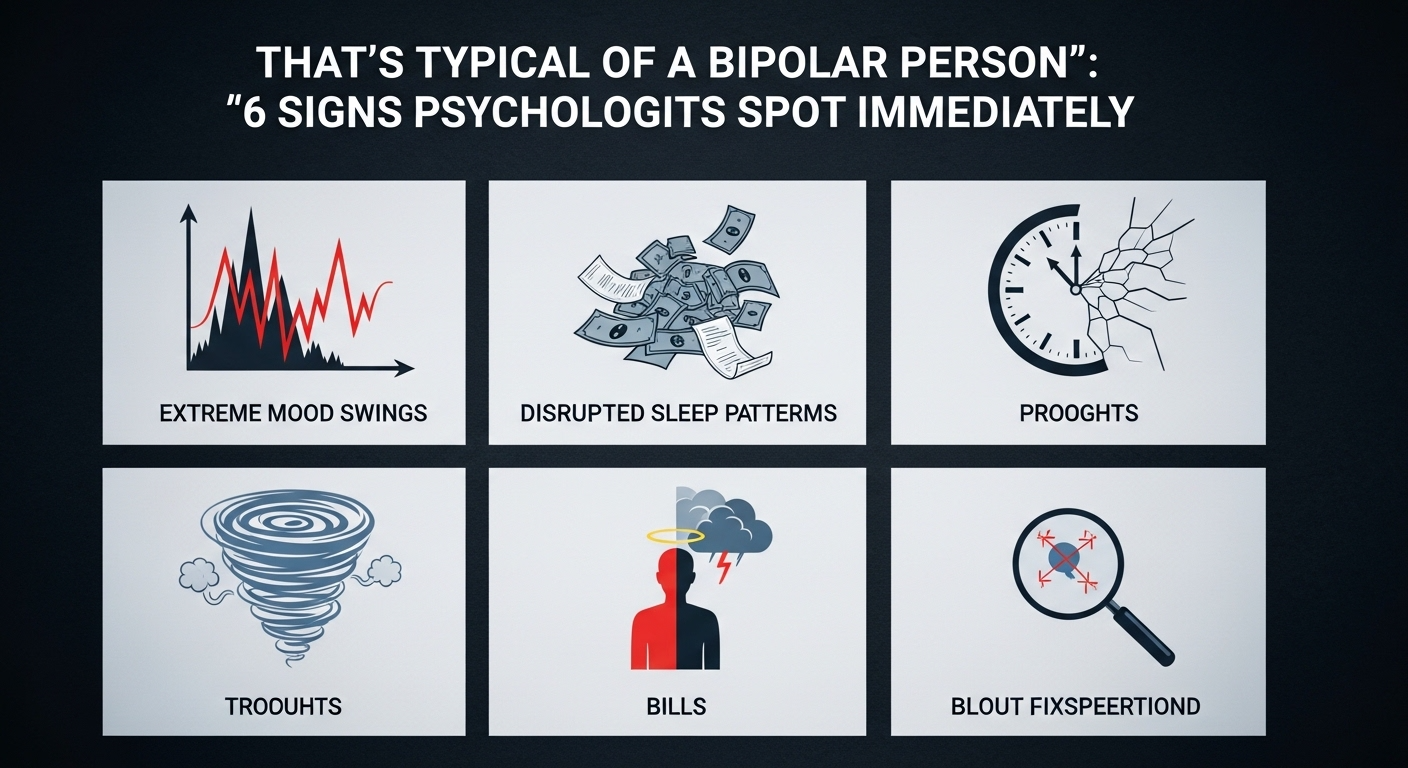
“That’s Typical of a Bipolar Person”: 6 Signs Psychologists Spot Immediately
The woman on the park bench is laughing so hard she’s wiping tears from her eyes. Her coffee sits forgotten next to her, cooling in the early evening air. Ten minutes later, as the light drains from the sky and the shadows stretch long over the grass, her body folds inward. The laughter is gone. Her shoulders hunch, her eyes turn glassy and far away. It’s as if someone reached into her chest and flipped a switch.
“That’s so bipolar,” someone behind you might whisper.
Maybe you’ve heard it tossed around at work when a manager’s feedback goes from warm to icy in a heartbeat. Maybe you’ve said it about yourself on a bad week, half as a joke, half as a quiet question you’re afraid to ask out loud.
These days, bipolar gets used like a throwaway adjective — an easy label for anyone who seems intense, unpredictable, or too much. But when a psychologist hears someone say “that’s typical of a bipolar person,” their mind doesn’t jump to the punchline. It zooms in, scanning for patterns that go far deeper than mood swings or drama.
Because bipolar disorder isn’t just about ups and downs. It’s about the pattern, the intensity, the way these shifts ripple out into work, relationships, sleep, energy, and the body itself. To a trained eye, there are signs that flicker like beacons in a storm — subtle, layered, and almost always misunderstood by the casual observer.
This isn’t a checklist for diagnosing yourself or someone you love. It’s more like walking into a quiet forest with a naturalist and learning what they notice instantly: the bent grass, the broken twig, the feather caught in the bramble. The signs were always there. You just didn’t know what they meant yet.
Sign 1: The Highs That Feel Like Superpowers
Imagine waking up feeling like the air itself is lighter. Colours sharpen. Music sounds deeper. Your brain crackles with ideas — start a business, write a book, finally rearrange your entire apartment at 2am. Your fingers fly across the keyboard, messages ping out to coworkers, friends, strangers. You barely notice you skipped lunch. Who needs food when you’ve got this much momentum?
To a friend watching from the outside, it might look like a good mood, a productive streak, a glow-up. They might say: you’re crushing it lately. But a psychologist listening closely hears the edges. Is this enthusiasm — or euphoria? Is this focus — or a restless energy that won’t turn off?
One of the signatures of bipolar disorder, especially in its hypomanic or manic phases, is an elevated mood and energy that isn’t just happy — it’s almost electric. The person may talk faster, move faster, think faster. They jump between topics like stones in a stream, never quite landing, ideas sparking off ideas, their eyes bright and wide.
Psychologists look for clues like increased activity that goes far beyond the person’s normal baseline, needing far less sleep yet still feeling wired rather than tired, a sudden explosion of plans and projects, and talking more rapidly with a kind of unstoppable momentum.
From the outside, it can look enviable — like a creative surge or a life finally catching fire. But underneath, there’s often a fragile edge. Something moving that fast can’t stay airborne forever.
Sign 2: The Reckless Impulses Hiding in Plain Sight
Under the glow of a manic or hypomanic mood, everyday decisions start to shimmer with a slightly dangerous light. That new car suddenly feels absolutely necessary. The risky investment seems like a once-in-a-lifetime opportunity. The stranger at the bar feels like fate, not caution.
This is another sign psychologists notice quickly: a pattern of behaviour that swings toward the impulsive, the risky, the I’ll-deal-with-it-later. Not once, not twice — but over and over, especially during those elevated mood states.
Someone in this phase might spend large amounts of money in short bursts with little thought to consequences, quit jobs impulsively or make sudden dramatic life changes, engage in risky behaviour they would normally avoid, or push their body well past reasonable limits.
To friends or family, this can look like someone finally living a little. They laugh it off: that’s just them when they’re in one of their moods. But a psychologist hears the echo of a repeating pattern — big choices made on a rush of feeling, followed by deep regret when the mood comes crashing down.
It’s not just poor judgment. It’s a brain temporarily tilted toward reward and thrill, the brakes loosened, the sense of danger blurred. In that state, the future feels far away, almost imaginary. Only the urgency of now feels real.
Sign 3: The Crashes That Feel Like the Colour Drained Out of the World
Then the sky changes.
One morning, the same person who was flying high can barely get out of bed. The ideas that sparked like fireworks last week now sit strangely lifeless. The projects that felt urgent feel embarrassing. Shame trickles in through the cracks: what was I thinking, why did I say that, how will I fix this?
To a psychologist, this isn’t just a bad day or feeling low. They’re watching for depressive episodes that arrive with a distinct weight and texture, often following those intense highs. The sharp drop from light to dark is a significant red flag.
In these low phases, common signs include a heavy almost physical sense of exhaustion, sleep that becomes excessive or disappears into restless nights, loss of interest in things that recently brought joy, feelings of worthlessness or intense self-criticism, and difficulty concentrating or following a simple conversation.
What makes bipolar depression especially hard is the contrast memory — the mind remembers how recently everything felt possible. That sharp swing can make the low feel even darker, even more confusing. Friends who don’t understand may say: you were fine last week, what happened?
The answer, clinically, is that nothing happened outside. Something shifted inside — the brain’s rhythms, its chemistry, its energy — like a tide turning without asking permission.
Sign 4: The Mood Swings With a Hidden Rhythm
Everyone’s mood changes. A bad commute, a kind word from a stranger — all of it can matter. But psychologists listening for bipolar disorder aren’t just tracking that moods change. They’re tracking how, how often, and what comes with them.
They’ll ask whether these elevated and low periods last for days or weeks rather than just hours, whether they happen in cycles even when life on the outside isn’t dramatically changing, and whether they cause noticeable problems at work, in relationships, or with money.
It’s not uncommon for someone with bipolar disorder to be told for years that they are moody, overreactive, or dramatic. The world may only see the surface. But a psychologist is listening for the pattern below the pattern.
For some people, these cycles are slow and seasonal, unfolding like long weather systems. For others, they move quickly and chaotically, with mixed states where agitation and despair slam together at the same time. It’s rarely as simple as happy versus sad. It often feels more like a storm front that changes shape in the middle of the sky.
Mental health professionals lean hard on careful timelines, sometimes sketching out a person’s life on paper and marking peaks and valleys like rings in a tree trunk. In that map they look for first episodes in late teens or early adulthood, periods of being creatively or socially on fire followed by deep burnout, and recurrent depressions that never fully matched life events. It’s like listening to a song not just for the notes, but for the repeating melody underneath the noise.
Sign 5: The Sleep That Tells a Hidden Story
Sleep is one of the first things psychologists quietly lean toward, like a tracker studying footprints in soft soil. Ask someone with bipolar disorder about their sleep across different phases and a revealing pattern often appears.
In elevated states, you might hear: I only slept three hours but felt amazing, I stayed up all night organising and writing and wasn’t even tired, I just didn’t need sleep — it felt like a waste of time.
In low states, you hear almost the opposite: I could sleep twelve hours and still wake up exhausted, getting out of bed feels like moving through wet cement, I lie awake worrying then crash late in the morning.
To a casual observer, this might seem like being a night owl sometimes or going through a rough patch. But for clinicians, the way sleep stretches and shrinks with mood is a vital sign — one of the most telling markers of bipolar patterns.
Psychologists don’t just ask how someone is sleeping right now. They ask how sleep has changed over time, what it was like during the most energised phases, and what happened just before the last big crash. For many people with bipolar disorder, sleep is not merely a symptom — it’s a delicate switch. A few nights of too little sleep can tilt someone into hypomania or mania. Too much sleep can deepen a depressive slide. It’s not just rest. It’s rhythm.
Sign 6: The History Written Between the Lines
When someone sits down in a therapist’s office and quietly admits they think they might be bipolar, what comes next isn’t a simple checklist. It’s a conversation about history — sometimes family history, sometimes personal history, often both.
Psychologists pay attention to a family tree dotted with mood disorders or unpredictable relatives, earlier labels that never quite fit such as depression or anxiety or ADHD, stories of being the intense one or the life of the party or the disaster waiting to happen, and hospitalisations for mood or crisis in the context of crashing after wild highs.
They also notice the way a person talks about themselves. Does the story swing between pride and shame? Are there tales of grand dazzling phases that feel like another person’s life, followed by long periods of hiding and repairing the damage?
What often stands out most is the storytelling itself — the sense of living life in chapters, not just days. For many people with bipolar disorder, their own life can feel like a collection of different versions of themselves: the one who starts everything, the one who ruins everything, the one who disappears.
Psychologists also file away quieter signals: humour that covers a deep fear of going off the rails again, a sense of relief when things feel stable mixed with boredom and restlessness, years of being called too sensitive or too much or too intense, and behaviours that only make sense when mapped against invisible mood cycles.
It’s rarely one giant flashing sign. More often, it’s many small signals slowly aligning into a picture that finally makes sense.
The Difference Between a Label and Understanding
When someone shrugs and says “that’s typical of a bipolar person,” as if an entire human being can be summed up in a single sweeping stereotype, what they’re really doing is flattening something deeply complex and deeply human.
Bipolar disorder is not just the friend who’s always dramatic, the coworker who changes their mind a lot, or the artist who stays up all night and crashes for days. It is a neurological rhythm — a pattern of energy and mood that can be chaotic and dangerous without support. It’s not a personality quirk. It’s not romantic or glamorous. It’s an illness that sits in the brain and body, often asking the person to rebuild their life again and again.
Diagnosis, when it fits, can be a kind of translation. Suddenly the reckless spending, the sleepless nights, the weeks of numbness, the overwhelming guilt after the high — they all land in the same place. Not as proof of moral failure, but as a map of a condition that can be treated, managed, and understood.
Psychologists, at their best, aren’t there to slap on a label and walk away. They’re there to say: these pieces of your story — you’re not imagining them. There’s a name for this pattern. And there are ways to steady the ground beneath your feet.
Because no one is typically bipolar. People are typically human: layered, messy, sometimes overwhelmed by the storms inside their own chest. Diagnosis doesn’t make any of that less human. If anything, it can be the first step toward a life where the weather inside you doesn’t feel quite so unpredictable — and where you’re no longer standing in it alone.
Frequently Asked Questions
Isn’t everyone a little bipolar sometimes? No. Everyone has mood changes, but bipolar disorder involves distinct episodes of elevated and depressed mood that are more intense, longer-lasting, and disruptive than ordinary ups and downs. It is a medical condition, not a personality type or a synonym for being moody.
Can you have bipolar disorder without extreme mania? Yes. Bipolar II disorder involves hypomania — elevated mood and energy that’s less intense than full mania — along with significant depressive episodes. Many people with bipolar II are misdiagnosed with depression alone for years because their highs seem like mere good periods.
How do psychologists actually diagnose bipolar disorder? They use detailed interviews, standardised criteria, and a careful history of mood episodes over time. They look at duration, severity, impact on daily life, and whether there have been periods of elevated mood in addition to depression. Sometimes they also gather information from family members or previous medical records.
What’s the difference between bipolar disorder and borderline personality disorder? They can look similar on the surface, but bipolar disorder is primarily about mood episodes lasting days to weeks, while borderline personality disorder involves rapid situation-triggered emotional swings and long-standing patterns in relationships and self-image. Only a trained professional can carefully distinguish between the two.
If I recognise these signs in myself, what should I do? The safest step is to speak with a mental health professional — a psychologist, psychiatrist, or licensed therapist — and share your full history, not just how you feel right now. Keeping a mood and sleep journal can be extremely helpful. You don’t have to decide your diagnosis alone, and you don’t have to keep white-knuckling your way through the storms without support.
If you are experiencing mental health difficulties, please reach out to a qualified professional or contact a crisis support line in your country.