If You Still Make Handwritten To-Do Lists, Psychology Says You Have These 7 Distinct Qualities
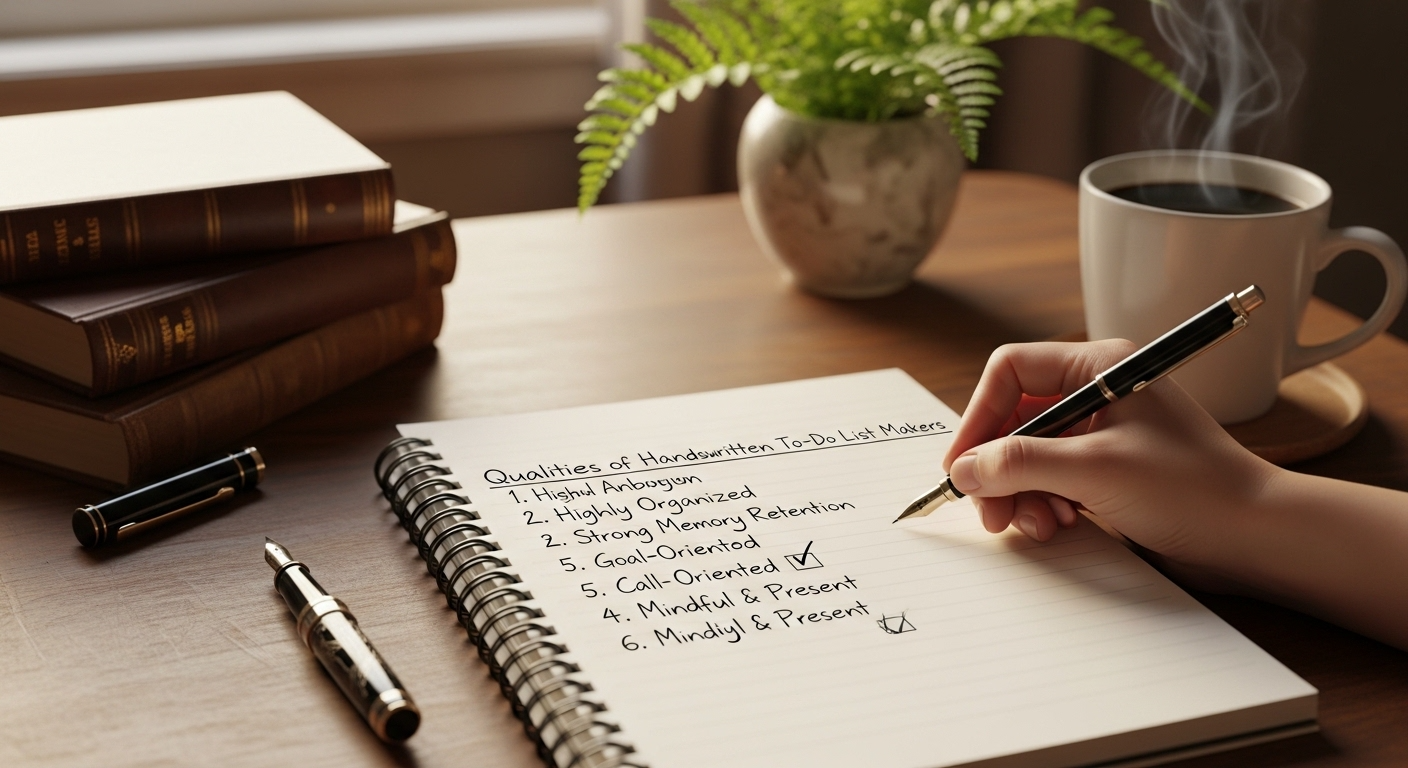
The pen hovers above the paper for a moment, just long enough for your brain to catch up with your intentions. A line of ink appears: “Email Sarah.” Below it: “Pick up coffee beans.” Then, slightly larger and underlined for emphasis: “Finally start that idea.” The page rustles softly as you shift your hand. There is a small thrill in seeing your day exist outside your head, suddenly real, suddenly possible.
If you still make handwritten to-do lists in a world of apps, voice commands, and smart reminders, it is not just nostalgia. Psychology suggests it actually reveals something distinct about the way your mind works and the kind of person you are.
The Quiet Ritual of Writing Things Down
Handwritten to-do lists are more than just scraps of responsibility. They are small rituals. You search for a pen that feels right in your hand, the paper that does not smear, the notebook that can survive the bottom of your bag. You pause, breathe, and translate the vague swirl of everything you have to do into lines and bullet points. In that fleeting moment between thought and ink, your attention narrows and the rest of the world blurs.
Psychologists call this kind of physical engagement embodied cognition. When you write by hand, your brain processes information differently than when you tap it out on a screen. You recruit more areas related to memory, spatial processing, and emotional tagging. You are literally carving the day into your mind, one small movement at a time.
But beyond the brain science, your preference for pen and paper tells a deeper story about your inner world. The person who still writes lists by hand while everyone else scrolls through productivity apps tends to have a particular psychological profile: seven qualities that quietly shape their days.
Quality 1: You Crave Tangible Control in an Intangible World
Open your phone and you will see a thousand invisible systems trying to guide your life. Cloud calendars, synced reminders, notifications that pop in and out like restless birds. All of it lives somewhere out there, on servers, in code, in a network you cannot see or touch.
When you make a handwritten to-do list, you reclaim something ancient and physical. Your tasks do not just exist in a cloud. They exist in the weight of the notebook in your bag, in the smear of ink on your thumb, in the page folded and tucked into your pocket. It is control you can hold.
Psychologists call this a need for cognitive closure. The list becomes an anchor. You know what today is made of because you have written it down. People who prefer handwritten lists often feel calmer when plans are visible and concrete. They like to see tasks all in one place, not scattered across five different apps. And they get real satisfaction from the physical act of crossing things out.
Each crossed-out line offers a tiny dose of closure. Not just done, but done in a way your senses can confirm. You hear the scratch of the pen. You see the line cutting through the words like a small victory banner.
Quality 2: You Are Quietly Reflective Even When Life Is Loud
There is a difference between dumping tasks into an app at a stoplight and sitting down with a pen and a blank page. One is reaction. The other is reflection. When you handwrite your to-do list, you are not just recording what is urgent. You are editing. You are deciding which of the many voices in your head gets to speak first.
Research on expressive writing shows that slowing down to write by hand forces a kind of mental sorting. You cannot write at the speed of your thoughts. You have to choose. That choosing is where reflection slips in. Even if it takes only three minutes, making a handwritten list becomes a tiny check-in with yourself.
You might notice which responsibilities keep showing up day after day uncrossed. Which dreams you always push to the bottom of the page. Which names you avoid writing down because the conversation feels hard. Those patterns are a mirror.
Think of the margin doodles, the stars next to items that really matter, the little arrows that move something to tomorrow, again. These are not just organizational choices. They are tiny acts of self-reflection. Handwritten list-makers tend to be the sort of people who notice their inner weather, even in small and practical tasks.
Quality 3: You Have a Strong Sense of Personal Agency
There is an odd thing about apps. They often feel like they are managing you instead of the other way around. They ping, buzz, flash, and insist. Your phone tells you what to do next, as if your life has been turned into a push notification.
When you write a list by hand, the direction reverses. You decide what makes it onto the page. You choose the order. You can circle or underline or add exclamation points where it matters. The list does not boss you around. It serves you.
Psychologists talk about locus of control: whether you believe life mostly happens to you or you have real power to shape it. Handwritten list-makers often have a stronger internal locus of control. They may not control everything, but they take clear ownership of their part. There is a subtle message written between every line: I can move this day forward.
That does not mean they are always confident or perfectly disciplined. It means they keep returning to the same quiet act: writing down what they can do, here, now, with what they have. In a way, the list is a declaration against helplessness. Even in seasons of chaos, illness, job shifts, grief, many people cling to their lists like a hand on the rail in a dark stairwell.
Quality 4: You Are Sensory, Not Just Digital
There is a reason a certain kind of person gets borderline emotional about the right notebook or the feel of a specific pen gliding across paper. If that sounds like you, it points to something deeper than a stationery obsession. You are wired to engage the world through your senses.
Handwriting a list touches multiple senses at once. The drag of pen on paper and the slight give of the page. The unique slant of your handwriting and the way tasks cluster in certain corners. The faint scratch of the pen and the rustle as you flip through old lists. This multi-sensory experience helps encode information more deeply. Studies comparing handwritten and typed notes consistently find that handwriting leads to better recall. You remember what you physically shape.
If you gravitate toward handwritten lists, you likely learn better when you doodle, underline, or color-code. You probably remember things you have written down without needing to check the list again. And you likely feel more committed to your plans when they are on paper rather than glowing on a screen. You live not just in your head, but in your body. And your to-do list quietly respects that.
| Method | Best For | Psychological Flavor |
|---|---|---|
| Handwritten List | Sensory thinkers, reflective planners | Embodied, intentional, personally meaningful |
| App-Based List | Highly dynamic schedules, collaboration | Flexible, data-driven, externally cued |
| Mental List Only | Low task load, improvisational days | Spontaneous, intuitive, but easily overloaded |
Quality 5: You Respect the Past While Moving Into the Future
In an age of constant updates, there is something gently rebellious about sticking with paper. You are not rejecting technology. You probably still use calendars, email, maybe even a notes app. But you are also not willing to let older, slower ways disappear entirely.
Psychologists sometimes call this integrative thinking: the ability to blend old and new instead of discarding one for the other. If you still keep handwritten lists, you likely enjoy traditions but adapt them to fit your life. You feel a pull toward analog pleasures, printed books, letters, real conversations. And you are quietly skeptical of the idea that new automatically means better.
You live in the modern world without surrendering fully to its pace. The list becomes a small act of time-travel, connecting you to the way your parents or grandparents might have organized their days. Yet your tasks are undeniably from this era: “book flight,” “update profile,” “join Zoom at 3.”
There is a humility in this stance. You are willing to admit that for all our advances, some very old human gestures, like pen meeting paper, still do something for us that an app cannot quite replicate.
Quality 6: You Are More Self-Compassionate Than You Realize
Look closely at an honest handwritten to-do list. Not the curated, aesthetically pleasing versions, but the messy, real ones. You will find things that are half-crossed out, arrows pointing to the margin, items circled three days in a row. You will see words like “try,” “start,” or “work on” instead of “finish or fail.” There is humanity in that imperfection.
People who rely on handwritten lists often develop a softer, more flexible relationship with their own productivity. The list is not a courtroom verdict. It is a living document. When something does not get done today, it does not vanish in a digital archive. You have to look it in the eye tomorrow. You physically rewrite it. And as repetitive as that can be, it also creates room for self-compassion.
Psychologists describe self-compassion as three things. Kindness instead of harsh self-judgment. Recognizing that your struggles are part of being human. And holding your thoughts and feelings with mindful awareness.
The simple act of rewriting “call therapist” or “go for a walk” day after day can become a quiet reminder: I am still trying. I have not given up on myself. People who work only with apps can swipe away unfinished tasks in a moment. There is efficiency in that, but also an easy route to avoidance. Paper will not let you forget. It also will not judge you. It just waits until you are ready to try again.
Quality 7: You Are Capable of Deep Focus in a Distracted Age
There is a moment, after you finish writing your list, when the phone is still face down. The laptop is still closed. It is just you and the page. That quiet is rare, and you create it on purpose, even if only for a minute.
Handwritten list-makers often value, and are genuinely capable of, a deeper kind of focus. The process of choosing what to write, of deciding what deserves ink, already begins to filter out the noise. Once the list exists, it becomes a compass when distractions swarm. Instead of bouncing between alerts, you glance at your page and remember the tasks you chose, in the order that made sense to you at the time.
This kind of self-directed focus is a precursor to what psychologists call flow: that state where your attention locks in and time blurs. People who keep handwritten lists tend to feel a sense of calm when they can work through tasks without constant switching. They use the list as a home base whenever their attention drifts. And they experience genuine satisfaction when they see a page full of crossed-out lines.
That page becomes evidence, not just that you were busy, but that you were present. It holds the day in a way that a string of notifications never quite can.
The Person Behind the List
It is easy to dismiss a to-do list as something purely functional, a rough map of errands and obligations. But when you choose to keep that list handwritten, you are revealing far more than your grocery needs.
You are someone who seeks tangible control in a digital storm, who pauses long enough to reflect before rushing ahead. You believe, on some level, that your actions matter and that you can shape your day even if you cannot control all of it. You are tuned into your senses, your history, and your limits. You may be harder on yourself than you admit, but the list you rewrite day after day suggests a stubborn, gentle resilience.
The handwritten to-do list is not really about old-fashioned charm or aesthetic minimalism. It is about a person sitting down, pen in hand, saying: here is what I can carry today. The ink might smudge. The page might crumple. Some tasks will migrate to tomorrow and the next day and the next. But each time you write them down, you are still choosing to try, to remember, to care.
In the end, the list is not about productivity. It is about identity. It is about the kind of person who, in a world of constant noise, still believes in the quiet power of a blank page and a pen.
Frequently Asked Questions
Does handwriting my to-do list really improve memory?
Yes. Studies on handwriting versus typing show that writing by hand activates more brain areas associated with memory and understanding. When you handwrite your list, you are more likely to remember your tasks even if you never look at the list again.
Is using paper less efficient than using an app?
It depends on what you mean by efficient. Apps excel at handling large numbers of tasks, recurring reminders, and collaboration. Paper often wins at clarity, focus, and emotional connection. Many people find a hybrid works best: digital tools for long-term planning and handwritten lists for the day-to-day.
What if my handwritten lists just make me feel guilty?
That guilt usually comes from overloading your list or treating it like a judgment instead of a guide. Try limiting yourself to three to five important tasks per day. Rewrite tasks with softer language like “work on” or “make progress.” And notice patterns instead of blaming yourself when things repeat. Your list should support you, not shame you.
Can handwritten lists help with anxiety?
They often do. Externalizing your worries and tasks onto paper can reduce what psychologists call cognitive load, the mental effort of holding everything in your head at once. Many people report feeling significantly calmer once they have captured their responsibilities in writing, especially before bed.
How can I start if I am used to only digital tools?
Begin small. Use a single page each morning for the day’s top priorities. Do not try to transfer your entire digital system to paper. Instead, treat the handwritten list as your daily anchor: a short, human-sized snapshot of what matters most today.