Four Risk Factors Explain 99% of Heart Attacks and Strokes
It’s never random,” the cardiologist said softly, pointing at the monitor where a patient’s heartbeat traced its uncertain path across the screen. “Heart attacks, strokes — people always think they come out of nowhere. But they almost never do.”
That sentence changes everything once it lands properly. We are used to thinking of heart attacks as lightning strikes: sudden, cruel, unpredictable. We picture the classic scene — hand to the chest, a stumble, the drama of sirens. But the story usually starts years, sometimes decades, before that moment. In quiet kitchens and office chairs. In grocery aisles and drive-through lines. In the slow, invisible conversations our blood has with our arteries every single day.
Researchers have arrived at a conclusion that is both startlingly simple and deeply unsettling: four risk factors alone can explain the overwhelming majority of heart attacks and strokes. Not dozens of mysterious variables. Not a complicated genetic lottery. Just four things that quietly shape the future of your heart and brain.
The Four Risk Factors Behind Most Heart Attacks and Strokes
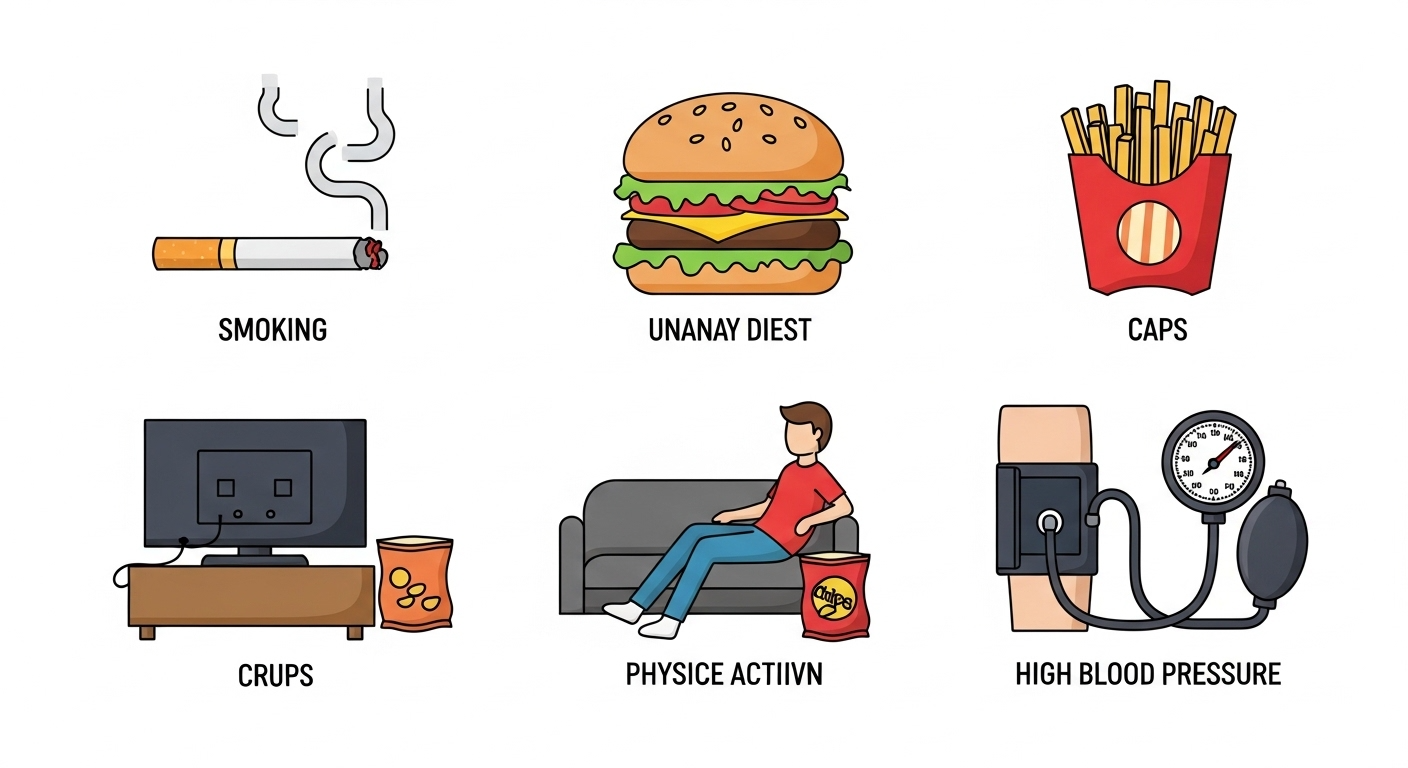
Scientists combing through data from tens of thousands of people found the same pattern again and again. When they asked who had suffered a heart attack or stroke, and why, the answer was almost brutally simple. Most of the risk traced back to four things:
High blood pressure
Unhealthy blood fats and blood sugar
Smoking
Physical inactivity
Not fate. Not bad luck. Not mystery. Choices, environments, and quiet numbers on lab reports that many of us glance at once a year and then forget. Understanding each one — what it does inside your body and why it matters — is the first step toward actually changing the outcome.
The First Risk Factor: High Blood Pressure You Cannot Feel
Blood pressure is one of those phrases we hear so often it starts to sound like background noise. Numbers the nurse mumbles as she unwraps the cuff from your arm. 130 over 80. 142 over 92. Numbers that hover in the air for a second and then disappear as you step back into your day thinking about parking meters and deadlines.
But inside your arteries, those numbers are anything but abstract. They represent the force of your blood striking the vessel walls, again and again, second after second, year after year. A gentle stream polishes stone. A relentless, over-pressurized river carves cracks, creates turbulence, and roughens the once-smooth inner lining of your arteries. Those microscopic tears become places where fatty deposits cling and inflammation takes root.
You do not feel high blood pressure the way you feel a headache or a sore throat. That is what makes it so dangerous. You can be sitting under a sunlit window with a cup of tea, your life feeling relatively calm, while deep in your chest your blood is pushing too fiercely against its confines, quietly reshaping the architecture of your vessels.
| Blood Pressure Category | Systolic (Top Number) | Diastolic (Bottom Number) | What It Means |
|---|---|---|---|
| Normal | Less than 120 | Less than 80 | Low risk, vessel walls preserved |
| Elevated | 120 to 129 | Less than 80 | Early damage begins |
| High Stage 1 | 130 to 139 | 80 to 89 | Risk climbs noticeably |
| High Stage 2 | 140 or higher | 90 or higher | Heart attack and stroke risk soars |
Too much salt and ultra-processed food. Too much sitting and too little movement. Chronic stress that never fully resolves. Poor sleep cut short by alarms and screens. Each of these adds quiet pressure to the system, turning up the volume on your internal storm. The first step out of danger is as quiet as the drift into it: checking your numbers and listening when they whisper instead of waiting for them to roar.
The Second Risk Factor: Unhealthy Blood Fats and Blood Sugar
High cholesterol. High triglycerides. High blood sugar. These terms have become so familiar they blur together into abstract medical wallpaper. But if you could shrink down and drift through your own bloodstream, you would see something startling.
Instead of a clean, clear flow, you might find a thicker, cloudier river. Tiny droplets of fat, some harmless, some dangerously sticky. Sugar molecules bumping along in such high numbers that they begin to damage the very lining of the vessels they travel through. Where the artery wall is already roughened by high blood pressure or inflammation, these fats cling and quietly build into plaque.
Over time, the channel narrows. The blood has to push harder. Sometimes a piece of plaque ruptures and a clot forms. If that clot travels to a coronary artery or a fragile vessel in the brain, the story can change in a single breath.
Our relationship with food is rarely simple. We eat for hunger, but also for comfort, celebration, and relief. Over time, those habits rewrite the blood. LDL cholesterol, the kind that likes to stick to artery walls, rises. HDL cholesterol, the kind that helps clear it away, falls. Blood sugar creeps higher as cells grow quietly resistant to insulin. The lab numbers march up as steady as the tide.
The good news is that the river can change direction. Even small shifts — more whole foods, fewer ultra-processed meals, trading a daily soda for water — start to shape the current differently. Arteries do not become sparkly and new overnight, but the progression slows. Sometimes it partially reverses. The blood moves a little more freely. The future loosens its grip.
The Third Risk Factor: What Smoking Does to Your Arteries
If high blood pressure is a storm and unhealthy blood chemistry is thickened water, smoking is the chemical spill no river can survive. Every inhale delivers a cloud of toxins that scrape and inflame the lining of your arteries. Nicotine tightens those vessels, making them narrower, more reactive, and more brittle. Carbon monoxide steals oxygen from your red blood cells, forcing your heart to work harder just to deliver the same breath of life to your muscles and brain.
Under a microscope, a smoker’s arteries look older than their owner’s face. The walls thicken. Plaque builds faster. Clots are more likely to form and more likely to stick. The entire cardiovascular system lives on a shorter fuse.
And yet, almost unbelievably, the body responds quickly when the smoke clears. Within days of quitting, blood pressure and heart rate begin to ease. Over weeks and months, circulation improves. Within a year or two, the risk of heart attack and stroke drops dramatically. The body, patient and persistent, keeps trying to rebuild.
For many people, quitting feels as impossible as rerouting an entire river by hand. Nicotine wraps itself not just around brain chemistry but around routines, friendships, and stress. Still, somewhere between one cigarette and the next, there is always a choice that becomes the beginning of the end of smoking. A grandchild’s drawing. A partner’s quiet plea. The sudden awareness that you would like to walk up a hill without stopping to catch your breath.
That single choice, repeated again the next day and the next craving, removes one of the largest single contributors to cardiovascular disease. One habit. One risk factor. Pulled like a rusted nail from the foundation.
The Fourth Risk Factor: A Body Built to Move That Has Stopped Moving
We are creatures shaped by movement. Our ancestors’ days were written in footpaths, in the steady rhythm of walking, lifting, reaching, and climbing. The heart was never meant to be a reluctant motor idling under a still chassis. It was made to be an eager partner, rising to meet each hill and each stretch of open ground.
Modern life has traded most of that landscape for chairs. Kitchen chairs, office chairs, car seats, and couches. We wake, sit, move a little, and sit again. The distances we travel are often measured not in footsteps but in screens scrolled.
Physical inactivity quietly narrows the riverbed. Muscles weaken, making every movement slightly harder, which makes us less likely to move, which weakens them further. The metabolism slows. Blood fats and sugars drift higher. Blood pressure creeps up. The heart, underused, becomes less resilient and less ready for sudden demands.
Many people imagine exercise as a kind of punishment: sweating under harsh lights, paying for every guilty snack. But the body does not understand it that way. When you walk, your arteries feel the gentler rhythm of blood flow. When you climb a flight of stairs, your heart learns to stretch and contract more efficiently. When you dance in your kitchen, garden, or ride a bike to the corner store, you are reminding your body what it was built for.
Even modest movement changes everything. Ten minutes here, fifteen minutes there. It improves blood pressure. It raises protective HDL cholesterol. It tempers blood sugar spikes. Over weeks and months, the cumulative effect on heart attack and stroke risk is enormous, not because you became an athlete, but because you simply stopped being still.
How These Four Risk Factors Work Together
These four risk factors do not operate in isolation. They feed each other. They magnify each other. High blood pressure damages artery walls, which makes cholesterol deposits more likely to form. Physical inactivity raises blood sugar and blood fats, which raises blood pressure. Smoking accelerates every one of these processes simultaneously.
But here is the crucial insight: because they are connected, changing even one alters the entire system. Quitting smoking lowers blood pressure and improves circulation. Regular movement raises good cholesterol and lowers blood sugar. Eating better reduces blood fats and eases the pressure your heart works under.
Picture your future as a landscape still being drawn. In one version, your arteries carry a clean, resilient flow: the banks cared for, the water moving freely. In another, the river has grown thick and loud, the banks eroded, the water straining through narrow passages. The difference between those two versions is not a single dramatic gesture. It is the accumulation of small, often quiet choices made day after day.
Checking your blood pressure regularly. Knowing your cholesterol and blood sugar not as mysterious codes but as stories about what your body is trying to tell you. Deciding that today will not be the day you smoke. Choosing to walk for ten minutes before dinner. Swapping one hyper-processed snack for something closer to the earth.
None of these choices guarantees anything. Life will always hold its share of mystery and unfairness. Genetics and sheer randomness are still there, moving in the background. But when four modifiable factors explain nearly all of the story of heart attacks and strokes, the message is clear: you are not a passive passenger in your own health.
Your heart, quietly beating as you read this, has never taken a day off. It has carried you through every morning and every midnight of your life. Somewhere today, in a hospital much like that sunlit corridor, someone’s story is crashing into a crisis that started building years ago. For many of them, nobody ever told them that their risk was not a riddle but a set of currents they could learn to read and, to some extent, redirect.
You are hearing that story now. Not as a warning shouted over sirens. As an invitation whispered while the water is still relatively calm.
Frequently Asked Questions
Do these four risk factors really explain almost all heart attacks and strokes?
Large international studies have found that high blood pressure, abnormal blood fats and sugar, smoking, and physical inactivity account for the vast majority of heart attacks and strokes. They do not explain every single case, but they cover most of the risk for most people.
If my genetics are bad, does changing these factors still help?
Yes. Genetics may load the dice, but lifestyle and risk factor control decide how often they are rolled. Even people with strong family histories can dramatically reduce their risk by managing these four areas.
What is the single most powerful change I can make?
It depends on your current habits. Quit smoking if you smoke, and control high blood pressure if you have it. Those two steps alone can cut risk sharply. Beyond that, regular movement and healthier eating amplify the benefits further.
How much movement do I really need to protect my heart and brain?
Aim for about 150 minutes a week of moderate activity like brisk walking, roughly 20 to 25 minutes a day. Even less is better than none, and more brings added benefits if your body allows it.
Can I reverse damage that has already been done?
Some changes like hardened plaque cannot be completely undone, but the progression can slow, stall, and in some cases partially reverse. Risk of future heart attacks and strokes can drop quickly once blood pressure, blood chemistry, smoking, and activity levels improve.
Do I need medication or can lifestyle alone be enough?
Some people can manage these risk factors with lifestyle changes alone, especially if problems are mild and caught early. Others need medication as well. Often the best results come from a combination of both, guided by a healthcare professional.
What is the first small step I can take today?
Pick one thing that feels doable. Check your blood pressure. Take a ten-minute walk. Smoke one fewer cigarette than yesterday. Swap one processed snack for something fresher. Let the river feel even a small change in its flow and build from there.