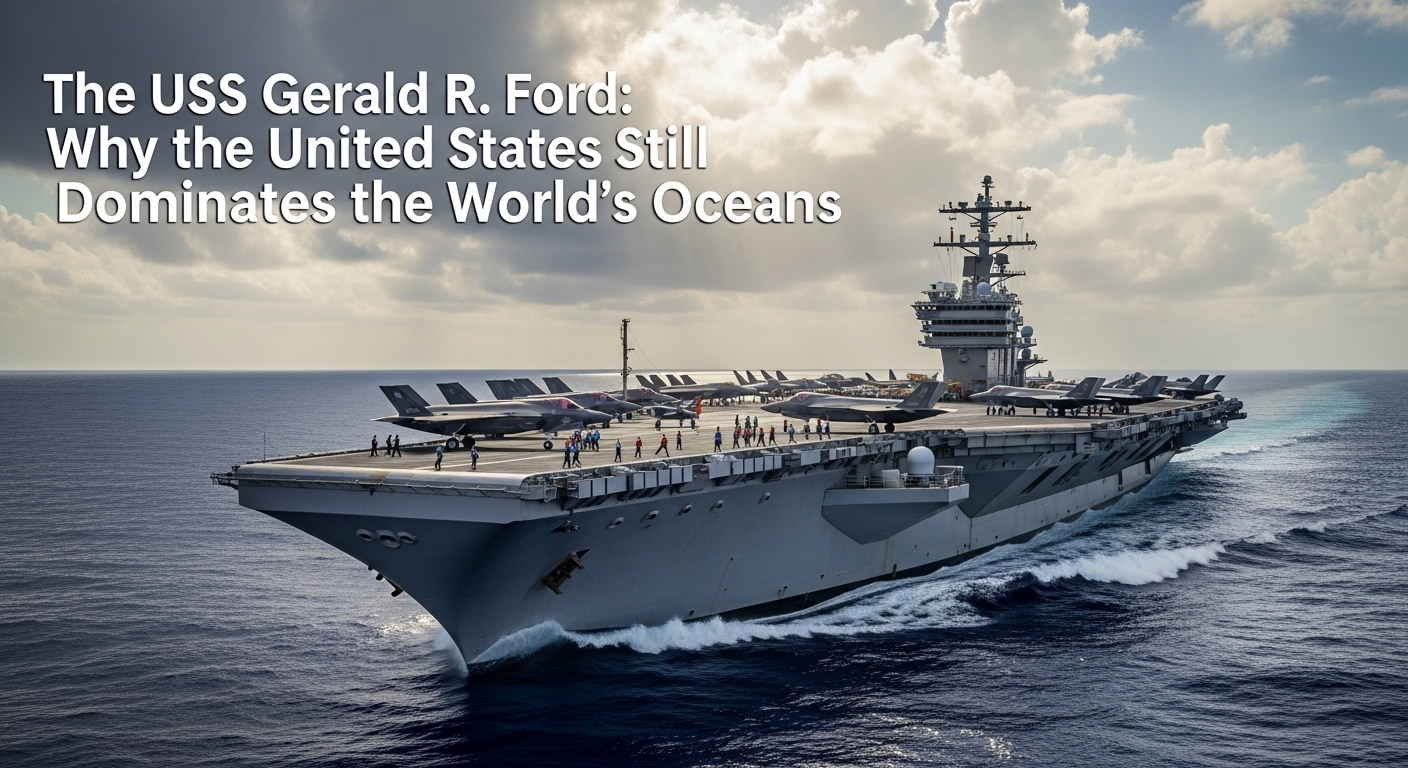
The USS Gerald R. Ford: Why the United States Still Dominates the World’s Oceans
The USS Gerald R. Ford is not just a ship. It is one of the most powerful statements of military strength ever built, and it is heading into active service.
Carrying up to 5,000 sailors and bristling with next-generation weapons and aircraft, this carrier is forcing rival nations, including China, to take notice.
The Largest Aircraft Carrier Ever Built
The USS Gerald R. Ford is the lead vessel of a new carrier class, designed to replace the ageing Nimitz-class ships that have served the US Navy for decades. It displaces over 100,000 tons and stretches nearly 1,100 feet from bow to stern.
To put that in perspective, this ship is longer than three football fields placed end to end. Its sheer scale alone makes it the most imposing naval vessel on water today.
A Leap Forward in Naval Technology
What truly separates this carrier from anything before it is its advanced technological systems. The ship uses electromagnetic aircraft launch catapults, replacing the old steam-powered systems that limited how quickly aircraft could be deployed.
Its radar, combat management, and propulsion systems have all been rebuilt from the ground up. Every system on board was engineered to be faster, more efficient, and more capable than anything in the current fleet.
Key Specifications at a Glance
| Specification | Detail |
|---|---|
| Displacement | 100,000 plus tons |
| Length | 1,092 feet |
| Beam | 256 feet |
| Top Speed | 30 plus knots |
| Crew Capacity | Up to 5,000 sailors |
| Aircraft Capacity | 75 plus aircraft |
| Propulsion | 2 nuclear reactors |
How It Compares to Previous Carriers
The Ford-class represents a significant step up from its predecessors in almost every measurable way. The table below outlines the key differences.
| Feature | Nimitz-Class | Ford-Class (Gerald R. Ford) |
|---|---|---|
| Aircraft Launch System | Steam catapult | Electromagnetic catapult |
| Sortie Rate | Standard | Up to 25 percent higher |
| Crew Required | Larger crew needed | Reduced crew through automation |
| Reactor Technology | Older nuclear design | Advanced nuclear propulsion |
| Combat Systems | Legacy radar | Next-generation radar suite |
The sortie rate improvement alone is significant. A higher sortie rate means more aircraft in the air, more firepower delivered, and more pressure on any adversary.
A Direct Message to China
The timing of this carrier entering service is not accidental. China has been expanding its naval presence aggressively across the South China Sea and into broader Pacific waters over recent years.
The US response has been measured but clear. Deploying the most advanced aircraft carrier ever built is a strategic signal that Washington intends to hold its position as the world’s leading maritime power.
Naval Supremacy in the 21st Century
Control of the seas has always shaped global trade, military strategy, and geopolitical influence. In today’s environment, freedom of navigation across key waterways is directly tied to economic security for dozens of nations.
The Gerald R. Ford and its carrier strike group give the United States the ability to project overwhelming force to virtually any point on the globe within days. That capability is difficult to match and even harder to counter.
The Human Side of a Naval Giant
Behind the technology and the strategy are the thousands of men and women who will operate this vessel every day. From fighter pilots to nuclear engineers, the crew represents the full depth of American military expertise.
Training programs for the Ford-class are among the most intensive in US naval history. The complexity of the ship demands a level of skill and readiness that takes years to develop.
What This Means for Allied Nations
For US allies in the Indo-Pacific and beyond, the Gerald R. Ford’s deployment carries real weight. Australia, Japan, South Korea, and the Philippines all benefit from American naval presence as a stabilising force in the region.
A carrier of this scale operating in the Pacific strengthens deterrence across the board. It raises the cost of any aggressive action and reassures partners that American commitments remain firm.
Investment in Long-Term Naval Power
The Ford-class program represents one of the largest defence investments in modern American history. Building, crewing, and sustaining a vessel of this complexity requires billions in ongoing funding and a vast industrial base.
That investment is also economic. The shipbuilding, engineering, and technology sectors that support the Ford-class employ tens of thousands of skilled workers across multiple US states.
The Ripple Effect on Global Naval Strategy
Other major powers are watching closely. Russia and China have both accelerated their own carrier development programs in response to American advances, though neither has matched the scale or capability of the Ford-class.
The gap in naval technology and operational experience remains substantial. The United States has operated carrier strike groups for generations, building doctrine, logistics, and expertise that cannot be replicated quickly.
Frequently Asked Questions
What makes the USS Gerald R. Ford different from older US carriers? The Ford-class introduces electromagnetic launch catapults, advanced radar systems, and a reduced crew requirement through automation. These upgrades allow the ship to launch more aircraft faster and operate more efficiently than the Nimitz-class it replaces.
How many sailors does the USS Gerald R. Ford carry? The carrier can accommodate up to 5,000 personnel, including the ship’s crew, air wing staff, and support teams. This makes it one of the largest self-contained military communities afloat.
Why is this carrier significant in relation to China? China has been expanding its naval capabilities and territorial claims across the South China Sea. The Gerald R. Ford’s deployment signals that the United States is maintaining and upgrading its ability to project power in the region and beyond.
How does the electromagnetic launch system improve operations? The Electromagnetic Aircraft Launch System, or EALS, allows for smoother and faster aircraft launches than traditional steam catapults. It also puts less stress on aircraft frames, extending the lifespan of the planes themselves.
What is a carrier strike group? A carrier strike group typically includes the aircraft carrier, several destroyers, a cruiser, submarines, and supply ships. Together they form a mobile, self-sustaining force capable of projecting power across thousands of miles of ocean.
When will the USS Gerald R. Ford be fully operational? The ship has been undergoing sea trials and systems testing and is in the process of entering full active service with the US Navy. More Ford-class carriers are also in various stages of construction and commissioning.
How does this carrier affect the balance of power in the Indo-Pacific? The Gerald R. Ford’s presence in the Indo-Pacific strengthens US deterrence significantly. It reassures allies like Australia and Japan while raising the strategic cost for any nation considering aggressive action against American interests or partner nations in the region.
Conclusion
The USS Gerald R. Ford is more than the world’s largest aircraft carrier. It is a deliberate statement of strategic intent at a time when global competition for maritime influence is intensifying.
For the United States and its allies, this ship represents both a technological achievement and a long-term commitment to naval dominance. As it enters service, the balance of power on the world’s oceans remains firmly anchored to American capability and resolve.
Read more: https://wizemind.com.au/