The US Director of National Intelligence Earns €177,000 a Year and Couldn’t Stop a Hacker from Stealing Her Passwords
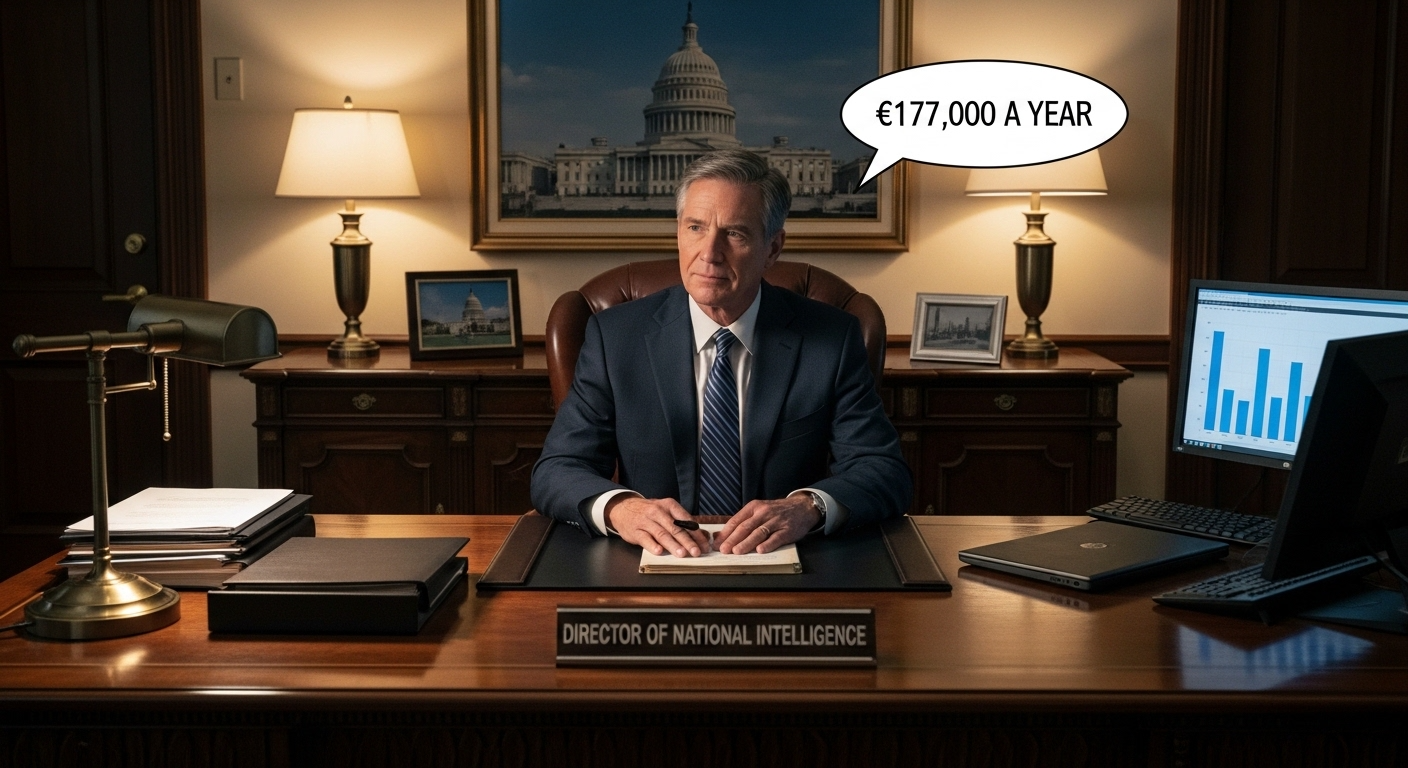
The story begins, as too many modern stories do, with a quiet click. Somewhere in a tidy Washington DC neighbourhood, the Director of National Intelligence, one of the most powerful people in the American security apparatus and earning around €177,000 a year, pressed a key, opened a laptop, and stepped into the churning ocean that is the internet. On the other side of that digital sea, invisible and patient, someone else was waiting. Not another government. Not an elite rival spy service. Just one more hacker in a world full of them, fingers hovering over a keyboard, watching for the tiniest mistake.
The Salary, the Title, and the Illusion of Safety
There is something deeply comforting about titles and numbers. Director of National Intelligence sounds like a fortress constructed from acronyms and sealed doors. A €177,000 annual salary sounds like competence, security clearances, long meetings in windowless rooms where people use words like briefing and sensitive compartmented information. We imagine layers of protection around a person like this. Guards, scanners, encrypted communications, passwords too complex to fit inside a normal human memory.
And yet the story that unfolded was disarmingly ordinary. The hacker, by all available accounts, did not require quantum computing or tools borrowed from science fiction. They needed something far simpler. The soft spots that hide in plain sight. Weak passwords, old habits, trusted systems that nobody thinks to question. The DNI’s title, her access, and her considerable salary could not build an invisible shield around her digital life. The internet does not check credentials before deciding who is vulnerable.
Consider that for a moment. The person responsible for coordinating the intelligence agencies of the United States, sitting at the apex of a vast surveillance and security architecture, became vulnerable through something as mundane as a stolen password. In the gap between power and practice, something uncomfortable lives. The recognition that cyber risk is not a specialist problem confined to people who lack resources or training. It is a human problem, and it does not make exceptions for impressive job titles.
The Sound of a Breach
If you have ever had an account compromised, a social media profile hijacked, an email taken over, you remember the particular quality of that experience. It is oddly quiet. No alarms sound in your home. No sirens activate outside your window. The hints are entirely digital. An automated message noting a new login from an unfamiliar location. The sudden failure of your usual password where it had always worked before. Perhaps a friend texting to ask whether you really sent them that link.
For the Director of National Intelligence, that silence would have carried a particular quality of dissonance. Imagine sitting through classified briefings on hostile cyber operations, reading detailed reports on ransomware groups that have paralysed hospitals and infrastructure, approving budget allocations for defensive systems with names that sound like they belong in a techno-thriller. Then, in your own life, something small slips. A password reused from an earlier period. A personal account that never received the same level of protection as official systems. A moment of inattention on a day when too many things were competing for attention at once. And the door swings open.
The hacker steps through. They may not immediately reach for something enormous. They may begin by simply exploring. Testing the same credentials across different services, the way a patient stranger might quietly try every door on a quiet street to identify which one has not been properly locked. Because passwords are creatures of habit, and humans are creatures of repetition, it is often remarkable how far a single successful guess can carry someone who knows how to follow that first thread carefully.
The Human Side of a Digital Failure
We enjoy imagining hackers as shadowy figures in darkened rooms with cascading code illuminating their faces. The reality is usually less cinematic and considerably more mundane. Many successful attacks begin with emails that look entirely unremarkable. Login pages that appear completely normal. A password reset link that arrives at precisely the moment when someone is moving quickly between obligations and not reading carefully.
Perhaps something like that is how this particular breach unfolded. A busy official moving through an ordinary day, and somewhere along the way a small and almost invisible misstep. A password recycled from years earlier. A personal email account that was created before multi-factor authentication became standard and was never updated. A security question whose answer was not nearly as private as it appeared, because questions asking for your mother’s maiden name or the high school you attended were designed for a more private century. In this one, the details of your childhood and family history are often a search away from anyone who is looking.
The sequence is easy to imagine once you understand how these things typically unfold. Credentials tested against a login page. One of them working. A sense of opportunity. A careful push a little further. And on the other side of that exchange, the Director of National Intelligence, for all her access to security expertise and classified threat intelligence, operating inside the same fallible human mind as everyone else.
When Power Meets Passwords
This is where the incident becomes more than an embarrassing anecdote. It becomes a mirror held up to something broader.
The Director of National Intelligence is not just another account holder. She is a symbol of American security policy at the highest level. She sits above a mountain of classified material, surrounded by agencies whose specific mandate is to detect, disrupt, and deter exactly this kind of threat. When someone manages to steal her passwords, even if the immediate material damage is contained, the symbolism is considerable.
It demonstrates that digital defence is not evenly distributed even within the most security-conscious institutions. Official government systems may be locked behind multiple layers of protocol and procedure. But personal accounts are left to individual judgement, individual habit, and individual attention on days when attention is being pulled in seventeen other directions simultaneously. The divide between work-secure and home-casual has blurred substantially, particularly now that phones and personal laptops carry our entire lives in a thin metal and glass shell that goes everywhere with us.
The hacker, importantly, does not care which door is labelled work and which is labelled personal. They care only about which one opens.
Why This Story Stings for Everyone
There is a particular chill in this incident because it removes the comfortable distance that most of us maintain between ourselves and the idea of being compromised.
It is easy to tell yourself that serious hacks happen to someone else. To large corporations with carelessly stored customer data. To international agencies engaged in quiet digital espionage. To abstract targets that exist in news headlines rather than in the texture of daily life. But this story does not permit that distance quite so easily.
If the Director of National Intelligence can be reached this way, what does that suggest about the teacher grading assignments on a personal laptop late at night? The doctor responding to patient messages while scrolling through a social media feed, using the same password in three or four places because there is simply never enough uninterrupted time to address it properly? The student in a busy café, logged into multiple accounts over public Wi-Fi, trusting that nothing bad will happen because nothing bad has happened yet?
Cybersecurity as a word sounds vast and remote, the concern of specialists and government agencies and people in expensive suits. But a stolen password is small and personal and intimate. It knows your email address and your late-night searches and your private conversations and your banking application. This story compresses the enormous scale of national intelligence work down to something as thin and fragile as a string of characters typed into a login box.
What This Reveals About Our Digital Habits
In that compression, there is a genuine wake-up call worth sitting with.
We have built lives that depend on fragile strings of text, many of them recycled across multiple accounts the way a worn-out key gets used for too many doors. We cling to familiar passwords because we are busy and distracted and managing more than any previous generation has been expected to manage simultaneously. We tell ourselves that nobody would bother with us specifically, that the real targets are the people with power and access, people like the DNI. But the pathways that lead sophisticated hackers toward high-value targets very often weave through the accounts of people around them. Assistants, relatives, friends, colleagues who share documents and email threads and digital trust.
The lesson is not that we should feel ashamed of the mistakes we have made or will make. It is that the entire structure of how we manage digital identity is precarious in ways that individual willpower alone cannot fully address. A world in which a national intelligence director and an ordinary citizen can both be undermined by the same category of password mistake is a world in which the problem is systemic, not simply a matter of individual carelessness.
Noting the key differences between what we tend to assume and what this story reveals is useful:
We assume high-ranking officials are perfectly trained and flawlessly protected in all aspects of their digital lives. The reality is that they are as human and as fallible as anyone else, particularly outside formally secured systems. We assume a substantial salary translates into stronger personal security practices. It does not guarantee good habits in the spaces between official responsibilities. We assume that sophisticated cyber threats require sophisticated tools to succeed. They very often succeed through basic credential theft and the exploitation of routine. We assume that intelligence leadership provides some kind of immunity to simple techniques like social engineering. It does not.
The Quiet Architecture of a Better Defence
From this uncomfortable episode, something more constructive can emerge. Because if a single stolen password can unravel the illusion of perfect protection even at the highest levels, then a small number of better habits can begin to rebuild something sturdier in your own digital life, quietly and without fanfare.
The humbling truth embedded in that €177,000 figure is that money can purchase consultants and technology and training programmes, but it cannot replace consistent attention. It cannot force good habits into existence by the authority of a budget line. Even in the highest offices, meaningful security ultimately comes down to repetitive and sometimes tedious personal practices.
Using a different, strong password for every important account. Turning on multi-factor authentication everywhere it is available and not putting off the ten minutes it takes to set it up. Being genuinely cautious with links that arrive in email and messages, particularly those that urge urgency or immediate action. Reviewing regularly which devices and applications have access to your accounts and removing the ones that no longer need it.
None of these steps are glamorous. None of them belong in a thriller about international espionage. But they matter precisely because they represent exactly what many attackers are counting on users to skip. When even a person at the apex of a national intelligence system appears to have been caught short on these fundamentals, the message is clear enough. Nobody is above the basics. The basics are the whole game for most of us, most of the time.
There is something oddly hopeful in that realisation. If the difference between reasonably protected and wide open is not a government salary or a classified security device but a handful of freely available habits that anyone can adopt, then some meaningful degree of power shifts. It moves, at least partially, into the hands of ordinary people who are willing to stop and think for a moment before typing the familiar old password into the familiar empty box one more time.
Reimagining Security as a Shared Landscape
The digital world functions as an ecosystem in the ecological sense. Not a collection of isolated individual users, but a web of connections that extends across people, organisations, time zones, and relationships. The Director of National Intelligence lives inside that web. So do you. So do the people you message and the colleagues who share documents with you and the family members who tag you in photographs.
When a hacker slips into that network through a stolen password, they are not accessing a bounded and isolated box of data. They are stepping into a map of relationships and patterns and connections. An email account is not just a container of messages. It is a navigable record of your life and your associations. A social media login is not just a profile page. It is a doorway into how you communicate and who you extend trust to. In that sense, the breach of a senior official’s accounts is not a distant scandal happening to a powerful person in a faraway city. It is a particularly visible and dramatic example of what is possible in any part of the shared digital environment that all of us inhabit together.
The question becomes less about how this could have happened to her specifically, and more about what it reveals about the kind of world we have collectively built and now all live inside. A world where extraordinary institutional power flows through the same ordinary consumer tools that a teenager uses to post photographs. Where the same cloud services hold family videos and sensitive professional correspondence. Where the same category of password protects both a banking application and a streaming service subscription.
Turning the Story Back Toward Ourselves
It is tempting to treat this incident as a punchline. The framing practically invites one. Big title, substantial salary, basic mistake. But beneath the irony sits a more honest and more useful response, which is recognition.
Because the gap revealed here, the space between what we know we should do and what we actually do on a busy Tuesday afternoon, is deeply familiar to most people who will read about it. Perhaps you have intended to sort out your passwords properly for some time. To finally install a password manager and work through the process of updating everything. To turn on two-factor authentication on the accounts that matter most. To review which applications have accumulated access to your data over the years. Perhaps you started once, but it felt laborious, and life was busy, and nothing had gone wrong yet, so the intention got shelved.
The DNI’s story is a public version of a very private failing that lives quietly in most of us. And that is precisely where it carries some real power. Not as a spectacle to observe from a comfortable distance, but as a reminder that the digital world does not reward inertia or forgive it particularly gently. Attackers need only one successful guess. People protecting their accounts need to be consistently careful across many opportunities for things to go wrong.
There is a peculiar intimacy in contemporary risk. Nobody is forcing a lock in the small hours of the morning. They are slipping into your life through the same glowing rectangle you scroll through when you cannot sleep. They are reading the same login screens you see every single morning. And they are counting on you to continue underestimating how much is genuinely at stake each time you type a familiar and convenient word into that small empty box.
If a person entrusted with a nation’s most sensitive secrets can stumble here, then the rest of us have permission, not to feel defeated, but to take this seriously without shame. To acknowledge that we are not weaker than the Director of National Intelligence. We are simply human in the same ways she is. And being human in the digital age means we will make mistakes. It also means we are entirely capable of learning to make fewer of them, starting with the next time we open a laptop and reach for a password we have used rather too many times before.
Read More: For more technology, cybersecurity, and digital life stories written for Australian readers, visit wizemind.com.au