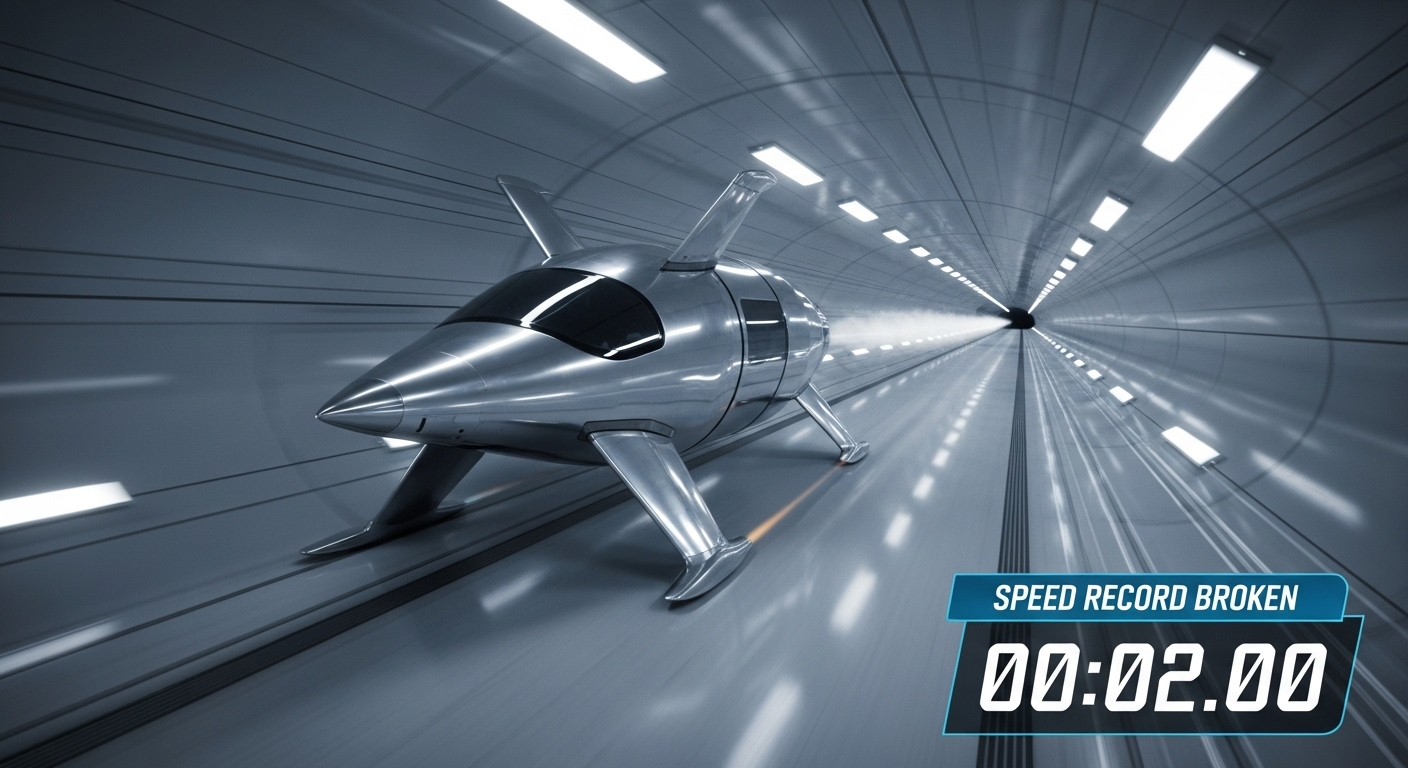
China Just Broke a Hyperloop Speed Record — And It Only Took Two Seconds
There were no fireworks. No big ceremony. No countdown clock.
Just a long silver tube in northern China, a capsule that looked like something from a science fiction film, and a team of engineers watching screens in near-total silence.
Then the numbers started climbing.
In two seconds — the time it takes to glance at your phone and look back up — China’s experimental high-speed train smashed a world record for ground-based travel inside a vacuum tube. And just like that, the future of transport got a little closer.
What Actually Happened
China built a train that runs inside a sealed tube with most of the air pumped out. Less air means less resistance. Less resistance means the train can go much faster without burning enormous energy just pushing air out of the way.
On top of that, the train doesn’t use wheels. It floats using magnets — a technology called magnetic levitation. No wheels grinding on rails means no friction, no vibration, and far less wear and tear. The train is also pushed forward by electric motors built into the track itself, not by an engine onboard.
Put all three things together — vacuum tube, floating magnets, electric track motors — and you have something that sits between a train and a plane. It travels on the ground but moves at speeds closer to aviation than anything rail has achieved before.
Why China and Why Now
China didn’t treat this like a startup project chasing investors. They treated it like building a motorway — slow, methodical, and serious.
They already run some of the fastest high-speed rail and maglev lines in the world. That gave their engineers decades of experience to draw on. When they turned that knowledge toward a vacuum tube system, they built a proper long test track, packed it with sensors, and pushed the technology hard — not for a flashy video, but for real data.
The world record is the headline. The data is the point.
What It Could Feel Like to Ride One
Imagine boarding a capsule at a station that looks more like a small quiet airport than a train platform. The door closes softly. There’s no rumble of wheels, no screeching brakes, no wind noise.
You feel a smooth, firm push — like a lift going sideways — as the speed climbs to 300, then 600, then beyond 800 kilometres per hour. There’s no turbulence. No rattling. Just clean, quiet motion.
Forty minutes later, the door opens. You step out in a city that used to be a four-hour train ride away. It already feels almost ordinary.
That’s the promise behind this record.
The Big Questions It Doesn’t Answer Yet
This record is impressive, but it solves the easy part of the problem. The hard parts are still ahead.
What happens in an emergency inside a sealed tube at 900 km/h? How do you evacuate passengers safely? How much would it cost to build hundreds of kilometres of precision vacuum tube across mountains and rivers? Who pays for it? And what happens to the towns that don’t get a station?
These aren’t reasons to dismiss the technology. They’re the real work that comes next. The record proves the physics work. Now engineers, governments, and planners have to prove the rest.
What Happens From Here
After a record like this, the next steps are more tests, more data, and eventually a short demonstration line built for real passengers. If that works, the argument for a bigger network begins.
It took Europe’s high-speed rail network thirty years to grow into what it is today. Vacuum-tube transport will likely take at least as long — probably longer. This is a technology for the next generation, not the next election cycle.
But it is moving. And two seconds in a Chinese test facility just made the conversation a great deal more serious.
Frequently Asked Questions
What record did China break? China set a new speed record for a full-scale vehicle travelling inside a near-vacuum tube using magnetic levitation, beating all previous benchmarks for this type of ground transport system.
How is this different from a normal fast train? Normal high-speed trains use steel wheels on rails in open air. Air drag becomes a huge problem above about 350 km/h. China’s system removes most of the air, floats the train with magnets, and drives it with electric track motors — cutting the main barriers to higher speed dramatically.
Is it safe? The basic physics and hardware have now been proven at record speeds. The full safety systems needed for passenger travel — emergency braking, evacuation procedures, long-term structural reliability — are still being developed and tested.
When could people actually ride one? A demonstration line could realistically appear within ten to fifteen years in China. A wider commercial network would take several decades. This is a long-term project, not a near-term product.
Why is China leading this? China combines world-class rail and maglev expertise, the ability to fund enormous infrastructure projects centrally, and a long planning horizon that allows investment in technology before it turns a profit. Most Western hyperloop companies that tried a commercial approach in the 2010s scaled back or shut down entirely.