Seniors and Backyard Spas: Deck Collapse Risks Rise Without Load Calculations
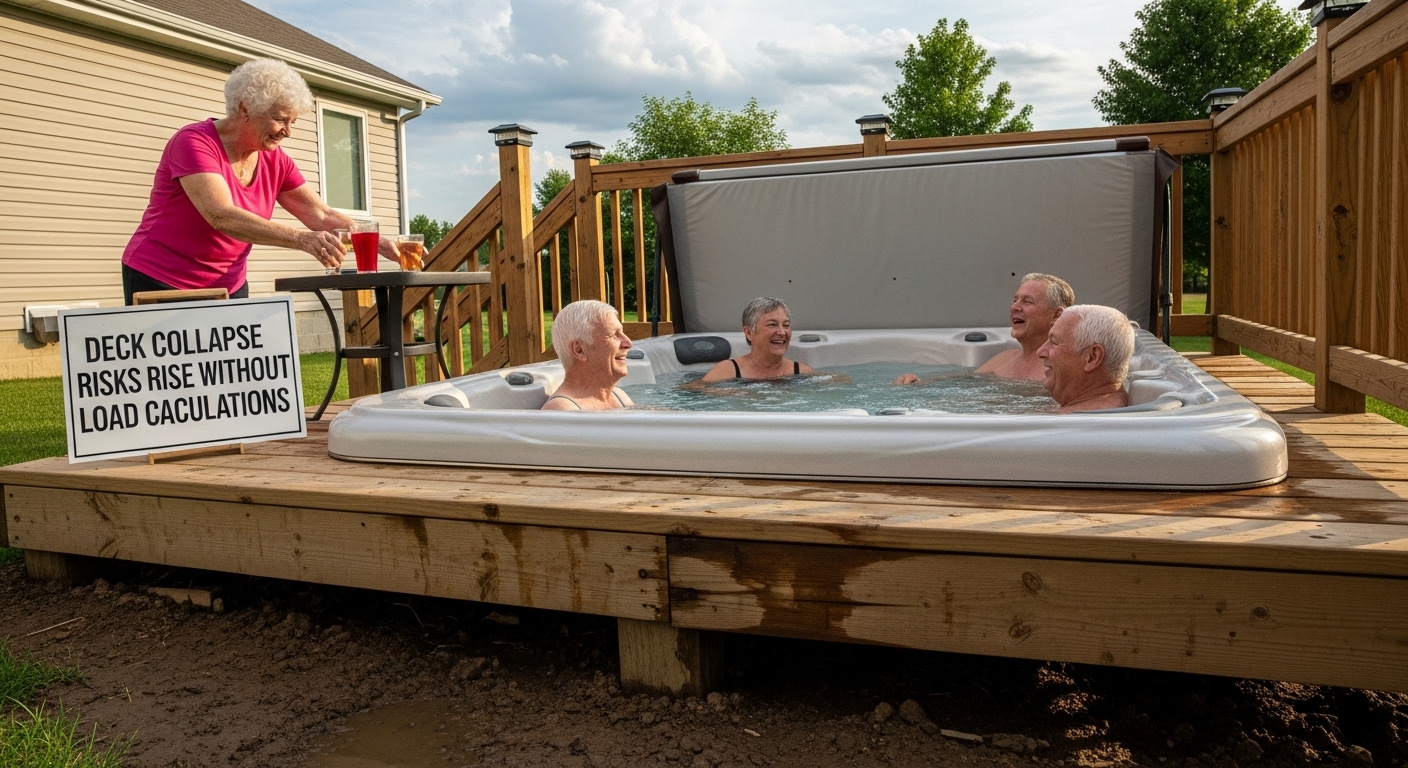
The first time Helen pressed the little round button on the spa control panel, she flinched. The jets rumbled to life, water frothed white, and a soft plume of steam rose into the cool evening air. Her backyard, once just a rectangle of weathered decking and a stubborn maple tree, suddenly felt like a private hot spring. A robin called from the fence, the neighbour’s wind chimes moved in the breeze, and for a moment the pain in her knees faded beneath the warm and buoyant water. At seventy-six, Helen thought, this is what they mean by quality of life.
The Lure of Warm Water and Easy Evenings
Spend time around older adults and you notice how their conversations gradually bend toward aches and stiffness the way a creek bends toward the sea. The hips that were once completely reliable become unpredictable. The shoulders that hoisted children and heavy shopping bags without a second thought now protest at the slightest provocation. A backyard spa, that glowing and bubbling square of comfort, promises something genuinely irresistible. Relief without leaving home.
It is no surprise that more seniors are installing hot tubs and spas on backyard decks. They are told about improved circulation, relaxed muscles, and better sleep. They imagine quiet evenings under open sky, the simple and uncomplicated joy of slipping into warm water rather than into another waiting room chair.
But beneath the glowing water and the outdoor lighting, under the smooth deck boards and the tasteful railings, another story is quietly unfolding. One about weight, timber, and the invisible mathematics that holds everything up. It is a story most people never hear until something goes seriously wrong.
The Weight You Cannot See
Helen’s spa looked almost delicate tucked into the corner of her deck. The fibreglass shell had a gentle sheen, the steps were narrow, the cover snug and efficient. It seemed, to any casual observer, no more demanding on the structure beneath it than a picnic table.
Yet every time it filled, Helen’s spa was carrying the weight of a small car.
Water weighs approximately 8.34 pounds per gallon. A modest 300-gallon spa tips the scale at well over 2,500 pounds once you add the shell, the pumps, and a couple of guests sitting in it. A larger spa can reach 4,000 pounds or considerably more, all of it concentrated into a tight rectangle on your deck.
To a structural professional that number is not an opinion. It is a load. To your deck it is a direct question. Can you actually carry this, day and night, through every season, for years at a stretch?
For many seniors, the deck beneath their new spa is not young either. It might have been built when their children were teenagers, long before backyard spas were a common purchase. The timber has absorbed thirty winters and summers, baking and freezing and soaking again in cycles. Fasteners corrode over time. Joists twist gradually. Ledger boards loosen silently from the house wall. And still the new spa arrives with its cheerful installation brochure announcing that it fits on most decks.
Backyard Spas and the Hidden Physics of Ageing Decks
In the golden light of a summer evening it is easy to forget that a deck is essentially a small bridge. An elevated platform engineered to carry weight safely across a span. Decks may look simple, but they balance forces, distribute loads, and depend on every component performing its quiet and unglamorous job. When you add a spa, especially for seniors who rely on railings and steps for balance and stability, you are asking that bridge to carry considerably more than it was ever designed to support.
Many older decks were built to handle roughly 40 pounds per square foot as a general live load. A few people, some outdoor furniture, perhaps a gas barbecue. A filled spa can push that figure to 100 pounds per square foot or more across a concentrated area. That is the structural equivalent of crowding a large group of adults into one small corner of the deck and asking them to stand there permanently.
The problem is not weight alone. It is the way that weight concentrates in a single location. The joist sitting directly beneath the spa may be deflecting far more than the one under the outdoor table. The posts that once felt solid now carry a quietly different and heavier demand. The connections that were perfectly adequate for normal deck use may be approaching failure.
For seniors this structural risk carries a sharper edge than it does for younger users. Older adults typically move more slowly, are more vulnerable to falls, and are less able to absorb the shock of a sudden unexpected movement. If a railing pulls loose or a section of decking sags without warning, the outcome for an older adult can be genuinely catastrophic. Fractures, head injuries, extended hospital stays. The very space that was installed to ease an ageing body can become the origin of a serious and life-altering injury.
Why Load Calculations Matter More with Age
In building terms, a load calculation sounds cold and technical, the kind of thing that happens quietly in the margins of a blueprint. In reality it is something closer to a promise. That the floor beneath you will not give way when you put your weight on it and trust it to hold.
When a spa is placed on a deck without a proper structural assessment, that promise becomes fragile. The risk is rarely immediate. Decks do not usually collapse the moment the spa is filled. Instead they begin a slow and invisible negotiation with gravity across seasons. Joists deflect a little more each year. Fasteners begin to creep. Timber fibres fatigue progressively. On warm evenings everything continues to look perfectly fine, until one day, with a crack or a sudden lurch, it is not fine at all.
Picture the specific scenario that matters here. A senior easing into their spa with one hand on the railing, relying on its steadiness the way they might rely on a walking aid. The deck shifts slightly, just enough to disturb their balance. A foot slips on a wet step and the world suddenly becomes very hard and very fast. Most serious falls for older adults are not dramatic events that unfold in slow motion. They are quick, bewildering, and often permanently life-changing.
This is why load calculations are not simply a matter for engineers and council inspectors. They are a practical and quiet form of respect toward the people who will lean most heavily on this space. The seniors for whom a backyard spa represents not a luxury but a genuine improvement to daily quality of life.
Planning the Safer Spa: A Different Approach
The good news is that this does not have to be a story about creaks and collapses. A backyard spa can absolutely become a safe and genuinely restorative space for older adults. But it needs to be approached with the same care you would give to adding a room to the house, not with the same casualness you might apply to buying a new piece of outdoor furniture.
Picture Helen a few weeks before her spa was delivered. Instead of simply marking out a corner with string and accepting a salesperson’s reassurances, she invites a structural professional to walk the deck with her. They kneel beside the ledger board together, examining the old bolts and looking for rust. They study the posts and joists and the span of the existing framing. Measurements are taken. The spa’s dimensions, its water capacity, the expected number of regular users, all of it feeds into a careful structural assessment.
Out of that process comes a clear recommendation. Reinforce. Add beams in the critical locations, sister a joist beside the existing one, replace the corroded bolts with new fasteners that meet current building standards. Add an additional footing or two so the spa’s concentrated weight travels down into the earth rather than hanging from overhead framing that was never designed for this purpose. It is not glamorous work and it is not visible once the spa is installed. But it is the hidden architecture of genuine peace of mind.
For older adults, that peace of mind is worth considerably more than any feature in the manufacturer’s brochure. It means stepping into warm water without the background presence of doubt. It means knowing the deck has been asked the right questions and has been properly strengthened to answer them honestly.
Spa on Deck Versus Spa at Ground Level
Sometimes the safest option for older adults is not a raised deck installation at all. A spa placed at ground level on a properly prepared concrete pad or reinforced base removes the structural risk of deck loading almost entirely and significantly reduces the consequences of any slip or fall.
Key considerations for each option:
Spa on an existing deck offers convenient access directly from the house and can be visually appealing, but carries substantial risk if no load calculations have been done, and existing step heights and railing standards may not suit older users without modification.
Spa on a purpose-built reinforced deck designed specifically for the installation can create a near-flush entry point and allows proper integration of handrails and pathway lighting, but requires permits, structural design work, and higher upfront cost.
Spa on a ground-level pad eliminates deck collapse risk entirely, reduces the height of any potential fall to almost nothing, and is often the easiest option to make genuinely accessible through gentle ramps and non-slip surfaces. The main trade-off is that it may sit further from the back door and require some landscaping work for safe and comfortable path access.
For seniors with significant mobility challenges, a ground-level installation with a carefully graded and well-lit approach path, solid handrails, and textured non-slip surfaces is often the quietly brilliant choice that no brochure ever highlights.
When the Deck Is Telling You Something
Even without a tape measure or an engineering background, an ageing deck often gives visible signals that it is under stress. Seniors and their families can learn to recognise these signs long before they become dangerous.
Sagging or a bouncy feeling underfoot near the spa suggests the structure may already be overstressed and deserves immediate professional attention. Cracking sounds, particularly sharp new sounds or persistent groaning when several people are in the spa at once, are not normal and should not be dismissed. Loose or wobbly railings are a direct safety concern for anyone relying on them for balance, and any movement in a railing near the spa area is a red flag rather than a minor inconvenience. Corroded hardware including rusted bolts, nails backing out of the timber, or metal joist hangers showing obvious surface corrosion all reduce structural strength, particularly under concentrated loads. Rot and soft spots in posts at ground level, in joists near the house wall, and in ledger board attachments are among the most common failure points in older decks, and if a screwdriver can be pressed easily into the timber surface, the support it provides may already be seriously compromised.
Noticing any of these is not cause for immediate alarm. It is an invitation to pause and call for a professional assessment before using the spa again. A trained eye can often identify straightforward reinforcement options that restore full safety without requiring everything to be torn out and rebuilt from scratch.
Designing for Dignity: The Details That Matter
Conversations about seniors and backyard spas tend to focus on the appealing features, the LED lighting, the water features, the sound systems, the jet configurations. The genuine safety magic, however, lies in much quieter choices.
A gently sloped ramp from the back door to the spa area, not too steep and not too long, removes the challenge of steps on a wet and potentially slippery night. Low diffused pathway lighting that is bright enough to reveal wet surfaces and level changes while soft enough to preserve the atmosphere makes the approach genuinely safe rather than merely attractive. Deck and path surfaces that are textured and slip-resistant reduce the risk of falls in the wet environment that inevitably surrounds any spa installation.
Handrails that are solid, properly anchored, and positioned where a person naturally reaches when moving between standing and seated give older users genuine confidence rather than the false security of a rail that wobbles under load. A spa that is partially recessed into the deck surface so that entry is closer to seat height removes the high step-over that is one of the most common points of stumble and fall for older users. A grab bar mounted at the natural point where a hand reaches during entry and exit completes the movement safely. A cover lifter mechanism that operates smoothly without requiring significant strength or awkward body positioning means an older adult can open and prepare their spa independently without wrestling with heavy vinyl and foam.
Each of these choices rests on exactly the same foundation as the structural load calculation beneath the deck. Genuine respect for the realities of an ageing body. The goal is not to remind seniors of what they can no longer do as easily as they once could. It is to remove the obstacles quietly and thoughtfully so they can enjoy what they came for.
The Conversation Families Need to Have
There is a gentle and often unspoken tension in many families around the process of ageing. Adult children worry about their parents but do not want to sound controlling or dismissive of their independence. Seniors value their autonomy and their remaining pleasures but sometimes underestimate the real risks that have quietly accumulated around them.
A backyard spa, dramatically heavy and deceptively simple in appearance, turns out to be an ideal place to practise a different kind of family conversation. Rather than saying that a hot tub is too dangerous and should not happen, the dialogue can begin from a different place. If we are going to do this properly, let us do it in a way that genuinely respects what your body needs now.
That might mean insisting on a structural assessment before any purchase contract is signed. It might mean choosing a smaller model than the one in the showroom, or relocating it to ground level for simpler and safer access. It might mean investing in a proper deck rebuild rather than hoping that timber which has already weathered three decades of Australian seasons has enough left in it.
These are not acts of limitation. They are acts of care. And for seniors, being fully included in those decisions rather than having them made on their behalf quietly and without consultation can itself feel like a meaningful form of respect.
When Helen finally settled into her spa for the first time, she did so over beams that had been added specifically for her, with bolts tightened by someone who had calculated exactly how much they needed to carry. Her deck had passed through the hands of a professional who had measured not only the pounds and spans but also, in a way that required no spoken acknowledgement, the value of one woman’s quiet evenings free from any reason to worry.
Letting the Water Be What It Should Be
A spa is, in the end, a promise. Between warm water and tired muscles. Between a backyard and the people who have genuinely earned some rest. For seniors that relationship carries particular weight. It holds both the real vulnerability that comes with ageing and the equally real and stubborn desire to keep enjoying simple pleasures on one’s own terms.
To honour that, the structure beneath the spa needs to be as carefully considered as the water above it. Deck collapses are not random misfortunes. They are preventable failures of attention and planning. The phrase load calculation may sound dry and technical, but for older adults it is as immediate and intimate as a solid handrail under the palm on a wet night. As direct and important as a step that does not shift when you put your weight on it.
The steam rising from a backyard spa on a cool evening should not carry the weight of unexamined risk. It should carry only the smell of cedar and the sound of water moving and the particular soft sound of someone finally, completely, letting their muscles release. The mathematics that makes that possible belongs entirely behind the scenes, finished and checked and trusted, so that the story unfolding above the deck is the one that brought everyone there in the first place. Warmth, ease, and the quiet and profound luxury of feeling genuinely safe at home.
Read More: For more health, safety, and lifestyle advice written for Australian readers, visit wizemind.com.au