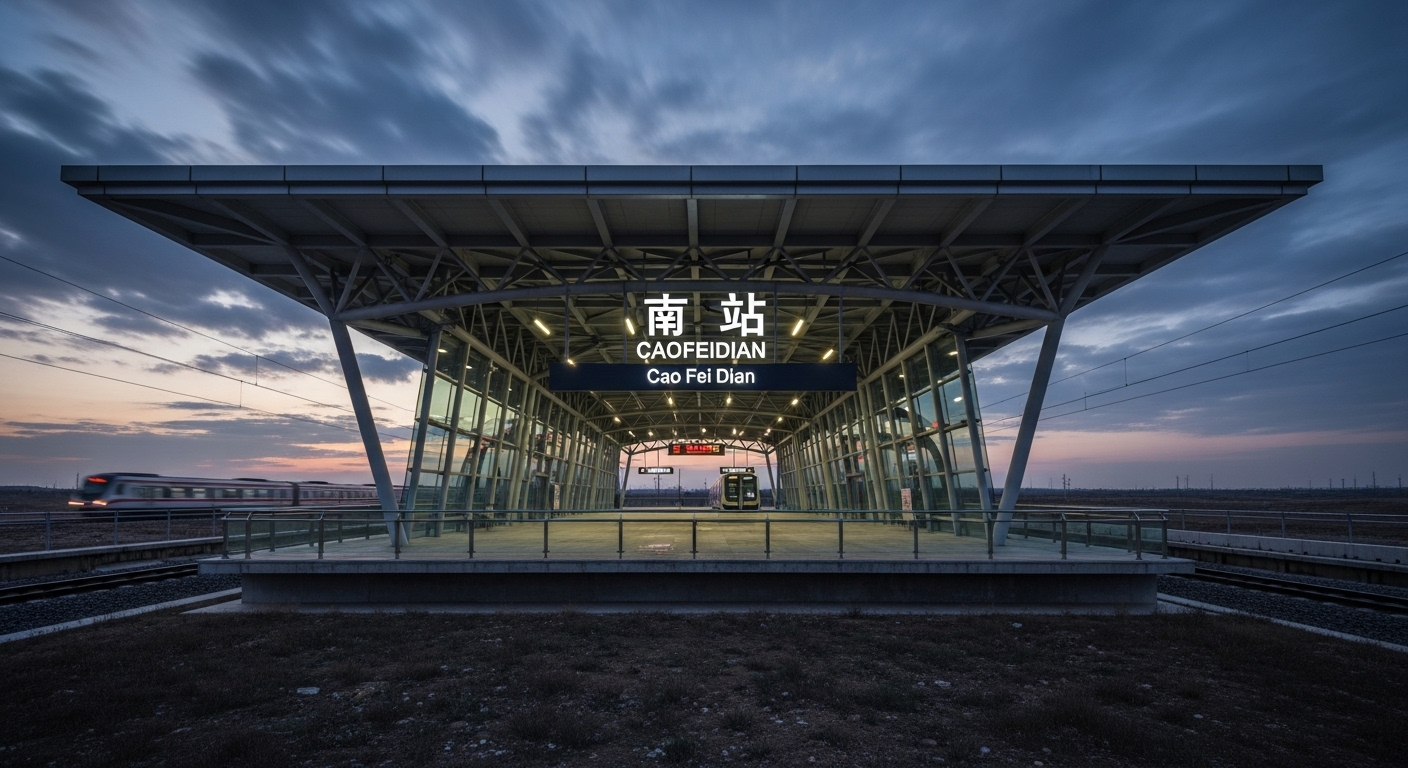
In 2008 China Built Metro Stations in the Middle of Nowhere
The train station stood completely silent. No commuters. No footsteps. No announcements echoing through the halls. Just an empty platform surrounded by farmland, rising out of the landscape like a structure that had somehow arrived decades before anyone had asked for it.
These were China’s so-called ghost stations. And for years, nobody outside the Chinese government fully understood why they existed.
What Were the Ghost Stations?
Starting around 2008, China began constructing metro stations in locations that had no obvious reason to have them. Fields. Forests. The edges of deserts. Sparse countryside where the nearest significant population center was sometimes many kilometers away.
From the outside, the project looked like a spectacular waste of money. Critics at home and abroad questioned the logic of pouring billions into infrastructure that served almost no one. The stations sat largely unused, their escalators running for nobody, their platforms empty during rush hour.
What was actually happening was something far more deliberate. China was not building for the present. It was building for a future it had already decided would happen.
The Numbers Behind the Vision
The scale of this experiment is worth understanding clearly before examining the reasoning behind it.
| Metric | Figure |
|---|---|
| Estimated ghost stations built | Over 100 |
| Total investment | Estimated $24 billion USD |
| Percentage now active | Over 80% |
| Estimated population now served | Over 10 million |
These are not the numbers of a failed experiment. They are the numbers of a long-term bet that paid off at an extraordinary scale. But in 2008, standing on one of those empty platforms surrounded by nothing, that outcome was far from obvious.
The Strategy Behind the Silence
Urban planning experts who have studied the ghost station program describe it in consistent terms. China was thinking in decades, not years. The government had analyzed where its cities were likely to expand, where population would shift as urbanization accelerated, and where the transport infrastructure would need to be if those expansions were to function properly.
The fundamental insight was straightforward even if the execution was bold. Building infrastructure after a city expands is significantly harder and more expensive than building it before. Land is cheaper before development arrives. Disruption is lower when construction does not have to thread through established neighborhoods. And the presence of a metro station actively accelerates the development around it rather than simply serving development that already exists.
By planting the stations first, China was using infrastructure as a tool to shape urban growth rather than simply responding to it. The ghost stations were not evidence of poor planning. They were the plan.
How the Stations Came to Life
The transformation of these stations from empty structures to busy community anchors did not happen overnight. But it did happen, and it happened with remarkable consistency across different cities and regions.
As China’s urbanization accelerated through the 2010s, millions of people moved toward cities in search of economic opportunity. Developers, looking for affordable land adjacent to existing transport infrastructure, found the ghost station zones exactly the kind of opportunity they were looking for. Residential towers went up. Commercial districts followed. Schools, hospitals, and businesses arrived.
One local resident in a formerly rural area described the change simply. The station had been there for years before anyone paid attention to it. Then suddenly it was at the center of everything. The shops, the businesses, the apartment blocks. The whole neighborhood had organized itself around the station as if it had always been there.
That is precisely what the planners had designed it to do.
Read More: https://wizemind.com.au
The Comparison That Tells the Story
Looking at how these stations changed between 2008 and 2022 makes the strategy legible in a way that abstract planning language cannot.
| Category | 2008 | 2022 |
|---|---|---|
| Active stations | 0 | Over 80 |
| Surrounding population density | Sparse | Thriving |
| Economic activity nearby | Limited | Bustling |
| Public perception of project | Wasteful | Strategic |
The shift in public perception is as significant as any of the physical metrics. What looked like overreach and poor governance in 2008 is now widely studied as one of the most successful examples of anticipatory urban infrastructure planning in modern history.
The Risks That Were Real
It would be misleading to present this as a straightforward success story without acknowledging the genuine risks that existed. The Chinese government was betting billions on growth patterns that were projections, not certainties.
If urbanization had slowed, if economic conditions had changed dramatically, or if development had moved in different directions than the models predicted, many of these stations could have remained empty indefinitely. The criticism they attracted was not entirely unreasonable given what was visible at the time.
Policy experts who studied the project noted that China was willing to absorb this risk because it understood the potential payoff. A network of thriving, well-connected cities capable of supporting hundreds of millions of new urban residents would generate returns that dwarfed the infrastructure investment many times over. The calculation proved correct.
The Environmental Question That Remains
The ghost station story is not entirely one of triumph. Environmental concerns about the program are legitimate and have not been fully resolved.
The construction of over 100 major metro stations, plus the urban development that followed each one, required enormous quantities of concrete, steel, and other materials. China’s construction-driven growth model has contributed significantly to its carbon footprint over the past two decades, and the ghost station program was part of that broader pattern.
Environmentalists have argued that the same investment in transit-oriented development could have been paired with stronger green building requirements, more green space, and urban designs that prioritized walkability and low-carbon living from the outset rather than retrofitting these principles afterward.
Government officials have responded that dense, compact urban development centered on public transport is ultimately far more sustainable than the alternative of sprawling low-density growth dependent on private vehicles. The long-term carbon mathematics of well-connected urban density, they argue, justifies the short-term construction impact.
What the World Can Learn From China’s Ghost Stations
Urban planners in other countries have been studying the ghost station program carefully for the lessons it offers about how infrastructure investment can actively shape city development rather than passively following it.
The core lessons that emerge consistently are:
- Long-term thinking requires accepting short-term criticism. The ghost stations looked like failures for years before they became successes.
- Infrastructure drives development as much as it serves it. Placing a transit hub in an undeveloped area pulls investment and population toward it.
- The cost of building ahead of demand is lower than the cost of retrofitting infrastructure into a city that has already grown around its absence.
- Scale and commitment matter. A single ghost station would have been an oddity. A coordinated network of them across multiple cities was a strategy.
- Government willingness to absorb long-term risk in exchange for long-term gain is a form of investment that private markets rarely make on their own.
For cities in developing economies facing rapid urbanization, the ghost station model offers a serious alternative to the reactive infrastructure planning that typically leaves new urban populations underserved for decades.
Q&A: China’s Ghost Metro Stations
1. What exactly were China’s ghost stations? Metro stations built in remote or sparsely populated areas, often surrounded by farmland or undeveloped land, as part of a long-term strategy to guide and support future urban growth.
2. Why did China build stations where nobody lived? To anticipate where cities would expand and ensure that transit infrastructure was already in place when development arrived, making urbanization more orderly and less expensive than retrofitting transport into already-crowded areas.
3. How many ghost stations did China build? Estimates suggest over 100 stations were built in this way, representing a total investment of approximately $24 billion USD.
4. Are the stations actually being used now? Over 80 percent of the ghost stations are now active and serving growing populations, with the network estimated to serve over 10 million people.
5. How long did it take for the stations to become useful? Timelines varied by location, but many stations that were empty in 2008 had become functioning community hubs within 10 to 15 years as surrounding development caught up.
6. Was the project criticized at the time? Heavily. Many observers described the stations as a colossal waste of money and questioned whether the growth the government was anticipating would ever materialize in those locations.
7. What role did urbanization play in making the strategy work? China’s rapid urbanization, with millions of people moving toward cities in search of economic opportunity, created the population pressure that filled the areas around ghost stations with residents, businesses, and development.
8. Did developers deliberately build around the ghost stations? Yes. Developers recognized that land near existing metro infrastructure but before significant development had arrived represented significant value opportunity, and construction followed accordingly.
9. What are the environmental concerns about the program? The massive construction required significant concrete and materials, contributing to China’s carbon footprint. Critics argue stronger sustainability requirements should have been embedded in the surrounding development from the beginning.
10. How does the government respond to environmental criticism? By arguing that dense, transit-connected urban development is ultimately more sustainable than low-density sprawl, and that the long-term carbon benefits of compact cities outweigh the construction impact.
11. Could other countries replicate this approach? The strategy is being studied seriously by urban planners internationally, though it requires a level of government capacity, long-term commitment, and willingness to absorb short-term criticism that many democratic governments find difficult.
12. What is the single biggest lesson from the ghost station program? That infrastructure can shape cities rather than simply serve them, and that investing ahead of demand, though politically difficult, can deliver dramatically better outcomes than reactive planning.
13. Were all ghost stations eventually successful? The majority have activated successfully, but outcomes varied by location. Stations in areas where projected growth did not materialize as quickly have taken longer to become active community hubs.
14. How did China decide where to build the ghost stations? Through analysis of urbanization trends, population projections, economic development patterns, and long-term city planning models that identified where growth was most likely to concentrate over the following decades.
15. Is China still using this approach to infrastructure planning? The principles behind the ghost station program continue to influence Chinese urban planning, though the most dramatic phase of building far ahead of demand corresponded with the peak of China’s rapid urbanization in the 2000s and 2010s.