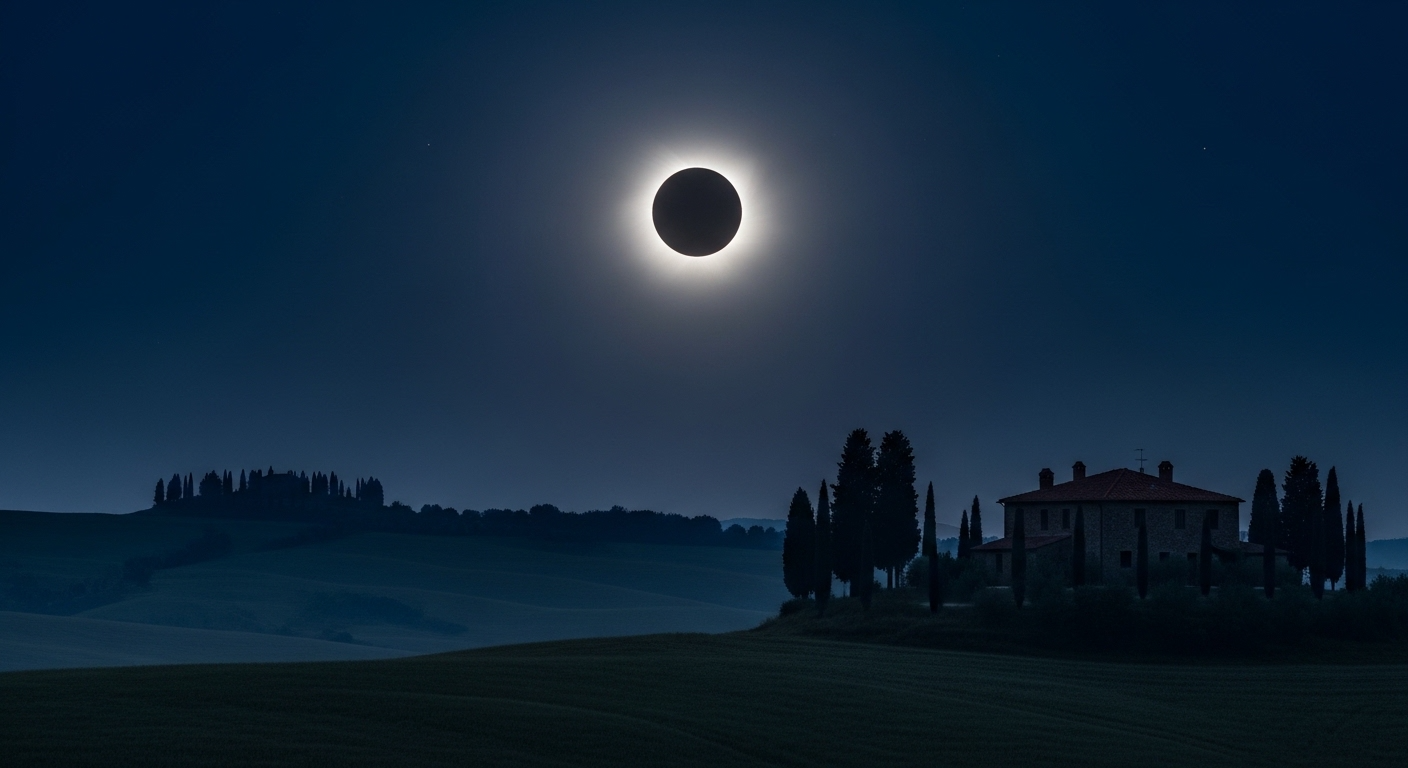
Total Solar Eclipse: Darkness for More Than Six Minutes, the Longest Until 2114, Visible from Italy
Italy is about to experience one of the most remarkable astronomical events in living memory. A total solar eclipse that will last for more than six minutes, the longest period of totality the country will see until the year 2114. For those standing in the path of the Moon’s shadow when it arrives, the middle of the day will become something else entirely. Not night exactly, but a deep and unsettling twilight that no photograph or description has ever quite managed to capture, and that everyone who experiences it tends to remember for the rest of their lives.
This is not a common event. Total solar eclipses happen somewhere on Earth roughly every eighteen months, but any given location on the planet may wait centuries between them. Six minutes of totality is exceptionally rare by any measure. Most total eclipses offer between one and three minutes of complete darkness before the Sun reasserts itself. This one will hold the sky for more than twice that, long enough for the strangeness of the experience to fully settle into the body before it ends.
The Eclipse That Makes Time Feel Different
There is something about a total solar eclipse that defies easy description to anyone who has not stood inside one. The photographs show a black disc ringed with white fire against a darkened sky, and they are genuinely impressive. But they do not convey the thing that everyone who witnesses totality describes first, which is not the visual spectacle but the physical sensation of being inside it.
The world behaves differently during a total eclipse. Street sounds diminish. Animals that were going about their ordinary business fall quiet or begin moving with the uncertainty of creatures who have received a signal they do not understand. The temperature drops several degrees in the space of minutes. The shadows before totality become sharper and stranger than ordinary shadows, acquiring a quality of definition that feels subtly wrong in a way that takes a moment to identify. The air itself carries a different quality, cooler and somehow stilled, as though the atmosphere is holding its breath alongside the people in it.
For more than six uninterrupted minutes this time, all of that will simply continue. The darkness will not flash and vanish. It will settle. And that sustained duration is what makes this particular eclipse something that astronomers and eclipse chasers from around the world are already making travel plans around.
The Hour Before Totality
The approach to a total solar eclipse is as much a part of the experience as the eclipse itself, and it begins well before the dramatic final moments. For roughly an hour before totality, the Moon is progressively covering the face of the Sun. Through eclipse glasses the change is visible and measurable. Without them, and this is part of what makes the experience so psychologically unusual, nothing appears to be wrong at all until the final minutes. The Sun is still bright enough to prevent you from looking directly at it, and the human eye adjusts so efficiently to the gradually dimming light that the change registers first as a feeling rather than an observation.
The quality of the light begins to shift. It becomes thinner and flatter, losing the warm richness of ordinary sunlight and acquiring something cooler and more metallic. Colours in the landscape flatten. Shadows sharpen in ways that feel counterintuitive because the light is clearly diminishing and yet the edges of shadows are becoming more precise rather than softer. This visual contradiction is one of the genuinely disorienting qualities of the pre-eclipse hour, and it tends to produce a mild but persistent sense that something in the ordinary rules of the day is being quietly suspended.
Birds respond before most people notice anything visually. Some species grow restless and loud. Others fall silent mid-song in the way they do at genuine dusk, apparently receiving the dropping light levels and the temperature change as a legitimate signal that the day is ending. Insects follow similar patterns. The natural world does not know this is temporary.
The Final Minutes Before the World Changes
As the last minutes before totality arrive, the pace of change accelerates noticeably. The crescent of remaining Sun shrinks quickly. On the horizon in every direction the sky begins to display something that has no equivalent in ordinary experience: a 360-degree sunset. Because the path of totality is limited in width, the edges of the shadow are always visible from within it, and those edges glow with the orange and pink and deep amber of a conventional sunset, encircling the landscape completely while the sky directly overhead deepens toward indigo and then toward something closer to night.
Streetlights and automatic systems that respond to ambient light begin to activate, confused by data that does not match any pattern they were designed for.
In the final seconds before totality, Baily’s beads appear. These are points of brilliant light along the edge of the Moon’s disc where the Sun’s light is passing through valleys and gaps in the lunar surface rather than being blocked by solid ground. They create a broken necklace of light that lasts only moments before the last bead of sunlight narrows to a single blazing point, the diamond ring effect, a phenomenon that experienced eclipse watchers consistently describe as one of the most beautiful sights in nature. It lasts perhaps two or three seconds. Then it is gone, and totality begins.
At that moment, and only at that moment, it is safe to remove eclipse glasses entirely and look directly at the Sun.
Six Minutes Inside the Shadow
What you see when totality arrives is the solar corona, the outermost atmosphere of the Sun, visible to the naked eye only during a total eclipse because the overwhelming brightness of the solar disc normally makes it completely invisible. The corona is not a static ring of light. It extends outward from the black disc of the Moon in flowing, asymmetric streamers that move and shift in ways that make it look genuinely alive. Its light is faint enough to see comfortably with unaided eyes but bright enough to be clearly visible against the darkened sky, a ghostly, luminous structure surrounding the perfect blackness of the Moon.
The sky during totality is dark enough to reveal stars and planets that are normally invisible during daylight hours. Venus is typically the first to become visible, bright enough to see comfortably. Jupiter may also appear. Brighter stars can sometimes be seen depending on conditions. The sky is not the sky of night exactly. It is darker than twilight but lighter than full dark, a colour and quality that does not have a common name because it only exists inside the shadow of the Moon for the few minutes a total eclipse lasts.
For more than six minutes this time, all of it simply continues. The corona streams. The planets hold their positions. The temperature stays dropped. The birds remain silent or confused. And the people standing in the path of the shadow have time to look, and look again, and look a third time, which is something that shorter eclipses rarely allow before the diamond ring reappears on the opposite edge of the Moon and the world begins reconstructing itself around returning sunlight.
Why This One Lasts So Long
The duration of totality in any given eclipse depends on several converging factors, and getting all of them to align in the most favourable direction simultaneously is what makes events like this so uncommon.
The primary factor is the apparent size of the Moon in the sky relative to the apparent size of the Sun. The Moon’s orbit is not a perfect circle. When it is closer to Earth it appears larger, and a larger apparent disc produces a wider shadow and longer totality. When it is further away the disc is smaller, sometimes small enough that it cannot fully cover the Sun at all, producing an annular eclipse where a ring of solar surface remains visible around the lunar edge throughout.
For this eclipse the Moon will be near the closer end of its orbital range, appearing larger than average in the sky and producing a shadow wide enough to sustain totality across its central path for an extended period. Earth’s own orbital position adds a small additional contribution. When Earth is further from the Sun the solar disc appears slightly smaller, which extends totality marginally. The combination of these factors, each individually modest in its effect but accumulating in the same direction, produces the result that Italy will experience. More than six minutes in the shadow, and nothing comparable expected from the same geography for the better part of a century.
Where to Watch and How to Prepare
The most important practical consideration for anyone planning to watch this eclipse is obtaining proper eclipse glasses before the event. Viewing any partial phase of an eclipse without certified solar filter glasses causes serious and permanent eye damage, and ordinary sunglasses regardless of their darkness provide no protection at all against the specific wavelengths involved. Eclipse glasses certified to the ISO 12312-2 international standard are the only safe option for the partial phases. Only during the brief window of totality itself, when the solar disc is completely covered, is it safe to look with unaided eyes.
Key preparation points for eclipse watchers:
- Purchase ISO-certified eclipse glasses well in advance, as supply typically runs short in the weeks before a major eclipse
- Identify your viewing location early and confirm whether it falls within the path of totality, where the full six-minute darkness will occur, or only in the partial eclipse zone where totality will not be experienced
- Arrive at your chosen viewing spot with time to settle and orient yourself before the partial phases begin
- Plan for the temperature drop during totality by bringing a layer even on a warm day
- Keep eclipse glasses on during all partial phases before and after totality, removing them only when totality is confirmed to have begun and replacing them the moment the first edge of the Sun reappears
Science museums and astronomy organisations across Italy are organising public viewing events with telescopes and expert commentary. These gatherings offer the additional dimension of experiencing the eclipse alongside a large crowd, which adds its own quality to the occasion. The collective gasp of thousands of people at the moment totality arrives is itself something worth being part of.
What the Eclipse Leaves Behind
After totality ends and the Sun slowly reassembles itself over the following hour, the immediate physical strangeness fades quickly. Light returns. Temperature rises. Birds resume whatever they were doing. Streetlights turn off. The world goes back to being the world.
What tends to linger is harder to describe but consistent across the accounts of everyone who has experienced a total solar eclipse. It is not quite like any other experience, and the reason seems to be that it operates on multiple levels simultaneously. It is scientifically explicable and yet viscerally, physically overwhelming in ways that bypass the explaining mind entirely. It is brief enough to feel precious and long enough to be genuinely absorbed. It connects you, in a way that is difficult to articulate but impossible to dismiss, to the specific fact of living on a planet, under a sky, governed by the movements of objects incomprehensibly large and far away that do not know you exist and have been tracing these patterns since long before there was anyone to watch them.
Italy will share this particular eclipse with the sky on a specific date that most people currently alive in the country will see only once. The next one of this duration and character from the same geography will be watched by people not yet born, by children of children who are themselves not yet children, in a century that none of us will see.
That is worth stepping outside for. It is worth the eclipse glasses and the early arrival and the crowd and the waiting. Six minutes of the sky doing something it will not do again in this place for a hundred years is, by any reasonable measure, an invitation that should not be declined.
Read More: For more science stories, astronomy features, and natural wonders coverage written for Australian readers, visit wizemind.com.au