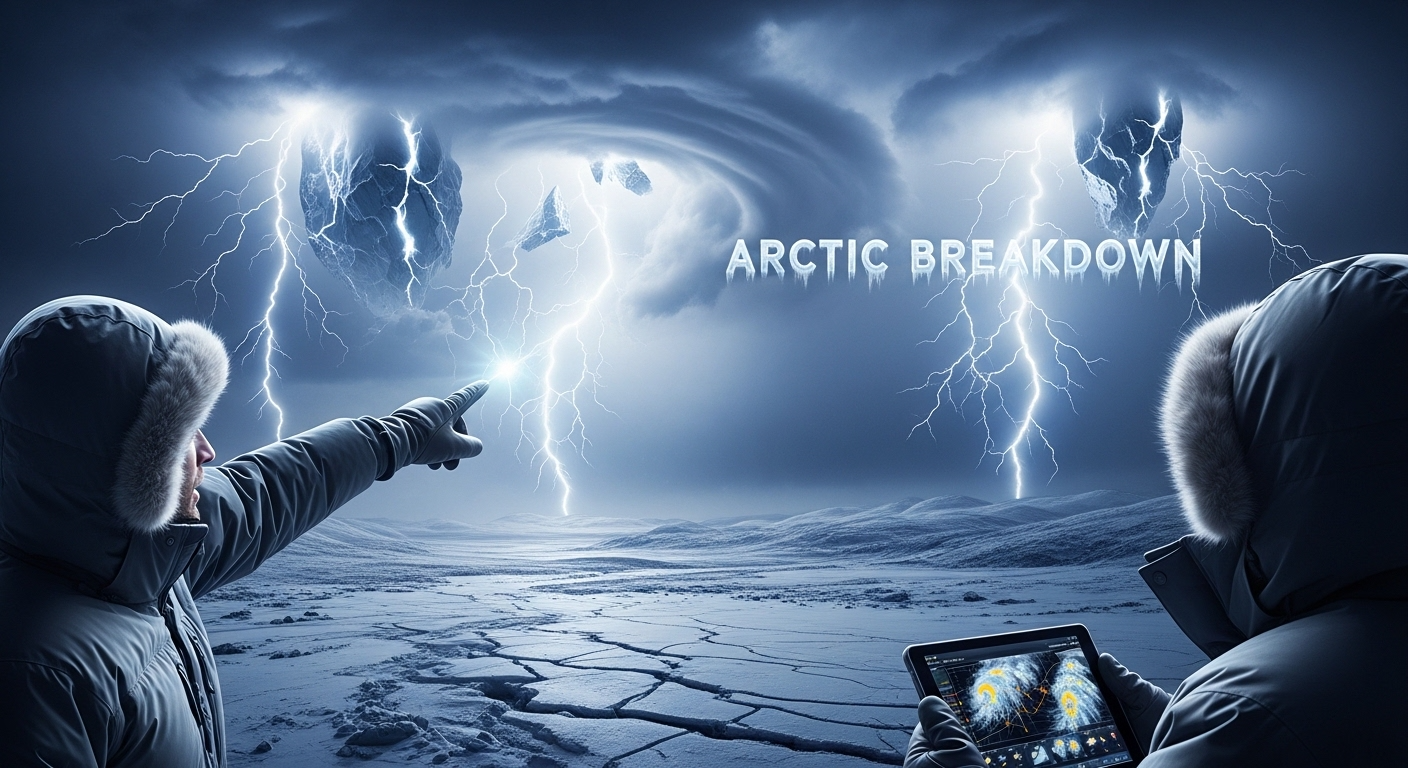
Meteorologists Warn February Begins With a Rare Arctic Breakdown
The warning arrived quietly but its implications were anything but small. Meteorologists were signaling that February would open with a rare Arctic breakdown, a sudden and dramatic shift in the atmospheric forces that normally keep the polar cold locked firmly in the north.
For millions of people across the Northern Hemisphere, that forecast meant one thing: brace for something significantly colder, stormier, and more disruptive than a typical winter week.
What Is an Arctic Breakdown?
An Arctic breakdown is not just a cold snap. It is a specific and relatively rare meteorological event triggered by instability in the polar vortex, the large mass of cold rotating air that normally keeps Arctic temperatures contained at high latitudes.
When the polar vortex weakens or splits, that containment fails. Cold Arctic air that would normally stay locked near the poles begins pushing southward into regions that are not built or prepared for such extreme conditions. The result is a cascade of disruption: heavy snow, ice storms, frozen infrastructure, and temperatures far below what local populations typically experience during even a harsh winter.
These events do not happen every year. They are genuinely rare, which is precisely why meteorologists treat them seriously when the conditions that produce them begin to develop.
What the Forecasts Were Warning About
Meteorologists had been monitoring warning signs in the Arctic for weeks before the February event materialized. The polar vortex had been showing clear signs of instability, and the data was pointing in one consistent direction.
The specific forecasts warned of:
- Heavy snowfall across regions not accustomed to significant accumulation
- Ice storms capable of bringing down power lines and making roads impassable
- Bitterly cold temperatures sustained over multiple days rather than brief overnight dips
- Disruption to transportation networks across a wide geographic area
- Strain on power grids from a sudden and sustained surge in heating demand
None of this was speculative. The atmospheric conditions that produce these outcomes were measurable and the models were in broad agreement about the direction of travel.
How Communities Were Affected
As the Arctic air pushed southward, communities across the affected regions felt the impact in deeply practical ways. Power grids that were designed for typical winter demand found themselves stretched by the sudden surge in heating requirements.
Transportation networks struggled to maintain operations as snow and ice accumulated faster than clearing crews could manage. Schools closed. Businesses shut down. Flights were cancelled and road travel became dangerous or impossible in the worst-affected areas.
For many households, the experience was a sharp reminder of how quickly extreme cold can shift daily life from normal to genuinely difficult. Pipes froze. Heating systems worked overtime. Elderly and vulnerable residents faced particular risks.
At the same time, something else emerged alongside the disruption. Neighbors checked on each other. Community centers opened as warming shelters. Local organizations mobilized supplies and support for those who needed it most. The breakdown brought out both the vulnerability and the resilience of the communities it hit.
Read More: https://wizemind.com.au
What the Natural World Experienced
The human experience of the Arctic breakdown was significant. But the natural world felt it too, in ways that carry consequences well beyond a difficult few weeks for commuters and homeowners.
In boreal forests, the sudden influx of extreme cold stressed trees that had been calibrated to a specific seasonal rhythm. Where the cold arrived earlier or more severely than usual, the risk of widespread damage increased significantly.
Migratory birds whose seasonal patterns are precisely timed to temperature and daylight cues faced serious disruption to the cycles they depend on for survival. Open farmland saw crop risks rise sharply, with the potential for damage to winter crops and soil structure from rapid freezing.
Coastal areas already dealing with the long-term pressures of climate change faced additional acute risks from storm surges and flooding driven by the weather system accompanying the cold air mass.
The Bigger Picture: Climate Change and the Polar Vortex
Arctic breakdowns are rare, but there is growing scientific concern that they may be becoming less rare. The connection between climate change and polar vortex instability is an active area of research and one of the more counterintuitive aspects of global warming.
As the Arctic warms faster than the rest of the planet, the temperature difference between Arctic and mid-latitude air masses decreases. It is that temperature gradient that helps keep the polar vortex stable and spinning consistently. When the gradient weakens, the vortex becomes more prone to the kind of wobbling, weakening, and splitting that sends cold air plunging southward.
In other words, a warming Arctic can paradoxically produce more frequent extreme cold events at lower latitudes. This is not a contradiction of climate science. It is one of its more complex and important predictions, and the February Arctic breakdown was a real-world data point in that ongoing story.
How to Prepare for the Next One
Arctic breakdowns will not announce themselves with much notice. The preparation that matters most happens before the warning arrives, not after it. Communities and individuals who have thought through their response in advance are dramatically better positioned than those who scramble when the forecast turns serious.
Practical preparation steps worth taking now:
- Ensure your home’s heating system is serviced and functioning before winter deepens
- Keep emergency supplies including warm clothing, blankets, food, and water for at least 72 hours
- Know where your nearest community warming shelter is located
- Check on elderly or vulnerable neighbors as part of your regular winter routine
- Have a backup plan for power outages including portable chargers and alternative heat sources
- Keep vehicles winterized with appropriate tyres, fuel, and emergency supplies
- Stay informed through official meteorological services rather than waiting for social media alerts
The communities that handle these events best are the ones that have built resilience into their routines long before the extreme weather arrives.
What Long-Term Solutions Look Like
Individual preparation matters but it only goes so far. The deeper responses to Arctic breakdowns require action at the infrastructure and policy level that goes well beyond what any household can manage on its own.
Researchers and policymakers are focusing on several key areas:
- Building more resilient power grids capable of handling sudden demand surges
- Investing in renewable energy infrastructure that reduces dependence on weather-sensitive supply chains
- Improving the accuracy and lead time of extreme weather forecasting models
- Developing better coordination frameworks between emergency services across regional and national boundaries
- Reducing the greenhouse gas emissions that are driving the Arctic warming linked to increased vortex instability
None of these are quick fixes. But the February Arctic breakdown was another demonstration that the cost of inaction compounds with every event that catches communities unprepared.
Q&A: Arctic Breakdown Explained
1. What exactly is an Arctic breakdown? It is a rare meteorological event caused by a weakening or splitting of the polar vortex, which allows large masses of cold Arctic air to push southward into mid-latitude regions, bringing extreme cold, snow, and ice storms.
2. How often do Arctic breakdowns happen? They are relatively rare, typically occurring every few years under natural conditions. However, some climate scientists believe warming in the Arctic may be increasing their frequency.
3. What is the polar vortex? It is a large area of low pressure and cold air surrounding the Earth’s poles. When it is strong and stable, it keeps Arctic cold contained at high latitudes. When it weakens or splits, cold air escapes southward.
4. What weather conditions does an Arctic breakdown bring? Typically heavy snowfall, ice storms, prolonged periods of extreme cold, disruption to transportation, power grid strain, and risks to vulnerable populations and ecosystems.
5. How far south can the effects reach? Depending on the severity of the vortex disruption, the effects can extend well into temperate regions including parts of the United States, Europe, and Asia that rarely experience such extreme winter conditions.
6. What is the connection between climate change and Arctic breakdowns? As the Arctic warms faster than the rest of the planet, the temperature gradient that stabilizes the polar vortex weakens. This makes the vortex more prone to instability and the southward escapes of cold air that produce Arctic breakdowns.
7. How can individuals prepare for an Arctic breakdown? By maintaining emergency supplies, servicing home heating systems before winter, staying informed through official forecasts, knowing where local warming shelters are, and checking on vulnerable neighbours.
8. What impact does extreme cold have on ecosystems? Forests can suffer cold stress and damage, migratory bird patterns are disrupted, crops and farmland are at risk, and coastal areas face elevated storm and flooding risks alongside the cold weather system.
9. How do power grids respond to Arctic breakdowns? Demand for heating surges rapidly and simultaneously across large regions. Grids that were not designed for such peaks can fail, causing widespread outages at exactly the moment people need power most.
10. Can Arctic breakdowns be predicted far in advance? Meteorologists can often detect signs of polar vortex instability weeks ahead of an event, but the precise timing, location, and severity remain difficult to forecast with high confidence until closer to the event.
11. What role do communities play in responding effectively? Community coordination including warming shelters, mutual support networks, and proactive checks on vulnerable residents consistently reduces the harm caused by extreme cold events.
12. Are some regions more vulnerable than others? Yes. Regions with older infrastructure, less insulated housing stock, higher proportions of elderly residents, and limited emergency service capacity are consistently more vulnerable to serious harm from Arctic breakdown events.
13. What happened to global trade and transport during the February event? Major disruptions to road, rail, and air transport cascaded across borders, affecting supply chains and international commerce in ways that extended the economic impact well beyond the most severely weather-hit areas.
14. How long does an Arctic breakdown typically last? The most intense period of cold and disruption typically lasts from several days to a couple of weeks before the polar vortex restabilizes and temperatures begin to recover toward seasonal norms.
15. What is the most important long-term response to increasing Arctic instability? Reducing the greenhouse gas emissions driving Arctic warming is the foundational long-term response, alongside investing in resilient infrastructure and improving extreme weather forecasting and community preparedness systems.