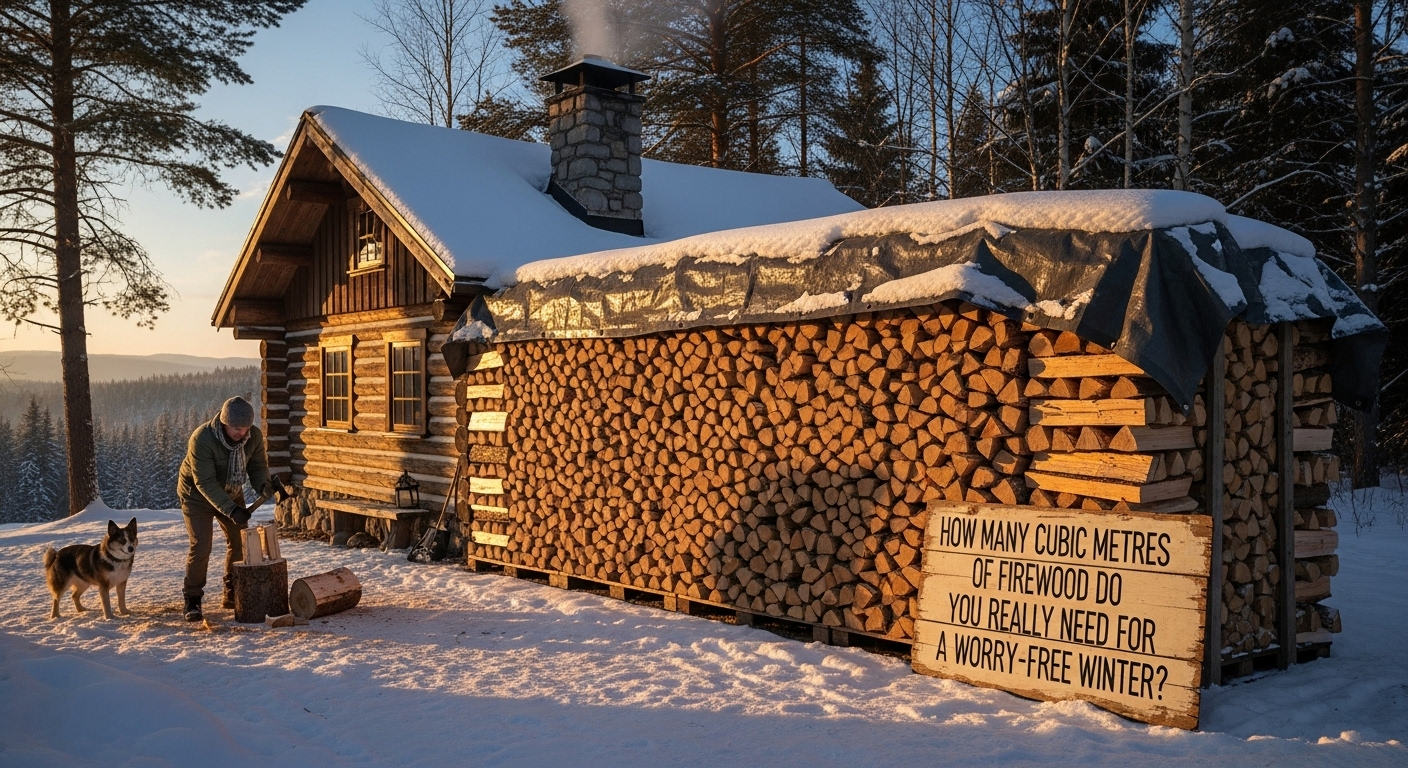
How Many Cubic Metres of Firewood Do You Really Need for a Worry-Free Winter?
The first frost always seems to arrive in the middle of something. You are making coffee, or hunting for a missing glove, when you glance out the window and notice the grass shining silver and fragile. In that quiet second, a thought pricks at the back of your mind. Do I actually have enough firewood for this winter?
It is a very particular kind of worry, the sort that sits behind everything else you do on a cold day. Because while snow can be beautiful and dark evenings can feel cosy, nothing is comforting if you are secretly counting logs and calculating what you can burn tonight and what you will wish you had saved in February.
The Sound of a Winter’s Worth of Wood
Imagine it is late December. The wind presses against the windows, a low, steady push. Somewhere outside, a branch knocks lazily on the side of the house. You lay another split log on the coals and it answers with that gentle hiss of resin and the soft crackle that sounds like distant rain.
There is a special peace that comes when you know, deep in your bones, that there is more than enough firewood outside. The pile might be stacked under the eaves in tight, perfect rows, or it might tower at the edge of your yard like a small, private forest. Either way, you are not calculating anymore. You are simply warm, and winter feels like something you are sharing with the weather rather than fighting against it.
Getting to that feeling of warmth without worry is the whole point of figuring out how many cubic metres of firewood you really need. What you are really measuring is peace of mind.
What Does a Cubic Metre of Firewood Actually Look Like?
Two cubic metres, someone says. You will be fine. But what does that actually mean in real life?
A cubic metre, in simple terms, is a cube one metre high by one metre wide by one metre deep. But your wood pile does not line up in a tidy cube. It has gaps, uneven ends, and the odd piece that refuses to stack neatly. When you see firewood sold in cubic metres, it usually refers to the volume of the stacked wood including the air spaces between logs.
To get a feel for it, imagine this. You stand beside your wood stack and stretch your arm out from your shoulder. That distance is often close to one metre. Now picture a row that deep, as high as your ribcage, running along the side of your shed for a metre. That is roughly a cubic metre. Not a mountain. But not nothing, either.
If you have ever bought a load of wood from a neighbour’s pickup, you have experienced another problem. Loads and trailer-fulls are technically meaningless sizes. Depending on how the wood is thrown in, a load can be anything from 0.6 to 1.5 cubic metres. The safest way is to always think in well-stacked, measured volume, not in loosely tossed heaps.
Key Factors That Secretly Eat Your Wood Pile
Before getting into exact numbers, it helps to know what quietly changes how much wood you will burn. Because it is not only about how cold it gets outside.
Your home itself is the first variable. A modern, well-insulated house with good windows and no mysterious drafts will hold heat the way a thermos holds coffee. An old stone farmhouse or a timber cottage with gaps in the floorboards will happily inhale your warmth and exhale it into the night.
Your stove or fireplace makes an enormous difference. A modern EPA-certified wood stove can wring far more heat from every log than an open fireplace or a cracked old burner. An open fireplace can look romantic, but a huge portion of the heat disappears up the chimney. In efficiency terms, it is a candle compared to a lantern.
Climate plays its part too. If you are in a place where winter starts early and overstays its welcome, where the cold does not just visit but moves in, your fire will be burning more days and more hours. In milder climates, you might light the stove only on evenings or the occasional cold snap, and your wood stack will last much longer.
And finally, there is you. How warm you like your home, how often you are there to tend the fire, and how much you rely on wood as your primary heating source. Someone who is home all day and loves a steady, slow burn will go through considerably more wood than a commuter who lights only a few evening fires each week.
So How Many Cubic Metres Do You Actually Need?
Most people can get surprisingly close with a simple, honest look at three things. How you use your fire, how efficient your setup is, and how long your winter really lasts.
| Heating Situation | Climate | Typical Use | Approx. Wood Needed per Season |
|---|---|---|---|
| Occasional fireplace, decorative | Mild | 1 to 3 fires per week | 0.5 to 1.5 cubic metres |
| Supplemental wood stove | Mild to moderate | Evenings and weekends | 2 to 4 cubic metres |
| Primary heat, efficient stove | Moderate to cold | Daily use, long season | 4 to 7 cubic metres |
| Primary heat, old stove or drafty home | Cold | All day, every day | 6 to 9 or more cubic metres |
A small, well-insulated house heated primarily by wood in a moderate climate might get through the whole season on 4 cubic metres. A big, drafty home in a region where winter forgets to end can easily swallow 8 cubic metres or more.
The crucial trick is to aim high, not low. Firewood does not go off like milk. It only gets better as it dries. If you overshoot and end the winter with a neat stack still waiting, that is not waste. That is next year’s head start. The real risk lies in underestimating and finding yourself phoning around for expensive, half-seasoned wood in the middle of a snowstorm.
How to Turn Guessing Into a Personal Formula
After one or two winters of paying attention, you can stop guessing entirely. Your household develops its own quiet arithmetic, based on experience instead of estimates. Here is a simple way to build that personal formula:
- Pick a baseline year. This winter, keep a note of exactly how much wood you have bought or cut, in cubic metres. If it arrives in a vague load, take the time to restack it into measured rows and calculate the volume.
- Observe your comfort level. Were there nights you shivered and rationed? Or did you end with a spare row untouched? That feeling of scarcity or surplus is as important as the raw number.
- Track how you burned. Was this a particularly cold winter? Did you work from home more, running the stove longer? Did you host extra guests who loved to keep it blazing?
- Adjust by a margin. If you ran short, add 20 to 30 percent to next year’s target. If you had plenty left, you might shave a little off, or keep it as deliberate surplus and build a two-year rotation.
Within a couple of seasons, you will know in your bones that six cubic metres is plenty, or that you are an eight-cubic-metre household. That knowledge transforms the woodpile from a vague worry into a clear, predictable resource.
The Secret Life of Dry Wood
You can buy or cut exactly the right cubic metres of firewood and still feel cold if the wood itself is not ready. This is one of the most frustrating lessons of wood heating. Unseasoned wood can turn a well-planned winter into a smoky, underwhelming slog.
Freshly cut logs are heavy with water, sometimes 40 to 60 percent moisture by weight. When you burn that, a shocking amount of the energy goes into boiling off water instead of heating your home. The fire smoulders, your glass blackens, and the chimney starts to collect creosote.
Properly seasoned wood, on the other hand, feels lighter in the hand, sounds more musical when two pieces knock together, and carries thin, radiating cracks at the ends. Split, stacked in the open air under a simple roof, and given time, usually 12 to 24 months depending on species and climate, it shrinks from wet, reluctant fuel into dry, eager heat.
This is why people say, only half joking, that you should be thinking about next winter while you are still in this one. When you plan a year or more ahead, your cubic metres start to mean something consistent.
Stacking Towards Peace of Mind
There is a rhythm to stacking wood that feels older than language. Lift, turn, place. The clack of one piece against another. The dry dust on your forearms. The slight sway of the growing wall. You find a kind of winter calm in the work, even when it is high summer and the thought of cold air seems far away.
The way you stack is not just about neatness. It is about how that wood will behave when you need it most. A loose pile under a tarpaulin can trap moisture for months. A tidy stack on pallets or rails, with wind slipping through the gaps, lets the wood dry and harden in the sun.
You can even think of your woodpile as a calendar. The oldest wood at one end, grey, checked, and feather-light, is this year’s fuel. The fresher, heavier splits at the far side are next winter’s promise. When you have built that two-year cycle, you are no longer simply surviving each season as it comes. You are living one winter ahead, steady and prepared.
When in Doubt, Add One More Cubic Metre
There is a moment in late autumn when you take your last honest look at the woodpile. The leaves are almost gone from the trees. Your breath is beginning to show in the morning. You stand there, maybe with a mug in your hand, and you try to see the future in stacked timber.
This is the moment where experience whispers a simple rule. If you are not sure, get one more cubic metre.
That extra metre is more than just wood. It is:
- The unexpected cold snap in late March that nobody forecast
- Your neighbour’s boiler breaking down and you deciding to share
- The storm that brings the power lines down and turns the stove into more than just ambiance
- The buffer that lets you burn freely in January rather than rationing anxiously in February
If you never touch that extra cubic metre, it quietly becomes part of next year’s store, better seasoned, more efficient. If you do need it, you will feel every log as a small act of foresight. Very few people regret having too much dry wood. Many, many people remember the discomfort of running out.
In the end, knowing how many cubic metres you need is not only a mathematical question. It is about knowing yourself, your home, and your winters. The numbers, four, six, eight cubic metres, are just ways of describing how you want the cold months to feel. Calm. Prepared. Warm enough that you can turn your attention from survival back to the small pleasures. A book, a conversation, the way the firelight moves across the ceiling.
Frequently Asked Questions
How many cubic metres does an average household need? For a typical, reasonably insulated home using a modern wood stove as a main heat source, most households fall between 4 and 7 cubic metres per winter. If you are only using wood for cosy evening fires, you may need as little as 1 to 3 cubic metres. Drafty homes or very cold climates can easily push the requirement to 8 cubic metres or more.
Is it better to have too much firewood or just enough? It is almost always better to have too much. Properly stored firewood improves with age as it continues to dry, so any surplus this year becomes high-quality fuel for next year. Running short, on the other hand, often means buying expensive, poorly seasoned wood in the middle of winter when prices are highest and quality is lowest.
How can I tell if my firewood is properly seasoned? Seasoned wood shows these clear signs: it is noticeably lighter in weight, produces a sharp hollow sound when two pieces are knocked together, shows small cracks radiating from the ends, and has bark that may be loose or coming away in strips. When burned, it lights more easily, produces less smoke, and creates brighter, more energetic flames.
Does the type of wood affect how many cubic metres I need? Yes significantly. Dense hardwoods like oak, beech, or ash contain more energy per cubic metre than softwoods like pine or spruce. If your supply is mostly softwood, you may need a slightly larger volume to get the same amount of heat over winter. However, fully seasoned softwood can still be excellent fuel, especially for shoulder seasons.
How far in advance should I prepare my firewood? Ideally at least one year ahead, with many experienced wood burners aiming for a two-year rotation cycle. This means burning wood that was cut, split, and stacked at least 18 to 24 months earlier. This ensures consistently dry, efficient fuel and makes your seasonal planning far more reliable and predictable.
Key Points
- The right amount of firewood varies significantly by home, stove efficiency, climate, and lifestyle, but most wood-heated households fall somewhere between 4 and 8 cubic metres per season. Understanding your own specific variables is more useful than any generic rule, and tracking your usage over two winters gives you a reliable personal benchmark.
- A cubic metre of stacked firewood is a specific, measurable unit, not a rough estimate, and it includes the air gaps between logs. Buying wood in vague loads or trailer-fulls without restacking and measuring makes accurate planning almost impossible and frequently leads to either wasteful overspending or running uncomfortably short.
- Dry wood is not optional. It is the foundation of efficient wood heating. Unseasoned wood can contain up to 60 percent moisture by weight, meaning a significant portion of each log’s energy goes into evaporation rather than heat. Properly seasoned wood burns hotter, cleaner, and more efficiently, meaning the same cubic metres deliver meaningfully more warmth.
- A planned surplus is never wasted. Any firewood left over at the end of winter simply continues seasoning and becomes even better fuel for the following year. Building a two-year wood rotation, where you always have one year of fuel fully seasoned and another year being prepared, is the most reliable way to achieve genuine peace of mind through every winter.
For more home, lifestyle, and practical living guides, visit wizemind.com.au