The World’s Largest Factory Employs 30,000 People and Can Build Eight Jets at Once
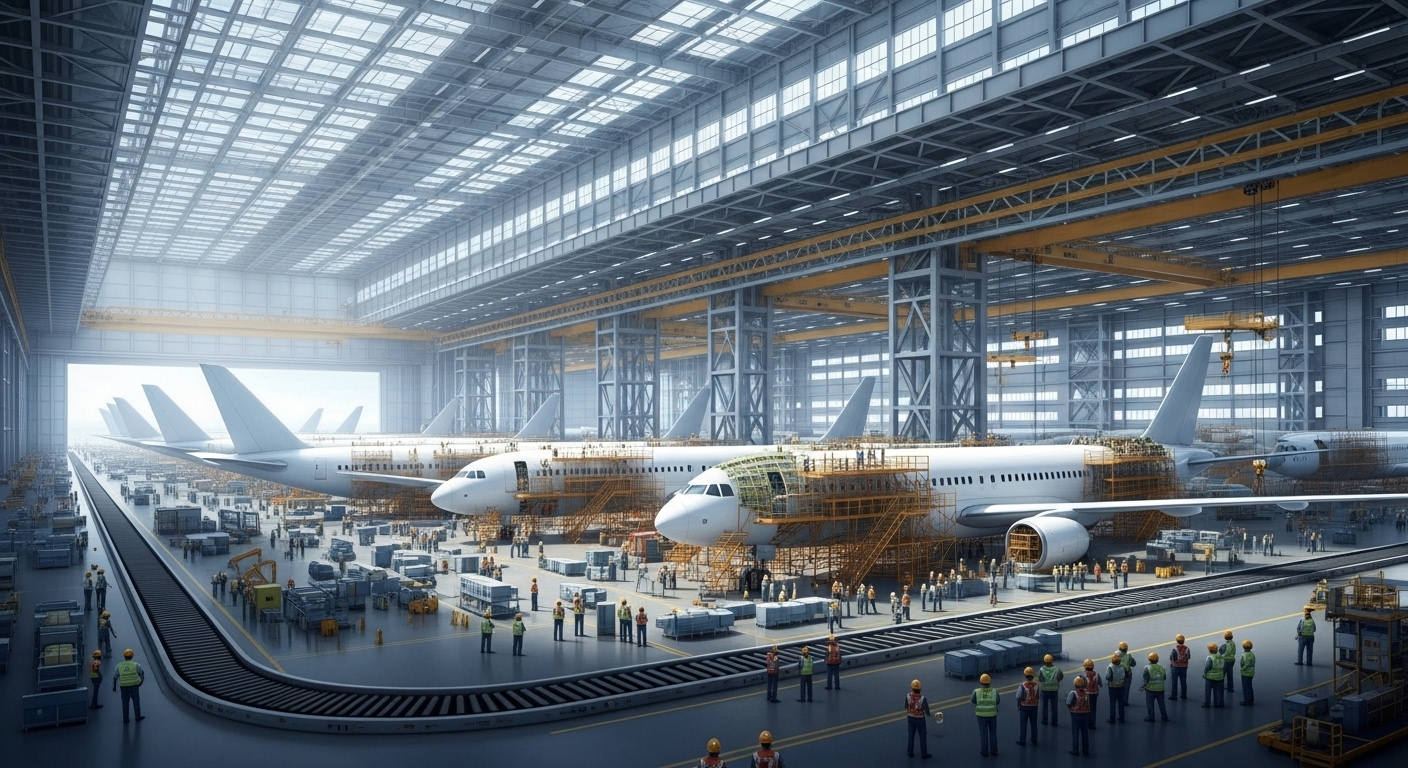
The first thing you notice is the air. Not its smell. There is not much of one. But its size. It feels taller, wider, somehow more spacious than anything you have ever breathed before. You step through a simple doorway in Everett, Washington, and suddenly the world stretches. The ceiling floats far above like a metallic sky. The walls seem to slide away into the distance. And in the middle of it all, half-hidden in scaffolding and glinting in soft white light, is the curved silver side of a jet the size of an apartment building.
The Day Begins in a City Under a Roof
By 6:00 a.m., the world’s largest factory hums like a waking city. Thirty thousand people flow into this building every day, the same way commuters pour into a downtown core. They arrive in waves. Engineers with laptops and coffee. Technicians in bright safety vests. Forklift drivers, logistics planners, cleaners, inspectors. If you stand on one of the walkways that cross the building high above the floor, they look like a slow-moving river of humanity, dispersing into a maze of workstations and shining airplane skeletons.
This is the Boeing Everett Factory, a structure so immense that it feels less like a building and more like a landscape with a roof. It can build eight wide-body jets at once, each one a metal bird so huge that its wing alone could shade a city street. Inside these walls, airplanes are not just assembled. They are grown, rib by rib, wire by wire, as if the factory itself is a living organism whose sole purpose is to make machines that leave it behind.
The atmosphere is cool but not cold, the lighting bright but soft. Overhead, cranes glide silently along tracks, moving parts that weigh as much as small houses with the eerie grace of ballet dancers. Down below, workers in scissor lifts lean into the smooth sides of unfinished fuselages, sparking brief constellations of light as they rivet and weld and wire. Everywhere there is motion, but not chaos. It is a choreography of precision. An enormous, industrial dance.
Despite the machinery, the sound is strangely muted. There is noise, of course. Beeps from reversing vehicles, whirs from drills, the occasional thud of something heavy settling into place. But the sheer size of the building seems to swallow the echoes. Voices travel just far enough for teammates to hear, then vanish into the ceiling’s distant hush.
The Building That Redefined Big
To understand this place, you need to let go of the usual sense of scale. Numbers help, but only a little.
| Feature | Approximate Scale |
|---|---|
| Number of employees | Around 30,000 people |
| Jets assembled at once | Up to 8 wide-body aircraft |
| Enclosed floor area | Roughly 100 acres under one roof |
| Primary purpose | Assembly of large, long-range jets |
| Key components arriving from | Global network of specialised plants |
At around 100 acres under one roof and a volume so vast it has its own weather control systems, the factory has more enclosed space than any other building on Earth. You could fit multiple city blocks inside it and still have room to spare. Some like to say you could tuck Disneyland inside and lose it in a corner.
From the outside, it looks deceptively simple. Long, low, and sprawling, with gigantic doors painted in colourful murals of aircraft. Trucks and buses look toy-like against it. The factory is not tall like a skyscraper. Instead, it stretches outward, hugging the ground like a continent of steel. Inside, perspectives get confused. The far end of the building shimmers slightly in the distance, not because of heat but because your eyes are not used to seeing an indoor horizon.
This megastructure was born in the 1960s, when the race to build larger, longer-range aircraft collided with the need for a place big enough to create them. The company needed a home for the 747, a plane so large and ambitious that it demanded an entirely new category of factory. So they did not just add on to an existing facility. They built a new giant, carved out of forest and farmland, and gave it a single, monumental purpose. Build airplanes so large they could carry hundreds of people across oceans in one leap.
Since then, the interior has evolved like a city reinventing itself. Where once the 747 dominated, other wide-body jets followed. The 767, the 777, the 787. The bones of the building remained, but the muscles shifted. Innovation here happens in steel and rivets, but also in how space is used.
Eight Giants in the Making
Walk the central aisle and you can count them. One, two, three, four, up to eight enormous jets in various stages of creation. Some are just a gleaming tube of fuselage sections joined together, their insides hollow and echoing. Others have wings attached, sweeping outward like the arms of a resting giant. Near the final stages of the line, you see fully formed aircraft, paint still missing, engines yet to be installed, but instantly recognisable as the familiar silhouettes from airport windows.
Each one is a project with its own story. One jet might be destined for an airline halfway across the world, its interior tailored for extra luxury seats and onboard suites. Another might be configured for cargo, its belly prepared to swallow containers and freight. A third could be built for long-haul routes, with fuel tanks and wing designs optimised for spending oceans of time over actual oceans.
Standing next to one of these fuselages, the curvature of its body feels like the side of a small hill. Workers move along suspended platforms, some inspecting panels with quiet focus, others running cables or installing structural components. The skin of the plane is thin relative to its size, carefully riveted sheets of aluminium or advanced composites, but there is a density of engineering just beneath the surface. Frames, stringers, ribs, like the skeleton and tendons of a giant animal.
It is easy to forget how much must arrive, on time and in the right order, to keep this dance moving. Components arrive from all over the world. Wings from one place. Tail sections from another. Interiors from specialised plants. Engines from their own dedicated factories. This building is the final theatre where it all comes together.
A City-Sized Crew
In a town of 30,000 people, you would expect schools, restaurants, neighbourhoods, and services. Inside this factory, the analogy holds surprisingly well. There are cafeterias where the lunch rush looks more like a festival crowd than a workplace break. Medical facilities, transit shuttles, maintenance crews, quiet rooms, meeting spaces, locker rooms and bike racks and endless numbers of coffee machines.
The people here are as varied as the jobs they perform. Some have been walking these floors for decades, having watched models rise and fall out of fashion, technologies change, processes refine. Others are fresh from universities or trade schools, bringing new skills in programming, robotics, and composite materials. Many come from families where working at the factory is almost a rite of passage, a shared history of building the machines that connect distant continents.
To coordinate this many people, the place runs on schedule and system. Shifts overlap to keep production stable, maintenance timed to avoid bottlenecks. Safety briefings begin the day. Digital displays high on the walls quietly track progress. Even from the floor, workers can glance up and know if they are on pace, like athletes checking a scoreboard.
There is a particular pride in being able to point to the sky when a jet passes overhead and say, “We built that.” In a world where so much work is invisible and digital, this factory produces objects that are astonishingly real. Hundreds of tons of metal, composite, and fuel that can lift hundreds of people into the air at once.
Where the Sky Begins Indoors
What makes this place feel oddly intimate, despite its jaw-dropping size, is how human it remains. For all the automation, there is an enormous amount of craftsmanship in each jet. You see a technician lying on their back inside a narrow compartment, tightening fasteners in spaces that machines cannot quite reach. You catch an engineer running their hand gently along a newly installed panel, the way a carpenter might check the fit of a door.
Step closer to a half-finished cabin and you will find yourself inside a kind of skeletal future. The windows are in place, but the walls are bare, exposing wiring harnesses in neat bundles, ventilation ducts, insulation panels. It smells faintly of new plastics, metal, and tape. Strips of wiring run like bright vines along the ribs of the plane, each one labelled, tracked, and part of a bigger nervous system that will eventually manage everything from in-flight entertainment to navigation.
Walk past the wing assembly area and the mood shifts. Wings are where much of the magic of flight happens, and here you can see their inner strength before the outer skin goes on. Spars, the main structural beams, stretch the length of the wings like the long bones in a bird’s limb. Ribs create the cross-sectional shape, turning raw beams into a surface that can bite into the air. Technicians move carefully among them, attaching control surfaces and mechanisms that will someday allow pilots to bank, climb, and glide.
Everywhere you look, signs remind you of the stakes. Safety checks. Torque specifications. Procedural steps. Every bolt matters. Every wire route has a purpose. When a finished aircraft eventually taxis to a runway and begins its sprint into the sky, the work done in this factory is the quiet, invisible foundation of that moment of lift.
Rhythms of a Rolling Line
Unlike older factories where planes stayed in one place and the people swarmed around them, here many jets slowly, steadily roll forward as they are built. It is a process closer to a gigantic, careful conveyor belt than a static workshop. The line moves at a pace that is almost imperceptible. You could stand next to a fuselage for a while and swear it is still, but come back after lunch and it will have crept several metres closer to its next station.
This rolling assembly line is a quiet kind of heartbeat. Every motion is scheduled. When the tail should be mounted, when the wings mate with the fuselage, when the landing gear is attached. Time is measured not just in hours, but in positions along the floor. Teams know that by the time a certain line on the ground passes under the nose gear, certain jobs must be complete, inspections signed off, tools cleared away.
Despite the enormity of everything, delays here are felt. One late shipment, one unexpected glitch in a test, and the ripple can nudge the entire line. That is why so many teams spend their days looking not at the planes themselves, but at screens full of data. For every set of hands on the floor, there are minds behind the scenes trying to ensure the rhythm of production does not skip a beat.
When a Giant Leaves Its Nest
Eventually, after weeks of work that stretch into months, a plane is ready to move out. It is fully assembled, painted in the colours of the airline that will soon be its home, its engines gleaming like polished bells. The moment when it emerges from the factory doors is oddly modest and monumental at the same time. No brass band. No speeches. Just a slow, careful tug as a towing vehicle guides it into the daylight.
From inside, those massive doors are like an artificial horizon line. From outside, watching them slide open, you get a sense of proportion. The airplane that seemed to fill the interior suddenly looks smaller against the sky, more like something that belongs there. Yet you cannot forget that this machine, now settling on its landing gear in the open air, was once nothing but parts and potential, scattered across warehouses and shipping containers around the globe.
Before it flies, the jet still has to prove itself. Engine tests, taxi tests, systems checks. Pilots will run it up and down the runway, listening, feeling, checking the behaviour of every surface and system. Test flights will follow, tracing loops and arcs in the air above nearby landscapes, invisible to most people who never think about the enormous work hidden behind each scheduled departure.
For the people in the factory, that first flight is a kind of graduation day they may or may not see in person. Many are already deep into the next aircraft in line by then. Their hands on a new set of wings, a new fuselage, a new future jetliner that will someday carry strangers across continents. Yet the pride lingers. When one of those jets passes overhead, contrail streaming behind it, its builders recognise things most of us miss. The angle of the wingtip. The contour of the nose. The distinctive shape of the engines.
The Human Scale of Something Inhumanly Big
It is easy to talk about this factory in superlatives. Largest, most, biggest, longest. But the true measure of its importance is more subtle. It is in how it captures a particular moment in human ingenuity. The point where we learned not just to fly, but to make flying reliably, predictably, and routinely possible for millions of people.
Inside these walls, flight is not a miracle. It is a process. A disciplined, repeatable, carefully controlled process. Yet even amid the clipboards and digital dashboards, the job carries a quiet awe. Workers will talk about heavies and wide-bodies and fuselage joins with the relaxed familiarity of people who do this every day. But pause for a moment and you can hear the undercurrent. They know they are helping shape something that will take people to weddings, to new jobs, to long-awaited vacations, to homes they have not seen in years.
The world’s largest factory, employing 30,000 people and capable of building eight jets at once, is ultimately a story about how many hands it takes to make something that appears effortless. We stand in airport terminals, watching a plane push back from the gate, and we rarely think of the city under a roof where its life began.
Yet that city hums on, shift after shift, turning raw material and expertise into long metal wings that pierce the clouds.
Key Points
- The Boeing Everett Factory in Washington State is the largest building on Earth by volume, covering roughly 100 acres under a single roof with a volume so enormous it requires its own weather control systems to prevent clouds forming inside. Its scale is not just a record. It is a functional necessity for building some of the largest aircraft ever made.
- Up to eight wide-body jets can be assembled simultaneously at different stages of construction along a rolling assembly line. From bare fuselage sections at one end to fully painted, engine-ready aircraft at the other, the factory operates as a continuous, carefully timed production system where every position on the floor corresponds to a specific milestone in the build.
- The 30,000-strong workforce represents a full cross-section of industrial society, from experienced mechanics who have worked the same floor for decades to recent graduates bringing skills in robotics, composites, and digital systems. The operation requires not just technical expertise but cafeterias, medical facilities, transit systems, and the entire supporting infrastructure of a small city.
- Components for each aircraft arrive from a global network of specialised facilities, making the Everett factory the final assembly point for parts manufactured across multiple countries and continents. The logistics of coordinating those arrivals, ensuring every component reaches the right station at the right time, is as complex as the engineering itself.
- The factory is both a monument to industrial precision and an intensely human workplace. For all its automation and scale, a remarkable amount of the work requires skilled human hands in spaces no machine can reach. The workers who build these jets recognise them in the sky long after they leave the building, by the angle of a wingtip or the shape of an engine nacelle, carrying a pride in their work that no departure board ever acknowledges.
For more science, technology, and world stories, visit wizemind.com.au