No More Traditional Yule Log: The New Christmas Dessert Trend From Top Chefs
The first time I realised the yule log was in trouble, I was standing in a tiny pastry kitchen in late November, watching a world-class chef torch a length of cinnamon bark. The whole room smelled like a forest on fire. Sweet smoke, evergreen, a whisper of citrus.
Yet on the steel counter in front of him, there was no roulade, no chocolate bark, no marzipan mushrooms. Instead, a long, shimmering cylinder of frozen pear mousse rested on a pedestal of walnut praline, veiled in a glaze so glossy it caught every flicker of light. It looked like moonlight on a frozen lake.
“This,” he said, sliding the torch back into its cradle, “is our Christmas log now.”
In that moment, I understood something quietly seismic was happening in the world of Christmas desserts.
From Forest Floor to Gallery Shelf
Traditional yule logs have always been about illusion. Turning cake into wood. Cocoa-dusted bark, powdered sugar snow, meringue mushrooms. So much of their charm lives in the playful mimicry of a winter forest.
But lately, chefs are more interested in evoking a feeling than copying a shape. They are trading the literal log for bolder, more abstract forms that still carry the soul of the season.
In one high-end hotel, the Christmas log is now a perfectly smooth, oblong sculpture, like a river stone washed by decades of water. The outside is a delicate white chocolate shell, barely thicker than an eggshell. When you press it with a spoon, it cracks with a crisp sigh, giving way to layers of spiced orange compote, almond crémeux, and a whisper-light gingerbread sponge. No fake knots. No carved wood grain. Just a clean, minimalist curve dusted with a fragile frost of cocoa butter.
Elsewhere, chefs build desserts that look more like pieces of modern art. Snow-globe domes made of blown sugar, suspended above tiny forests of pistachio moss. Crystalline sugar shards rising from cakes like frozen waves. One chef described her Christmas dessert as the idea of a winter walk translated into textures.
“Cold air, citrus in your pocket, pine sap on your fingers.” That meant juniper-infused cream, clementine gel, spruce needle caramel, and shards of candied peel that crackle like thin ice.
In this new wave, flavour leads form. The dessert might still arrive shaped like a log, but it is no longer pretending to be a tree. It is telling a story about winter itself.
The Rise of the Plated Christmas Journey
One of the clearest signs that the yule log is loosening its grip is the emergence of the Christmas journey menu. A progression of small, plated desserts that together replace the single showpiece.
Instead of one big log in the centre of the table, you get a series of edible vignettes. Little scenes. Little memories. Served over the course of the evening.
At a mountain restaurant, a tasting might begin with a tiny pre-dessert of pine sorbet. Barely sweet, as sharp and green as breathing in cold air on a hike. Then comes a warm, sticky date cake with rum caramel and smoked vanilla ice cream. Finally, an elegant chocolate tart capped with a thin disc of cocoa nib brittle and a gleam of citrus marmalade.
No log. Yet no one at the table misses it.
This shift is not just about aesthetics. It is about how we want to feel after a holiday meal. Many of the new Christmas desserts are intentionally lighter. Mousses, sorbets, airy sponges. Chefs talk openly about fatigue with heaviness. After hours of roasted meats, gratins, sauces, and cheese, the idea of a dense rolled cake can feel more daunting than celebratory.
But lighter does not mean less indulgent. The best of these modern creations are deep with flavour. Roasted pear and miso caramel. Burnt honey and chestnut. Dark chocolate folded with coffee and black cardamom. There is a newfound interest in bitterness, in saline notes, in balancing sweetness with savor. Less sugar rush, more slow-blooming warmth.
Flavours From Far Beyond the Fireplace
Walk into a top pastry kitchen in December now, and you might catch a scent that has nothing to do with Victorian Christmases. Toasted sesame. Pandan. Yuzu. Hibiscus. Black lime.
One of the quiet revolutions in seasonal desserts is the widening of the flavour map. Chefs are folding in their own histories, their travels, their heritage, rewriting what winter can taste like.
In one London bakery, the Christmas centrepiece is a snow-white coconut mousse dome filled with calamansi curd and kaffir lime leaf custard, set on a crisp black sesame sablé. The whole thing looks like a snowball resting on dark earth. When you cut into it, a vivid sunburst of citrus spills out.
“I grew up in Manila,” the pastry chef says, shrugging. “Christmas for me tastes like citrus, coconut, and humidity. The snow is borrowed; the flavours are mine.”
Across the ocean, Latin American influences are filtering into festive menus. Tamarind and piloncillo caramel. Cajeta swirled into spiced chocolate crémeux. Tres leches cakes scented with star anise and orange blossom. In Nordic countries, rye crumbs and fermented berries lend a quiet tang to otherwise rich desserts. Japanese patissiers infuse creams with roasted green tea, kinako, and sake kasu.
These global notes do not erase the old flavours. They coexist, layering familiarity with surprise. Cinnamon still curls through the air. Cloves and nutmeg still anchor the spice box. But they are no longer the only voice in the choir.
The holiday table becomes, in a small way, a map. And while the form of the log may fade, the idea of gathering stories and memories into a single sweet moment remains. Only now those stories come from far more corners of the world.
The Beauty of Imperfect, Shared Desserts
Beyond the realm of glossy hotel counters and jewel-box pâtisseries, another trend is quietly rising. The return of the humble, generous, shareable dessert.
Not the meticulously piped, mirror-glazed sculptures that demand silence and reverence. Big, soft, warm things designed to be placed in the middle of the table and attacked with spoons.
Some chefs, weary of the showpiece-or-nothing mentality, are leaning into what they call honest desserts. Picture a burnished pan of brioche studded with candied citrus, soaked in vanilla custard, baked until the edges caramelise and the middle stays trembly. It arrives at the table with a pitcher of crème anglaise and a scoop of salt-streaked ice cream.
Others serve colossal pavlovas with billowing meringue, topped with roasted winter fruits. Plums, quinces, grapes blistered in the oven until their skins wrinkle and split. The pavlova cracks the moment a spoon touches it, collapsing into a cloud of cream, fruit, and shards. The drama is no longer in the knife reveal. It is in the communal wreckage.
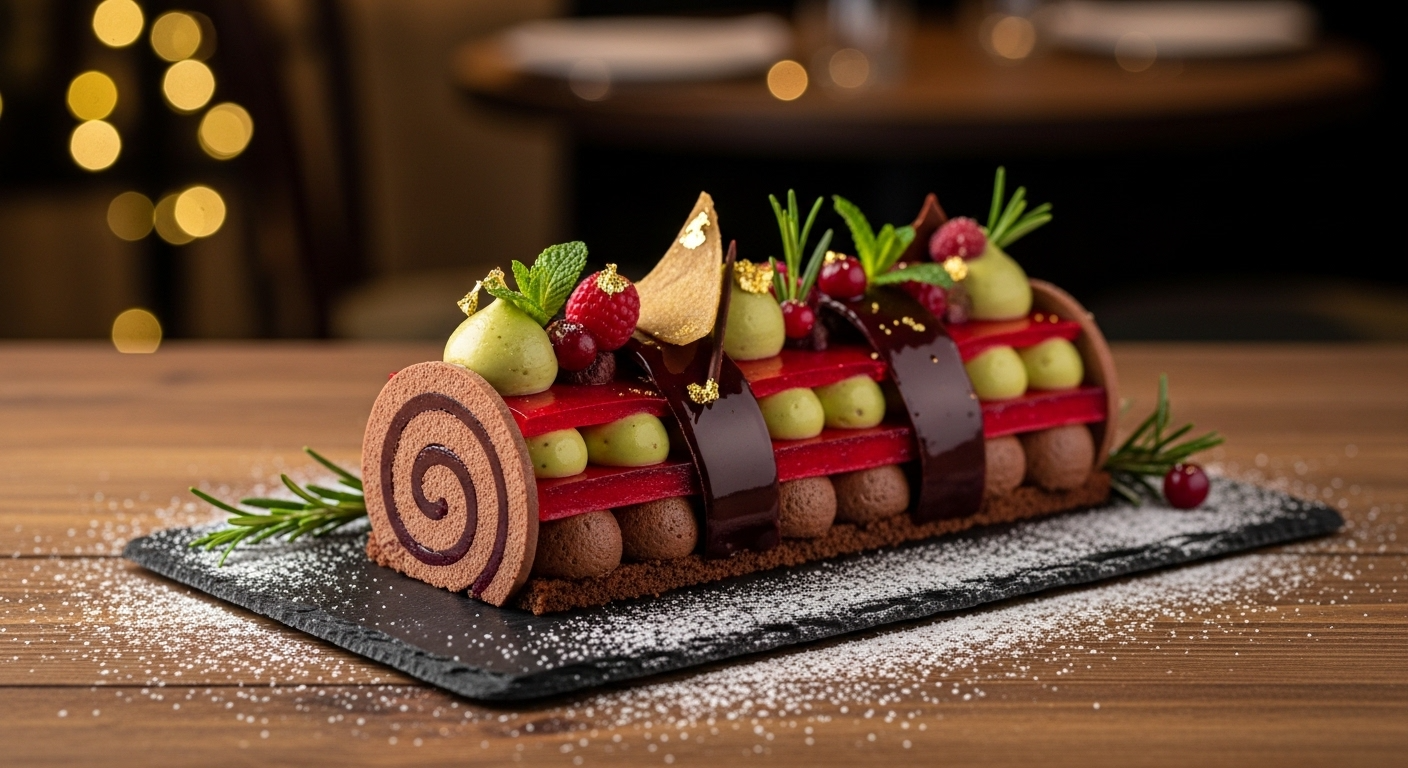
Even when logs remain, they are often less fussy, more honest about being cake. Gone are the days of pretending your dessert is a fallen tree. Now, the trendiest logs might be unrolled entirely, presented as long rectangular entremets with visible layers. Praline crunch, chocolate mousse, a thin stripe of cassis gelée. Like geological cross-sections of flavour instead of camouflaged bark.
It is as if the world of pastry, after years of striving for perfection and illusion, is learning to breathe again. The new message: let it crack, let it sag just a little under the weight of cream and fruit, let it feel human.
Designing Christmas: When Dessert Becomes Sculpture
Of course, the other side of this movement is pure spectacle. At the highest level, Christmas desserts have become design objects. Limited editions crafted in collaboration with architects, sculptors, even perfumers.
One famed pastry chef worked with a glass artist to create a series of translucent sugar branches that could be assembled on top of a base like some edible, glittering tree. Nestled between the branches were tiny spheres of chestnut cream, caviar-sized pearls of kirsch gel, and brittle leaves of dark chocolate.
Another designed a dessert to mimic a snow-dusted mountain range, complete with peaks of chocolate mousse coated in powdered cocoa butter and valleys filled with hazelnut praline rockslides.
These creations are not for the faint of heart, or the faint of budget. They require equipment, time, and teams. But they are crucial bellwethers for where the wider trend is heading. As top-tier chefs push into new shapes and constructions, those ideas filter down over time into more everyday sweets.
The sleek glazes, the moulded silicone shapes, the ultra-thin shells, the interplay of crisp, creamy, and airy. These have already begun showing up in more accessible bakeries and home kitchens. That silicone mould you bought online for a birthday mousse cake? Its ancestors were once Christmas centrepieces in palace hotels.
New Christmas Dessert Ideas You Will Actually Make
All of this innovation can sound intimidating, like Christmas is becoming a competition between pastry architects. But one of the most interesting shifts is how approachable many of these new ideas actually are when you strip away the professional gloss.
| Traditional Element | Modern Twist | Easy Way to Try It |
|---|---|---|
| Chocolate sponge yule log | Rectangular layered log with visible strata | Layer chocolate sponge, ganache, and jam in a loaf pan, chill, and slice |
| Buttercream filling | Lighter mousse or whipped ganache | Swap buttercream for whipped cream folded with melted chocolate |
| Heavy, dark flavours only | Bright citrus, herbal, and floral notes | Add orange zest, cardamom, or rosemary to your usual chocolate dessert |
| Single big centrepiece cake | A flight of smaller desserts | Serve mini pavlovas, a citrus trifle, and spiced cookies instead of one large cake |
| Log shape and bark décor | Abstract, sculptural forms | Use loaf or dome moulds, keep decoration minimal with cocoa powder and candied peel |
At the heart of these ideas is a simple shift in question. Instead of asking how can I make this look like a log, chefs and increasingly home bakers are asking: what does winter taste like to me?
Maybe that is roasted apples and buckwheat. Maybe it is ginger and black tea. Maybe it is cocoa and chili, or dulce de leche and toasted pecans. Once you know your story, the dessert becomes a canvas.
A trifle layered in a glass bowl can feel every bit as celebratory as a sculpted centrepiece if its flavours are thoughtful and its textures varied. A humble loaf cake drenched in clementine syrup and topped with a snow of mascarpone and candied peel can outshine the glossiest log purely by tasting like something you want a second slice of.
Why We Are Letting Go of the Log But Not the Magic
So why now? Why, after decades of rolling and frosting and dusting, are we drifting away from the traditional yule log? The reasons are as layered as the desserts themselves.
Partly, it is about changing palates. We have become used to tasting the world without leaving our cities. That curiosity does not stop at the dessert course. A simple chocolate log, however beloved, can start to feel like only one note in a symphony we now know can be far richer.
It is also about how we live. Many of us are baking in smaller kitchens, feeding smaller families, or gathering in ways that do not match the old formal model. A towering centrepiece designed to be carried out with ceremony no longer fits every table.
And then there is the emotional texture of the season itself. In a time when so much feels uncertain, there is comfort in traditions but also pressure. The yule log can become a symbol of that pressure. It must roll without cracking. It must slice neatly. It must look like the picture on the box.
The new wave of Christmas desserts, with their intentional cracks and airy textures and off-centre shapes, seem to be saying something important. It is okay if your holiday does not look perfect. It can still be beautiful. Still be unforgettable. Even if it arrives in broken meringue and melting cream.
Ultimately, what top chefs are doing is not tearing down the yule log. They are translating it. The spirit of that old cake, the sense of gathering light and warmth around something shared, remains. It just does not have to be a rolled sponge wearing chocolate bark anymore.
It might be a citrus pavlova collapsing in laughter. A sleek mousse cake gleaming like midnight snow. A pan of bread pudding passed from hand to hand. It might even still be a log, just stripped of its costume, honest about being cake.
Key Points
- The yule log is not dying. It is evolving. Top pastry chefs across Paris, London, New York, and Tokyo are reinterpreting the bûche de Noël rather than abandoning it, moving from trompe-l’oeil bark and marzipan mushrooms toward abstract forms, sculptural glazes, and layered entremets that evoke winter through flavour and texture rather than visual mimicry.
- The flavour map of Christmas dessert has expanded dramatically. Alongside classic chocolate, vanilla, and warm spices, contemporary Christmas desserts draw on yuzu, calamansi, black sesame, juniper, pandan, tamarind, matcha, and fermented berries. Chefs are folding personal heritage and global travel into the season’s flavours, producing desserts that reflect many different versions of what winter tastes like.
- Lightness is the new indulgence. After years of rich, heavy rolled cakes, the trend is toward mousses, sorbets, airy sponges, and whipped ganaches that feel easier to enjoy after a large holiday meal without sacrificing depth of flavour. Bitterness, acidity, and salt are being used deliberately to balance sweetness and create more complex, lingering impressions.
- Imperfection has become a design choice. Some of the most celebrated contemporary Christmas desserts are intentionally cracked, slouched, or messily communal. Collapsing pavlovas, bread puddings passed around the table, and log cakes presented as honest rectangular layer cakes rather than bark-covered illusions all reflect a broader shift toward desserts that invite participation rather than demanding admiration from a distance.
- The home kitchen can access all of this without specialist equipment. Swapping buttercream for whipped ganache, brightening a chocolate base with orange zest or cardamom, serving three small desserts instead of one large showpiece, or simply asking what winter tastes like to you personally are all entry points into the new Christmas dessert conversation. The professional innovation and the home kitchen version are closer together than they have ever been.
For more food, lifestyle, and trending culture stories, visit wizemind.com.au