Swap Your Breakfast Bread For This 5-Minute Wheat-Free Recipe
The morning you first notice it is never particularly special. Maybe there is rain shouldering against the kitchen window. Maybe the sunlight is already too bright for this hour. The kettle sighs, the fridge door thumps shut, and your hand, acting on decades of muscle memory, reaches for the bread.
Toast. The automatic pilot of breakfast.
But today the loaf feels a little heavier than it used to. Not in grams. In something else. Habit, maybe. A quiet nudge in your chest wonders, again, if there is another way to begin your day.
The Morning You Decide to Break Up With Bread
It does not start with a grand health manifesto. It starts with noticing how you feel after breakfast.
The familiar pair of toast slices, golden, crackling, perfumed with butter, has always felt comforting. Yet more and more, you have been catching yourself mid-morning. Eyelids weighted. Brain a little foggy. Energy slipping away like steam from your coffee cup.
Maybe your doctor murmured something about blood sugar. Maybe your stomach has been quietly staging protests in the hours after you eat. Or maybe it is simpler than that. You are just curious what life might feel like if your first meal of the day was not built on wheat.
But then the questions roll in as quickly as the doubts. If not toast, then what?
You do not have time for elaborate grain-free pancakes that require fourteen ingredients and a minor in culinary science. You do not want to become the person who spends half their week pre-cooking complicated wellness breakfasts stored in perfectly labelled glass jars.
You want simple. Familiar. Satisfying. Something you can flip in a pan before your tea goes from steaming hot to lukewarm forgettable.
You want the experience of bread without the crash, the bloat, or the wheat.
The 5-Minute Flatbread That Changes Everything
The recipe that answers this quiet search does not look like much on paper. It does not need yeast, or proofing, or a patient afternoon of rising dough.
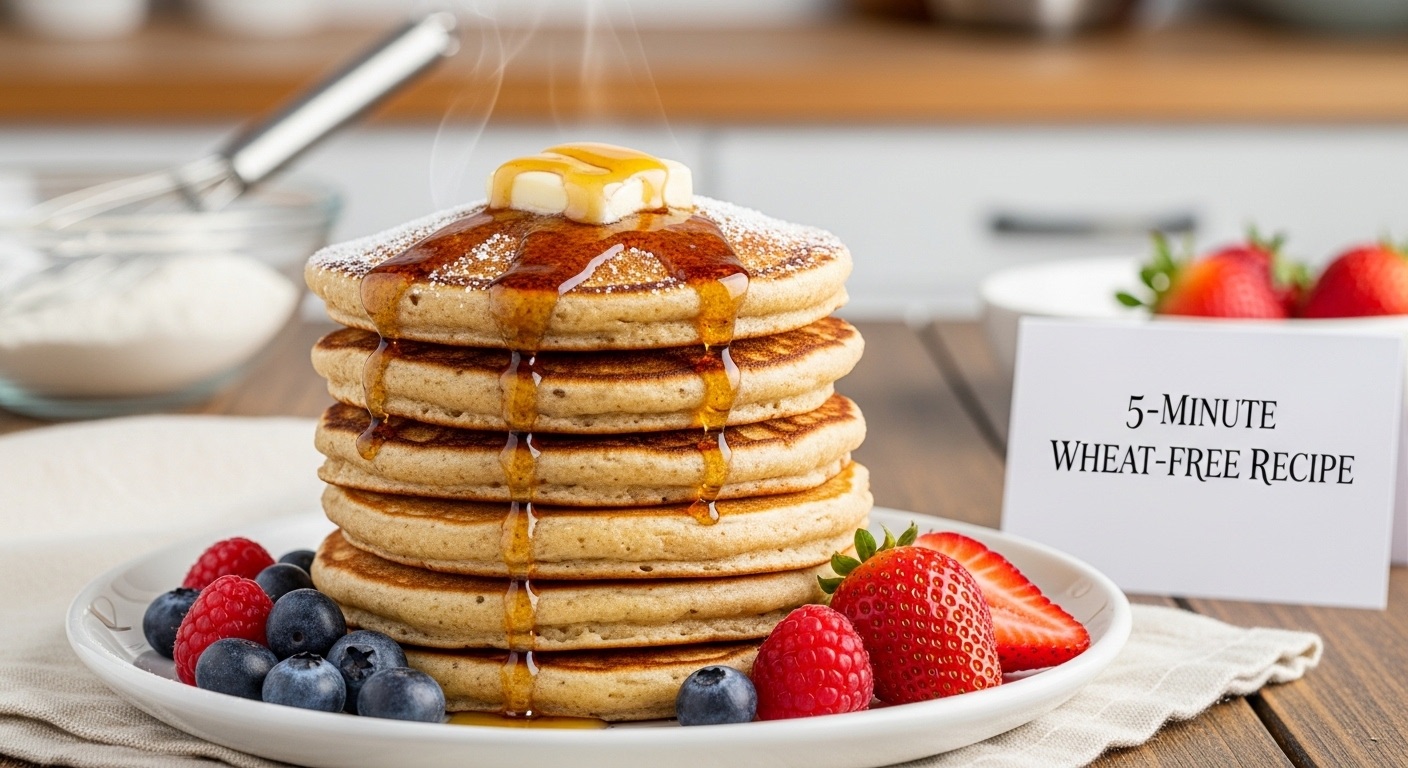
It is more like a cross between a pancake and a soft flatbread. A simple batter that goes from bowl to pan to plate in about five minutes. One bowl, one pan, one wooden spoon if you are feeling romantic about it.
The magic lies not in fancy techniques or exotic ingredients. It lies in what it does not use. No wheat flour. No kneading. No waiting. Just a short list of pantry staples you can whisk together while your kettle boils.
You begin with a mild, nutty base, often a combination of ground oats or buckwheat flour and finely ground nuts or seeds. The mixture looks humble, like the soft pale dust of a country road in summer. You add an egg or a chia egg if you prefer to keep things plant-based, a splash of milk or water, a pinch of salt.
Stir. The spoon pulls through the batter with a quiet, sticky whisper. Five, six, seven gentle turns, and you are there.
On the stove, a small pan warms with a ribbon of oil or butter. It shimmers, releasing that faint, comforting aroma of something about to happen. You pour the batter, hearing the initial hiss as it hits the heat. The edges lace themselves into a soft ring. Within a minute or two, the underside turns golden, the surface sets, and your breakfast foundation emerges.
A bendable, tender, wheat-free flatbread. Ready to carry whatever your morning is craving.
What You Will Need for the Base Recipe
| Ingredient | Amount | Notes |
|---|---|---|
| Fine oat flour or buckwheat flour | 3 tbsp, around 25 to 30g | Use certified gluten-free oats if needed |
| Ground nuts or seeds, almond, sunflower, or sesame | 2 tbsp | Adds richness and protein |
| Egg or chia egg | 1 medium | Binds everything together |
| Water or milk, dairy or plant | 3 to 4 tbsp | Adjust for a pourable batter |
| Salt | A good pinch | Essential for flavour |
| Oil, butter, or ghee for the pan | 1 to 2 tsp | For a softly crisp, golden edge |
To make a chia egg: mix 1 tbsp chia seeds with 3 tbsp water and let it thicken for 5 to 10 minutes.
From this base, you can wander in countless directions. A pinch of dried herbs and cracked pepper for something savoury. A dusting of cinnamon and a whisper of vanilla if you are leaning toward something gently sweet. The batter is your blank page. Breakfast is the story you write on top.
The Five-Minute Dance in Your Kitchen
When you strip a recipe down to its essentials, you start to notice the choreography. There is a rhythm here you can fall into, even half-asleep, bare feet on cold tile.
You crack the egg into a bowl. The yolk lands with a soft, golden thud. In go the flour and the ground nuts, pale and powdery, like the first dusting of snow. You add the liquid, watching it seep into the dry ingredients, darkening them shade by shade. As you stir, the mixture shifts from sandy to silky, from separate to one.
On the stove, the pan grows warm. A teaspoon of butter slides across the metal, leaving a glossy trail that smells faintly of toasted cream. The world, for a moment, narrows to the sound of a spoon scraping the side of a bowl and the low, steady sigh of the burner.
You pour. The batter fans out obediently, finding its circle. Small bubbles appear at the surface, like tiny punctuation marks. The underside begins to brown, and you peek, lifting the edge with your spatula just enough to glimpse the colour. Not pale, not dark. That perfect in-between shade that says eat me now.
The flip is the only dramatic moment. A quick turn of the wrist, a soft flump as it lands on its other side, steam briefly rising like an exhale. Another minute. While you wait, you slice a ripe tomato, or spread a spoon of nut butter, or mash half an avocado with a fork, its green flesh yielding in slow, satisfying waves.
By the time your tea or coffee is ready, so is your flatbread.
Simple Topping Ideas That Feel Like Rituals
You do not have to turn this into a masterpiece every day. Some mornings, the best breakfast is the one that asks very little of you. But when you do have a minute, these quick combinations transform the humble flatbread into something worth sitting down for.
Forest Morning: Spread with creamy goat cheese, add sliced cucumber and fresh dill, finish with a squeeze of lemon. It tastes like walking through a garden when the dew is still out.
Sunrise Sweet: Swirl on almond butter, top with banana slices, and dust with cinnamon. As you bite in, the warmth of the bread gently melts the nut butter, turning everything into a soft, sticky, deeply comforting tangle.
Market Day Savoury: Mash avocado with lime, salt, and a pinch of chili. Pile it high and finish with a fried or poached egg. The yolk breaks and runs, streaking your flatbread with golden richness.
Berry Woods: Spread thick yogurt, then scatter fresh berries and a few crushed nuts. The cool, tangy yogurt against the warm, toasty base is a little bit like standing in shade after stepping out of bright sun.
Herb Garden Wrap: Add hummus, grated carrot, thinly sliced radish, and torn mint or parsley. Roll the flatbread into a wrap and feel how your fingers softly sink into it as you hold it. Firm enough to grip. Tender enough to bite.
Why Your Body Notices the Difference
You may not write out a nutrition chart every time you cook. But somewhere inside, your body keeps score.
It recognises the difference between a slice of refined wheat toast and this dense, seed-and-oat flatbread in ways you can feel long before you can measure.
There is the slower rise of energy. Without the fast-burning starches of white bread, your blood sugar does not bolt upward and crash back down. The combination of fibre, protein, and healthy fats from the nuts or seeds gives your body more to work with, more to chew on, metaphorically and literally.
There is the quieter stomach. If you are one of the many who feel inexplicably puffy or uncomfortable after a wheat-based breakfast, a few days with this flatbread can feel like someone turned down the volume on your midsection. The ingredients here are simple, recognisable, pronounceable. No conditioners, no dough enhancers, no modified mysteries.
And there is the calm in knowing that what you are eating is something you made yourself, out of foods you could picture growing somewhere. Oats swaying in a field. Buckwheat with its delicate white flowers. Almonds hardening slowly behind pale blossoms. Sunflower seeds hidden in the black centres of cheerful yellow faces.
In a world of packaged everything, that mental connection to the source is its own kind of nourishment.
Adjusting the Recipe to Your Life
Kitchen habits are personal, like handwriting. Once you have made this flatbread a few times, it will start to bend to your routine without you thinking about it.
These simple adjustments help it fit even more snugly into your mornings:
- If you are in a rush: Measure the dry ingredients into a jar the night before. In the morning, crack in an egg, add the liquid, stir, and cook.
- If you cook for more than one: Double or triple the recipe and cook two or three smaller flatbreads in quick succession. Stack them like pancakes and let everyone top their own.
- If you are plant-based: Use the chia egg and a plant milk. Add an extra spoon of ground seeds for better binding and richness.
- If you like it crisp: Use a slightly thinner batter and a hotter pan, and cook a little longer until the edges turn delicately brittle.
- If you prefer it soft and bready: Keep the batter a bit thicker and cook on a gentler heat so it sets through without over-browning.
Letting Your Senses Lead the Way
One of the quiet luxuries of this simple recipe is how it invites you to pay attention again. Breakfast becomes less of a reflex and more of a tiny daily ritual. One you can tailor not just to your nutritional needs, but to your mood.
On cold mornings, you might lean into warmth. Cinnamon in the batter, maybe a dash of nutmeg, toppings that feel like blankets. Melted cheese, sautéed mushrooms, a soft pile of scrambled eggs. The kitchen windows fog up, and the smell of browning batter feels like a small act of defiance against the grey outside.
On hot days, you might keep everything light. Fresh cucumber and tomato slices, a spoon of thick yogurt, a spray of lemon juice. You eat with your sleeves rolled up, maybe by an open window, listening to the world awaken.
When you are tired and a little wrung out, there is something beautifully grounding about this process. The simplicity of stirring batter and watching it transform on the stovetop can be a quiet kind of meditation. Tangible. Fragrant. Reassuring.
This is not the kind of recipe that demands perfection. If the edges are uneven, if the circle is more of an oval, if you flip it too early and it lands a little wrinkled, it still tastes like comfort. It still shows up for you.
A Gentle Invitation to Experiment
As you grow more familiar with this wheat-free flatbread, you may find yourself bending the rules, then rewriting them.
Maybe you add a spoon of grated carrot or zucchini to the batter and watch how it softens and sweetens. Maybe you sprinkle sesame seeds into the pan before pouring, so the seeds toast and cling to the surface like tiny golden freckles.
You might split the batter in half and make two smaller rounds. One sweet, one savoury. You might double the recipe on a lazy Sunday and stash a couple of cooled flatbreads in the fridge, knowing that weekday-you will be quietly grateful to weekend-you.
Some mornings, you may even wander away from toppings entirely and eat it plain, torn into pieces with your hands, dunked into your coffee or tea in small, unhurried gestures. The simplicity of flour, egg, seeds, and heat suddenly feels like more than enough.
When a Small Change Feels Like a New Beginning
There is a particular kind of courage in changing things that seem trivial on the surface. Swapping your breakfast bread does not sound like much. Certainly not compared to moving cities, changing jobs, or starting a new relationship.
And yet, the rituals we repeat every day are the ones that quietly define us. They shape our energy, our mood, our conversations, even the way we inhabit our bodies.
When you choose, on an average morning, to reach for a bowl instead of the bread bag, you are practising something subtle but powerful. The art of not doing things just because you have always done them. Giving yourself permission to ask what if this felt better, and then listening when the answer comes back as a satisfied, steady kind of fullness instead of a mid-morning crash.
Over time, this 5-minute wheat-free flatbread can become much more than a recipe. It can become a small, daily promise you keep to yourself. To nourish your body with foods that feel good. To slow down just long enough to notice the colour of the batter, the sound of it landing in the pan, the way it smells when you bring it close.
You may still love toast. You may still find yourself, on some rushed or nostalgic mornings, sliding a couple of slices into the toaster. But you will also know, in the quiet comfortable way of things learned by heart, that you have another option now.
The kettle sighs. The pan warms. The batter pours. A new kind of morning begins.
Key Points
- The 5-minute wheat-free flatbread is built on three or four pantry staples and requires no yeast, no rising time, and no specialist equipment. The base of oat or buckwheat flour combined with ground nuts or seeds produces a tender, flexible flatbread that functions as a direct replacement for toast in both savoury and sweet breakfast contexts.
- The body responds differently to this flatbread than to refined wheat toast. The combination of fibre, protein, and healthy fats from seeds and nuts slows the release of energy, reducing the blood sugar spike and mid-morning crash that many people experience after a standard bread-based breakfast. For those sensitive to wheat, the simpler ingredient list also tends to produce a quieter digestive response.
- The recipe is highly adaptable to different dietary needs and morning routines. A chia or flax egg replaces the standard egg for plant-based versions. Dry ingredients can be pre-measured the night before to make weekday mornings even faster. Thinner batter produces a crispier result while thicker batter stays soft and pliable for wraps. The template is a starting point, not a fixed rule.
- The topping combinations are what transform the flatbread from functional to genuinely enjoyable. Whether it is goat cheese and cucumber, almond butter and banana, smashed avocado with a poached egg, or simply hummus and fresh herbs, the neutral base carries flavours cleanly without competing. The flatbread holds toppings the way good toast does, without the wheat.
- Changing a daily breakfast ritual is a small act with disproportionate impact. The foods we eat first thing in the morning influence energy, mood, and focus for hours afterward. Choosing a breakfast built on whole, recognisable ingredients rather than processed wheat flour is not a dramatic transformation. It is a quiet, repeatable decision that compounds over time into a genuinely different way of feeling in your own body.
For more lifestyle, wellness, and recipe inspiration, visit wizemind.com.au