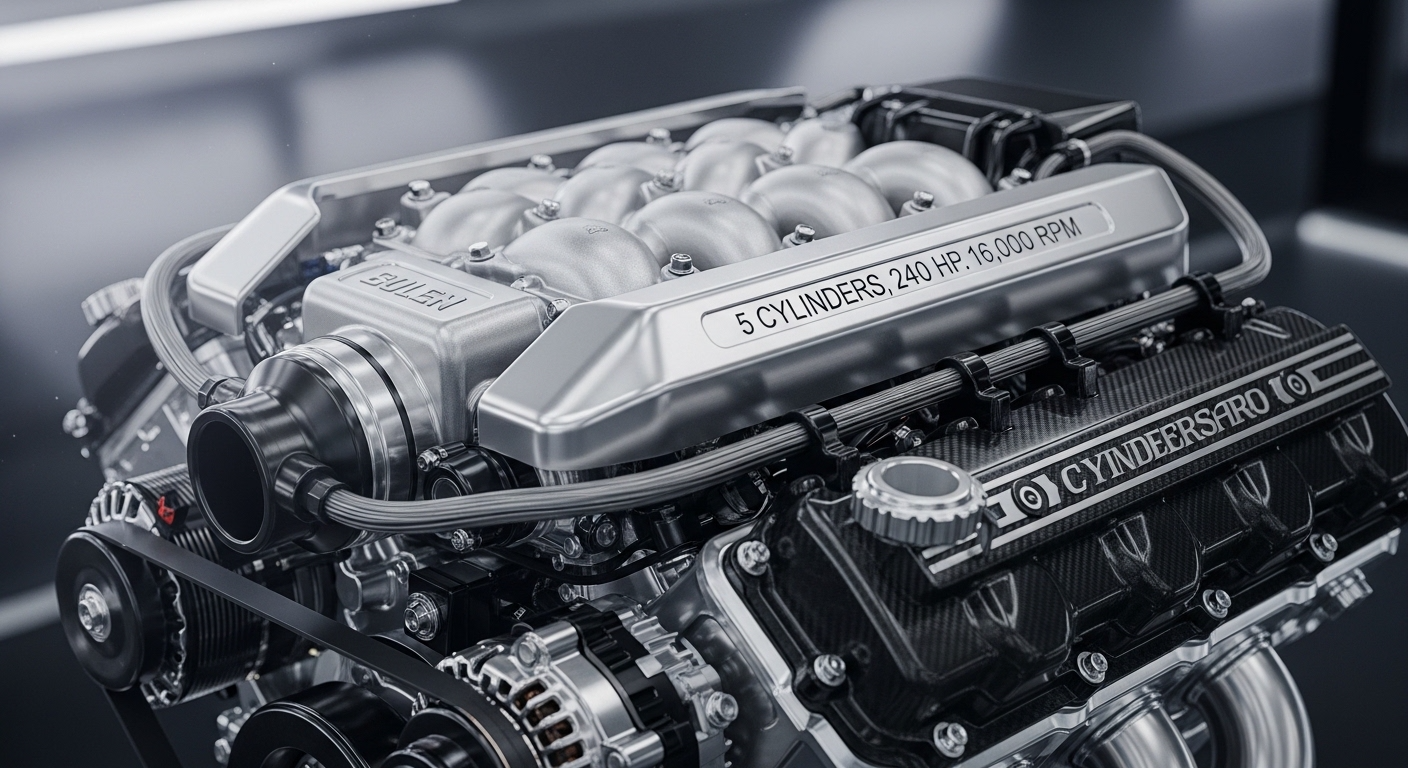
5 Cylinders, 240 HP and 16,000 RPM: This Engine Is Europe’s Last Hope of Keeping Petrol Alive
The first time you hear it, you stop whatever you are doing. It is not the kind of sound you process and move on from. It starts somewhere low, uneven, almost nervous, and then it climbs. And keeps climbing. Past the point where most engines give up, past the point where common sense says this should not be possible, up into a register that you feel in your chest before your brain has even caught up with what is happening. At 16,000 revolutions per minute, this engine does not sound like machinery. It sounds like something alive.
Five cylinders. 240 horsepower. 16,000 rpm. Written on a spec sheet, it looks like an interesting engineering footnote. Heard from twenty metres away at full throttle, it feels like a declaration. In an era when electric motors are quietly taking over European roads, when politicians are drawing lines through calendar years and calling them deadlines for combustion, this engine is making its argument the old-fashioned way. Not in a conference room. Not in a white paper. Through sound, sensation, and the kind of mechanical honesty that no algorithm has yet managed to replicate.
The World Is Getting Quieter, and Then There Is This
Spend a morning in any major European city right now and you will notice what is missing. The sputtering of a cold engine on a frosty morning. The ragged blip of a downshift at a roundabout. The low, rolling note of something powerful passing under a bridge. The streets are cleaner, the air is better, and the soundtrack has changed. Electric buses drift past without ceremony. Delivery vehicles accelerate from lights with a sound like distant applause. Scooters hum instead of bark. Progress, by almost every measurable standard, is working.
And then, somewhere over the crest of a hill or behind the fence of a test facility, you hear it. That needle of sound, thin and metallic and utterly serious, slicing upward through the air in a way that makes everything else feel slow. You move toward it before you have made any conscious decision to do so. The fence vibrates as it passes. The air carries a brief, sharp smell of hot fuel. And for just a moment, the quieting world feels interrupted by something that refuses to be tamed.
This 5-cylinder engine is that interruption. It is not interested in being sensible. It was not built for school runs or motorway cruising or city efficiency ratings. It was built for the test track, the dyno room, the kind of engineering conversation that starts with the question: how far can we actually push this? The answer, it turns out, is much further than most people expected.
Why Five Cylinders?
Five-cylinder engines have always occupied an unusual space in the world of combustion. Not common enough to be ordinary, not exotic enough to be immediately understood. Inline threes and fours dominate the compact end of the market. Sixes and eights carry the flag for prestige and outright power. Five sits awkwardly in between, which is exactly what makes it interesting.
The firing order of a five-cylinder engine creates a rhythm that does not belong to any neat category. It does not bark like a four under load. It does not sing with the creamy smoothness of a straight-six. Instead it produces something warbling, slightly uneven, urgent in a way that feels almost biological. Like an animal breathing hard. Like a racing heart. Engineers have described it over the years as syncopated, which is a musical term, and that is exactly right. It has a beat that your own body wants to match.
This new engine takes that personality and amplifies it to an almost unreasonable degree. To extract 240 horsepower from a compact five-cylinder block while spinning to 16,000 rpm requires every single component to be at the absolute limit of what current materials and manufacturing can achieve. There is no margin for compromise anywhere in the design. Everything is optimized, calculated, and balanced to a degree that most road car engineers would consider borderline obsessive.
The pistons travel up and down their bores at speeds that used to be the exclusive territory of Formula 1 machinery. The valves open and close in a frenzy of controlled violence, thousands of times per minute, with timing measured in fractions of a degree. Oil is not simply pumped around the engine. It is directed with surgical precision to surfaces that are constantly trying to fling it away at speed.
The Science of 16,000 RPM
Most people have no real frame of reference for what 16,000 rpm actually means in physical terms. A family hatchback rarely ventures above 6,000 rpm and does not particularly enjoy the experience when it does. A typical high-performance road car might consider 8,000 rpm its upper limit, a number treated with some ceremony. At 16,000, the laws of physics do not change, but their consequences become much harder to manage.
The stresses on every moving component increase not in a linear way but exponentially. A connecting rod that would last the lifetime of a vehicle under normal conditions might now have a service life measured in hours. Pistons that carry acceptable loads at 7,000 rpm are being asked to survive forces several times greater. The entire engine becomes a precision instrument operating permanently at the edge of its own destruction.
Weight becomes the central obsession. Every gram that can be removed from a rotating or reciprocating component reduces the stress it generates at high speed. Pistons are forged from exotic alloys and machined to the minimum possible thickness. Connecting rods are shaped to carry load through the most direct path while shedding material everywhere else. The crankshaft is balanced to tolerances that most workshops cannot even measure, because at 16,000 rpm a single misplaced gram becomes a vibration that can tear an engine apart within seconds.
Friction is the invisible enemy at these speeds. Special coatings appear on cylinder bores, piston skirts, and bearing surfaces that would have been considered unnecessary on any slower engine. The oil itself is chosen for its ability to cling to fast-moving surfaces without breaking down under shear stress. Even the shape of the oil galleries inside the block is redesigned to ensure lubrication arrives where it is needed without lag, because at 16,000 rpm there is no time for anything to wait.
Heat management becomes a different kind of problem entirely. The engine generates thermal energy at a rate that makes conventional cooling solutions inadequate. Water jackets are rerouted to target the hottest zones more precisely. Radiators are made more efficient rather than simply bigger. Air is channeled ruthlessly through the engine bay, guided by shapes and ducts that took as long to develop as some complete engines. Stand near one of these machines after a hard session on the dyno and the residual heat comes off it in waves, like standing too close to something that is still deciding whether to calm down.
What Makes the Sound So Extraordinary
Specifications can tell you the numbers, but they cannot tell you the experience. The sound of a 5-cylinder engine at 16,000 rpm is not something that translates well into words, which is perhaps why people who have heard it tend to describe it in terms borrowed from music, from nature, from things that are alive.
At idle, it has an uneven, slightly nervous tick. The syncopated firing order of the five cylinders means it never quite settles into the mechanical regularity you associate with a four or six. It sounds like something impatient, like an athlete warming up, full of restrained energy that has nowhere to go yet.
As the throttle opens and the revs begin to climb, that unevenness tightens. The individual pulses begin to merge. The sound moves from a growl into something more metallic and precise, a mechanical whirr that makes the hairs on your arms stand up before you have consciously registered why. There is an urgency to it that feels almost confrontational. It demands your attention in a way that is difficult to ignore and impossible to fake.
At full throttle, approaching the rev limit, it becomes something else entirely. The individual combustion events disappear into what feels like a single continuous note, thin and fierce and somehow fragile, like a violin played right at the edge of the bow’s grip on the string. The air around the exhaust shimmers. Nearby metal surfaces vibrate at sympathetic frequencies. People who have been around engines their entire lives stop what they are doing and just listen.
This is where petrol still does something that electric power cannot. Not in outright performance numbers, not in efficiency charts, but in the quality of the experience it creates. An electric motor delivers its power in silence, through software and inverters and algorithms that are hidden from the person using them. The story of how the energy arrives is invisible. With a high-revving combustion engine, nothing is hidden. Every rise and fall in pitch is a report on what is happening inside, a direct translation of mechanical events into sound and sensation that you can feel and interpret in real time.
Why This Engine Matters in an Electric Age
Nobody is suggesting that a 5-cylinder racing engine is going to reverse the direction of transport policy across Europe. The regulations are real, the deadlines are real, and the shift toward electrification in mainstream transport is already well underway. Standing in a city square and breathing cleaner air, watching buses glide past in relative silence, is objectively a better experience for most people than the alternative. That argument is not being contested here.
What this engine contests is a different and quieter assumption: that combustion has nothing left to say, that every remaining development is just delay, that the only honest response to the electric age is to wind things down and wait.
The engineering inside this five-cylinder says otherwise. It represents a level of combustion development that has genuinely not been seen before in this configuration. The specific power output, the rotational speeds achieved, the thermal and mechanical solutions required to make it work, these are not recycled ideas from the 1990s. They are new answers to new versions of old questions, and the knowledge they generate does not stay confined to the race paddock.
Technologies developed for extreme motorsport have always filtered down into everyday engineering. Materials science, combustion chamber geometry, friction coatings, oil circuit design, fuel injection strategies. The lessons learned trying to keep a five-cylinder alive at 16,000 rpm for a full race distance will eventually appear in engines used in hybrid systems, range extenders, and niche performance applications that complement rather than compete with electric powertrains.
Important reasons this engine matters beyond the racetrack:
- It proves that compact combustion engines can achieve extraordinary specific power with modern engineering
- The materials and coatings developed for it will influence future engine designs across multiple sectors
- It demonstrates that high-revving naturally aspirated engines can still be developed rather than simply preserved
- It provides a technology platform for hybrid systems that need a small, powerful, characterful combustion component
- It keeps the engineering knowledge and craft of advanced engine development alive in European industry
The Cultural Argument That Specs Cannot Capture
Europe’s relationship with engines is not purely functional. It never has been. From Italian V12s with their operatic top ends to German straight-sixes with their purposeful surge, from the screaming British racing fours of the 1960s to the charismatic five-cylinders that defined certain eras of rallying, the continent has treated engine design as something close to an art form. The sound of an engine has been part of European cultural identity in a way that is genuinely difficult to quantify but impossible to dismiss.
The argument against preserving this is usually framed as sentiment versus responsibility. If you love combustion engines, you are told you are prioritising emotion over science. If you embrace electrification fully, you are sometimes told you have given up on something essentially human. Neither of these positions is complete or fair.
What this engine suggests is a third path. Not preservation for its own sake, not abandonment in the name of progress, but genuine development. Pushing combustion into new territory not because the past was better but because there is still unexplored ground, still engineering challenges worth solving, still an experience worth creating that no other technology currently replicates.
The analogy to analog photography in a digital age is useful here. Film photography did not disappear when digital cameras became better by every objective measure. It became rarer, more deliberate, more appreciated by the people who chose it. The choice became meaningful precisely because it was a choice. A high-revving, beautifully engineered combustion engine in a future dominated by electric transport would carry a similar weight. Not the default option. A considered one.
Hybrid Futures and the Role of the Five-Cylinder
The most realistic future for engines like this one is not as standalone powerplants in pure combustion vehicles. It is as the combustion component in sophisticated hybrid systems designed for performance and character rather than commuter efficiency.
Picture a lightweight sports machine where this five-cylinder provides the emotional core, the sound and the sensation and the connection that drivers want, while electric motors handle low-speed torque delivery and energy recovery. The petrol engine would not need to operate at low efficiency in city traffic because it would simply not be called upon there. It would be reserved for the moments and conditions where it does what it does best, spinning freely toward its limit, filling the cabin with that extraordinary note, giving the driver a direct mechanical conversation that no amount of synthesized sound through a speaker system can replicate.
This kind of hybrid architecture is already being explored at the highest levels of motorsport, and the lessons are slowly moving toward road applications. The five-cylinder in this configuration would be smaller, lighter, and more purposeful than the large displacement engines it might replace in a purely combustion context. Less fuel used overall. More enjoyment per litre. A better argument for its own continued existence.
Synthetic and advanced biofuels also enter this picture. If the fuel burned in engines like this can be produced with a significantly reduced carbon footprint, the environmental case for keeping them alive becomes considerably stronger. Several European manufacturers and racing series are already moving in this direction, and the regulatory environment, while challenging, is not entirely closed to the idea.
The Engine as a Living Project
One of the things that makes extreme engine development so compelling from an engineering perspective is that it is never finished. There is no point at which every variable has been optimised and the work is done. Every session on the dyno produces new data. Every track outing reveals something that the lab did not predict. The engine that runs today is never quite the same as the engine that ran last month, and the one planned for next season is already different again.
Engineers who work on projects like this describe it in terms that sound more like craftsmanship than manufacturing. A revised cam profile that unlocks three hundred extra safe revolutions sounds like a small victory until you stand next to the engine and hear the difference it makes in the top end. A new fuel map that moves the power curve slightly does not just change a number on a screen. It changes the character of the thing, the way it responds, the sound it makes, the feeling it gives to the person controlling it.
This is a dimension of engine development that is genuinely difficult to replicate in any other technology. Software updates to an electric motor can change performance characteristics significantly, but they do not change the physical experience of using the machine in the same way. When a combustion engineer finds a solution that adds revs or power or response, the result is tangible and immediate and felt in the body, not just observed on an instrument.
For the people who do this work, the five-cylinder at 16,000 rpm is not a rearguard action against an inevitable future. It is the most demanding and interesting problem available to them right now. And the answers they find will not stay inside the fence of the test facility.
Is This Really Europe’s Last Hope?
The phrase is deliberately dramatic, and perhaps it should be taken that way. No single engine saves an industry or reverses a regulatory trend or single-handedly reframes a cultural conversation about transport and climate. To claim that would be an overstatement.
But the spirit of the question is worth taking seriously. In the rush toward electrification, which is in many ways necessary and overdue, there is a risk of losing something that Europe has spent generations building. Not just the manufacturing capacity and the supply chains and the jobs, though those matter enormously. But the knowledge. The craft. The specific engineering intelligence that lives inside the people who know how to make a combustion engine do things it has never done before.
Once that knowledge is no longer being practiced, it begins to fade. The engineers retire. The techniques are not taught. The instinct for what an engine needs, developed over decades of listening and testing and adjusting, becomes historical rather than living. That loss is harder to reverse than a policy change or a market shift.
Engines like this one keep that knowledge active. They give the next generation of engineers a reason to learn the craft at its most demanding level. They maintain a standard of excellence that feeds into adjacent technologies and keeps European engineering competitive in ways that go beyond any single powertrain type.
And on a less strategic, more human level, they keep alive the possibility that someone standing near a racetrack on a quiet morning will hear that sound rising through the air and feel something that cannot be measured or mandated. A sense that somewhere, in five frantic cylinders spinning toward an impossible number, the old conversation between human beings and machines is still very much ongoing.
Somewhere on a test track right now, as you read this, a five-cylinder is coming up to temperature on a warm-up lap. An engineer watches a screen and listens. The driver feels the engine wake up beneath them and opens the throttle just a little further. The note climbs. The air shimmers. For a few extraordinary seconds, petrol is not a habit waiting to end. It is a bright and burning idea, still finding new ways to exist.
Read More: For more automotive stories, technology deep dives, and expert analysis written for Australian readers, visit wizemind.com.au