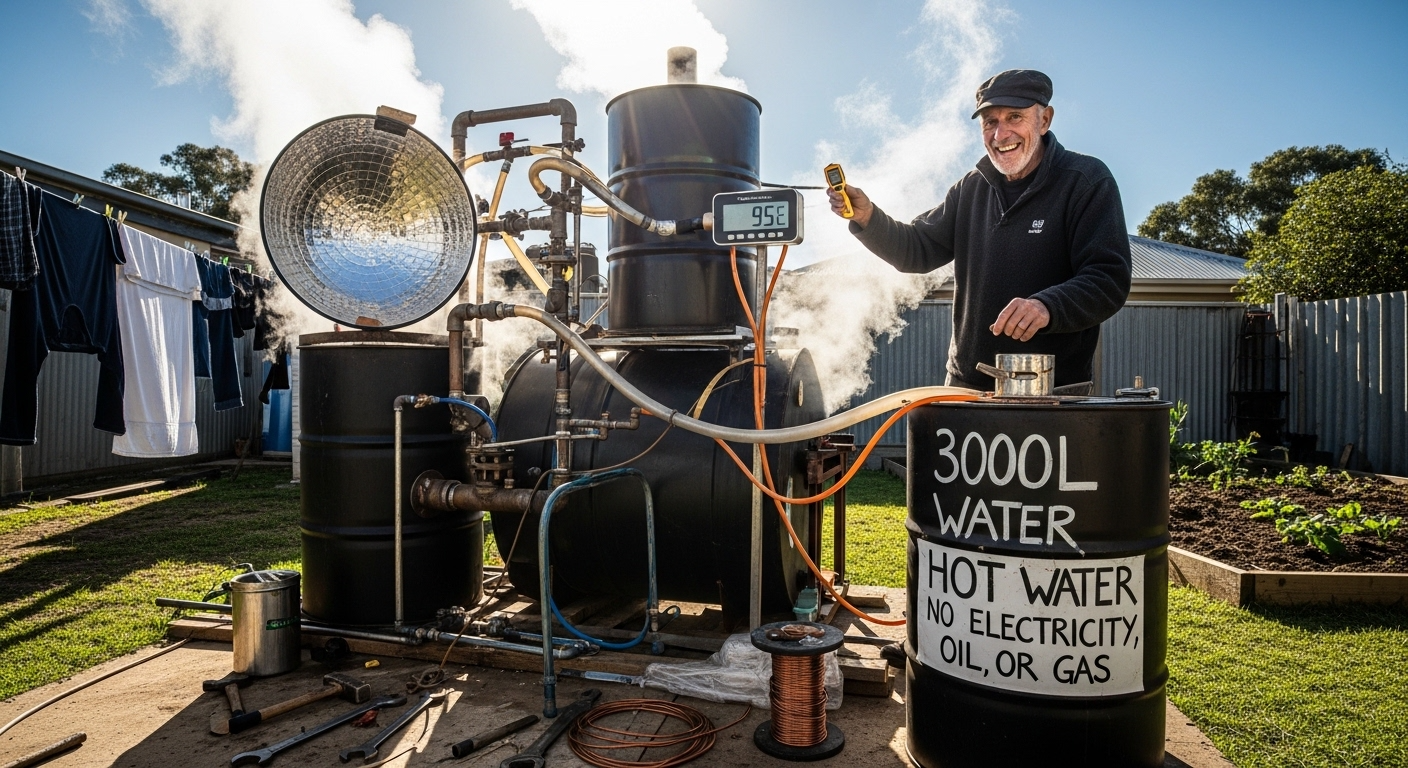
3,000 Liters Of Hot Water A Day: Tinkerer Needs No Electricity, Oil Or Gas
The first thing you notice is the silence. No generator hum, no burner roar, no solar inverter ticking away in the background. Just the soft cluck of chickens beyond the hedge and the whisper of wind slipping along a row of black-painted pipes. Somewhere inside those pipes, water is heating up. Enough for showers, dishes, laundry, and even a steaming bath. Three thousand liters a day, the tinkerer says with a shrug, as if that number were no big deal. No electricity. No oil. No gas. Just sunlight, gravity, and a stubborn refusal to believe that hot water needs flames or cables.
Key Points
- A self-taught tinkerer built a passive solar water heating system that produces up to 3,000 liters of hot water daily with no electricity, gas, or oil
- The system works using thermosiphon circulation, where warm water naturally rises and cool water sinks, creating a continuous loop with no pumps or electronics
- Flat solar collectors made from salvaged glass and black-painted metal pipes absorb sunlight and transfer heat directly to the water
- A large insulated storage tank holds the heat for hours, keeping water hot well into the evening and overnight
- The whole system is built mostly from reclaimed materials including old windows, surplus tanks, and secondhand plumbing parts
- The family now uses backup heating so rarely that their annual energy consumption for hot water is almost negligible
- The approach works in cold climates too, with proper insulation and frost protection built into the design
A House That Smells Like Sun-Warmed Metal
The workshop behind the small pale-yellow house smells of solder, pine boards, and sun-warmed metal. Shelves sag under the weight of valves, old radiators, glass panes, and the kind of plumbing fittings that make most people vaguely nervous. There are dog-eared notebooks stacked on a workbench, corners darkened from years of greasy fingers turning the pages.
“I hate waste,” the tinkerer says, running his hand along a length of copper pipe. “We burn fossils just to heat water we are going to forget about in ten minutes. Showers, dishes, mop buckets. It is like lighting a bonfire to toast one slice of bread.”
He walks out into the garden, boots crunching over gravel, and gestures toward a low sloping structure leaning against the south-facing wall of the house. It looks like a row of windows laid flat and tilted toward the sun. Up close, you see that each window is actually a collector: a shallow wooden box glazed with salvaged glass, inside which serpentine coils of dark metal tubing snake back and forth. Everything is painted matte black, absorbing light like a heat-hungry animal.
From each collector, insulated pipes wrapped in sun-faded foam carry water toward a bulky upright tank tucked safely in the shade of the house. There is no wire running from the system to the electrical panel. No fuel line snaking in from the street. Yet when the tinkerer opens a valve, steam licks from a nearby vent, ghostly in the morning air.
“It is not magic,” he says, watching the vapor curl and fade. “It is just that we forgot how simple heat can be.”
The Day He Got Angry At A Shower
This whole contraption started, as these things often do, with a small dissatisfaction that grew claws. Years ago the tinkerer came home to find his gas bill sitting on the kitchen table, half-opened, like a threat dressed in white paper. It had crept higher each month and now it practically growled when he looked at it.
Later that night he stepped into the shower. Twist of the chrome knob, blast of hot water, steam clouding the glass. A small luxury at the end of a long day. But this time, as the warmth poured over his shoulders, he saw the falling water differently. Each drop was a coin sliding down the drain. Each second of comfortable warmth was another tiny puff of gas burned somewhere far away. He imagined the flame, blue and silent in the metal belly of the heater, flaring only so that he could stand there and do nothing at all.
“I realized I was paying for invisible fire,” he says now. “I never saw it. Never touched it. But it ruled my bills and my habits.”
The next morning he started sketching. He had no special training, was not an engineer, not a plumber, not an off-grid expert with a following online. Just a man with a knack for taking things apart and a conviction that the sun should be doing more than brightening curtains.
His early drawings were rough: boxes, arrows, temperature notes scribbled in the margins. He raided recycling centers for old windows. He haggled for discarded radiators. He ruined more than a few afternoons burning his fingers on solder and cutting boards just a fraction too short. But piece by piece a system took shape, less like a machine and more like a living thing gradually discovering what it wanted to be.
How To Heat Water Without Burning Anything
The heart of the system is painfully simple. Sunlight hitting a dark surface equals heat. People have known this for thousands of years. Black pots on stone hearths, sun-warmed roof tiles, the burn of a dark car seat in July. The tinkerer’s achievement lies not in inventing something radically new but in arranging old ideas so efficiently that the results start to sound like fiction.
Here is the path the water takes from cold to hot.
It begins in a large well-insulated storage tank, a vertical cylinder salvaged from an industrial building, cleaned, lined, and wrapped in so much insulation it resembles a padded tree trunk.
From the bottom of the tank, cooler water is drawn into a circuit of collectors on the sunny side of the house. Inside each collector, the water travels through narrow metal pipes laid out in tight zigzags beneath the glass cover. The black-painted metal drinks in sunlight and gives up that heat to the passing water.
As the water warms it becomes slightly lighter. The storage tank sits higher than the collectors. That temperature difference sets up a lazy but reliable circulation called thermosiphon: warm water rises back into the upper part of the tank while cooler water from below sinks and gets pulled into the collectors to be reheated.
No pumps. No sensors. No wires. The system circulates because warm water is lighter than cold water, and gravity is patient.
On a good day the sun beats against those collectors from mid-morning until late afternoon. Slowly, steadily, the whole tank becomes a vertical gradient of warmth: almost cool at the bottom, bath-hot at the top. By evening there can be three thousand liters of usable hot water stored like liquid sunlight behind the house.
What 3,000 Liters Feels Like In Everyday Life
Numbers can be slippery, but showers are not. If you have ever stood under a stream of water and waited, teeth chattering, for the warmth to arrive, you already know the emotional weight of a good hot-water system.
In this house, hot water has become almost casual. There is enough for the family’s showers, for washing dishes without flinching, for laundry cycles that do not leave clothes feeling rinsed in mountain runoff. On some days there is even enough to fill an old-fashioned clawfoot tub and sink into it with a book until the fingers wrinkle.
The tinkerer learned to think in what he calls liters of comfort. Three thousand liters is a rough daily estimate when the weather cooperates and the tank begins the day at a reasonable baseline temperature. But even on cloudy days, the sheer volume of stored heat keeps the house supplied far longer than a typical small tank system ever could.
He does not talk about savings first. He talks instead about the feeling of stepping into a sun-powered shower on a frosty morning, knowing that somewhere behind the wall, yesterday’s daylight is still patiently waiting for you.
Inside The Tinkerer’s Notebook
Leaf through those stained notebooks and you see the story of years of trial and error. Early pages show oversized pipes and under-insulated lines, with notes that read: lost too much heat overnight, tank sweating. Later sketches show insulation wrapped three layers deep, with tiny arrows indicating potential heat leaks that needed sealing.
The trick, he says, is not just catching the heat. It is keeping it.
That means excellent insulation around the storage tank so the water stays warm even through cloudy stretches. It means short well-insulated pipe runs between collectors and tank to minimize what the cold air can steal. And it means a tank sized carefully to the household’s actual needs, not so small that hot water runs out by noon, not so large that the sun cannot reasonably warm it.
There were mistakes along the way. One winter, cold reversed the gentle thermosiphon circulation and the collectors began giving their heat back to the night sky rather than to the house. A few plumbing adjustments and one-way flow fixes corrected it. Another note went into the book: never underestimate what cold air will steal from you.
In summer a different problem appeared: too much success. Without enough hot water being used, the tank approached scalding temperatures. The solution was a simple mixing valve that tempers outgoing hot water with a small amount of cold to keep tap temperatures safe, plus a way to dump excess heat into a garden hose line when needed.
Living By The Weather Instead Of The Grid
The system has changed not just the plumbing of the house but the rhythm of the lives inside it. In winter the family watches the weather forecast with a different kind of attention than their neighbors do. A string of clear days means long showers, a chance to wash blankets, perhaps an indulgent afternoon soak. A grey spell and they naturally shift into conservation mode, spacing out hot-water use to give the system time to recover between demands.
We have learned to live a little more like the garden does, the tinkerer’s partner says, pouring tea. You take what the sun gives. On bright days you stretch. On dim days you tuck in.
They are not martyrs. There is a backup, a small efficient heater that can step in during extended bad weather. But it is used so rarely now that the annual consumption feels almost symbolic, an admission that no system is perfect but some can get very close.
This attentiveness to weather creates a quiet intimacy with the sky. The sun is no longer just light. It is a slowly filling tank behind the house. Morning frost is a reminder of the day’s starting temperature. A passing cloud is a temporary dimming of the burner that hangs 150 million kilometers away.
The Beauty Of Low-Tech Thinking
In a world dazzled by sleek solar panels and smart thermostats, the tinkerer’s system feels almost old-fashioned. There is no app to check, no data stream whispering from the roof. Yet when you stand between the collectors and the tank on a bright day, you can sense the power threading silently through metal and water.
He points to a set of vertical pipes and explains how he tilted their angles slightly so that even the smallest temperature difference encourages circulation. Here, a tiny air vent to prevent bubbles from stalling the flow. There, a simple manual valve that can isolate any section of the system for maintenance or repair.
The less that can break, he says, the less you depend on someone else to fix it.
This is where his deeper philosophy becomes clear. It is not just about lower bills or a smaller carbon footprint, though both matter. It is about autonomy. About the quiet thrill of knowing that if the power goes out for a week, hot water will still run into the sink. That your comfort is not entirely at the mercy of distant grids and buried pipes that belong to someone else.
There is a certain clarity in the simplicity too. No invisible electronics making choices on your behalf. Just physical principles you can explain to a curious child in the time it takes the kettle to boil. Heat rises. Metal conducts. Glass traps. Water stores.
From One Backyard To Many
Word spreads slowly in the neighborhood. First it is the friends who come for dinner and notice how the hot water never seems to run out no matter how many dishes pile up. Then it is the cousin who asks why there are windows lying flat in the garden. A plumber stops by to deliver a part and leaves an hour later with a phone full of photographs and a head buzzing with new ideas.
The tinkerer is not secretive about any of it. He draws diagrams on napkins at birthday parties. He walks neighbors out to the collectors and explains, step by step, how the system breathes. He tells them there is no single kit, no off-the-shelf answer. Each house has its own best angle, its own available wall, its own particular dance of sun and shade.
I am not selling anything, he insists. I just want people to see what is possible with what we already know.
Some people nod politely and change the subject. Others go home and stare for a long time at their south-facing walls, imagining rows of black panels quietly heating water all day long. A few call him back weeks later with rough sketches and cautious excitement in their voices.
He helps them avoid his early mistakes. Do not skimp on insulation, he warns. Respect the sun, but respect frost more. Put the tank somewhere accessible because you will want to check on it occasionally, like looking in on a sleeping animal.
Slowly a small constellation of homemade solar-thermal systems begins to appear within biking distance of the pale-yellow house. None as large as his, since three thousand liters is ambitious after all, but all pushing in the same direction: away from automatic dependence, toward deliberate and visible design.
What This Means For The Rest Of Us
Not everyone has a south-facing wall or a building code that accommodates a project like this. Not everyone has the time, tools, or temperament to design a hot-water system from scratch. But this story is not a prescription. It is an invitation.
It suggests that some of the comforts we have been taught to assume require complex infrastructure might actually submit to much gentler solutions. That everyday needs like hot showers and warm dishwater can be met, at least in part, by systems that are passive rather than powered, visible rather than hidden, and understandable rather than opaque.
Standing in the garden, the tinkerer runs his hand along a length of insulated pipe and feels the faint inner warmth.
“We keep talking about the energy transition like it is somewhere far away,” he says. “But some of it can happen right in our backyards, with wood, glass, and a good weekend’s work. The sun does not care how fancy your system is. It just keeps shining.”
The air smells faintly of resin and soil. A bird lands briefly on the edge of one collector and then flits off again. Behind the wall, three thousand liters of water hold the day’s heat in silence, waiting for the small domestic rituals that will turn stored light into steam and comfort.
Invisible fire, made visible at last.
Frequently Asked Questions
Does a system like this work in cold climates?
Yes, but it must be designed carefully. In cold regions, collectors and pipes need excellent insulation and protection against freezing. A closed-loop system with antifreeze fluid in the collectors and a heat exchanger in the tank is often used so that the main water supply never comes into contact with the outdoor circuit. Even in winter, clear skies can provide substantial heat gain.
Can it provide all of a household’s hot water year-round?
In many climates, a well-sized solar-thermal system can cover most hot-water needs from spring through autumn. In winter or during extended cloudy periods, a backup heater typically steps in. The tinkerer’s achievement is reducing that backup from a daily necessity to a rare helper.
Is it expensive to build?
Costs vary widely. Using reclaimed materials such as old windows, surplus tanks, and salvaged pipes can bring the price down considerably. The main investments are good insulation, durable piping, and solid mounting structures. Over time the reduction in energy bills typically repays the initial outlay.
How much space does a 3,000-liter system need?
You need space for a large insulated tank and enough sun-exposed surface for the collectors, typically a significant portion of a south-facing roof or wall in the northern hemisphere. Smaller households can scale both the tank and the collector area to their own needs and available space.
Is it difficult to maintain?
Maintenance is relatively straightforward compared to most high-tech systems. Periodic checks for leaks, insulation damage, air in the lines, and proper valve operation are generally sufficient. Because there are few moving parts and no electronics in a passive setup, long-term reliability can be very high when the system is built well from the start.
Read more health and wellness articles at wizemind.com.au